The malicious actor behind the massive $293 million Kelp DAO exploit has successfully laundered nearly all of the unfrozen stolen funds, moving approximately $220 million across the blockchain in just six weeks, according to comprehensive data from Arkham and insights shared by prominent onchain analysts.
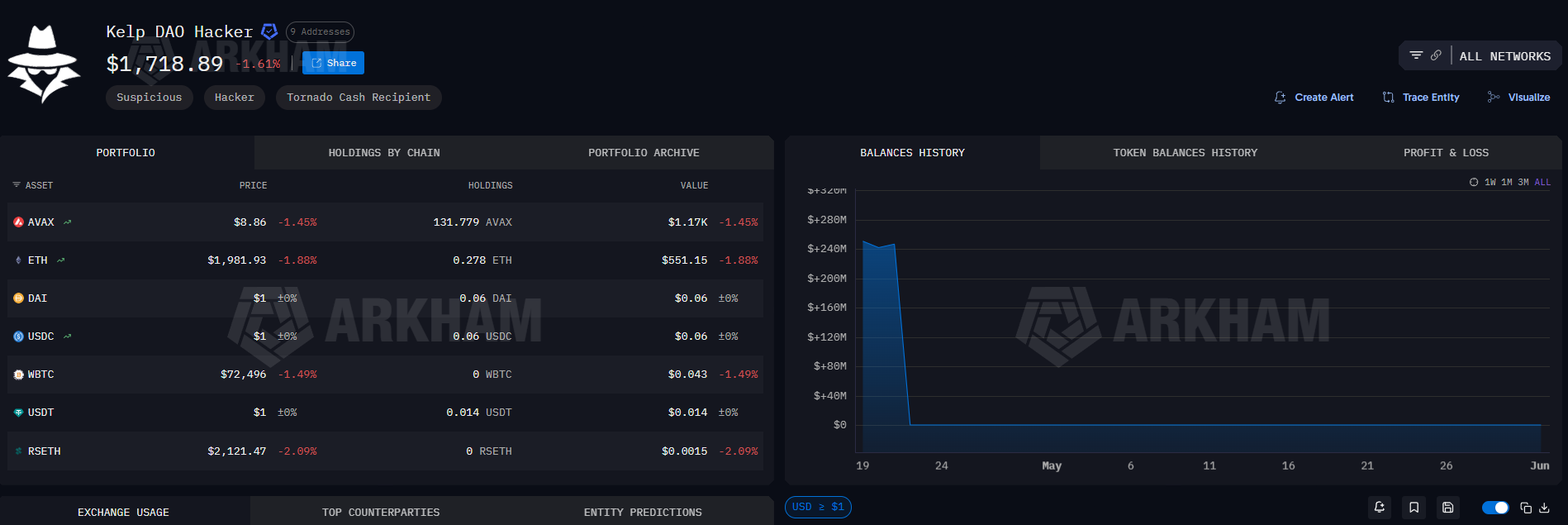
The hacker-tagged wallet associated with the high-profile exploit now holds a mere $1.7 million in traceable funds, signaling that the vast majority of the liquid loot has been successfully obscured through complex obfuscation techniques. The incident originally took place on April 18, when the attacker managed to drain an astounding 116,500 Kelp DAO restaked Ether (rsETH) tokens in a single, devastating blow. This catastrophic exploit single-handedly drove the total volume of funds stolen from the broader cryptocurrency ecosystem to an alarming $630 million for the month of April, marking one of the most financially damaging months for decentralized finance security in recent years.
According to detailed tracking provided by onchain analyst Specter, the laundering operation was executed through a meticulous two-layered strategy designed to evade detection and law enforcement tracking. The attacker initially bridged the stolen assets over to the Bitcoin network by leveraging the privacy-focused crypto mixer Wasabi. Following this cross-chain transit, the funds were routed back to the Ethereum network before being systematically withdrawn and deposited through the notorious mixing protocol Tornado Cash. Because of the inherent anonymity features provided by these mixing services and cross-chain hops, the successful completion of this laundering phase significantly reduces the likelihood of recovering the remaining unfrozen portion of the stolen capital.
Despite the attacker’s rapid laundering activities, a substantial portion of the stolen capital was successfully intercepted in the immediate aftermath of the attack. On April 21, just days after the initial breach, an additional $71 million in Ether connected directly to the Kelp DAO exploit was swiftly frozen by Arbitrum’s Security Council. This protective measure was backed by a formal governance proposal and a subsequent United States court order, which collectively approved the secure transfer of the frozen assets into an Aave-controlled multi-signature wallet dedicated entirely to the ongoing rsETH recovery and remediation initiative. Legal proceedings surrounding these recovered assets continue to move forward, with a highly anticipated court hearing regarding ownership claims tied to the frozen funds scheduled to take place on Friday in New York, as confirmed by official court documents.
This latest development unfolds just a week after Kelp DAO officially announced that it had successfully restored its restaked Ether token supply, marking a major milestone in a grueling five-week recovery effort. The milestone was achieved after the final tranche, consisting of 20,373.7 rsETH tokens, was safely transmitted back to the LayerZero smart contract. This specific contract is responsible for handling the locking, minting, burning, and releasing of rsETH during cross-chain transfers, bringing a measure of relief to affected users and stakeholders.
Crypto Hacks Decrease by 90% in May, but DeFi Security Concerns Persist
The chaotic environment that defined the cryptocurrency markets in April shifted noticeably in the following month. The broader cryptocurrency sector logged a dramatic decrease in exploit-related losses during May, though the steep drop was ultimately insufficient to alleviate the deeply rooted and growing anxieties surrounding the overall security posture of the decentralized finance industry.
According to data compiled by prominent crypto security and auditing platform CertiK, losses resulting from cryptocurrency exploits plummeted to $68.3 million in May. This figure represents a staggering 90% decline compared to the astronomical losses recorded during April. A closer examination of the May security incidents reveals that approximately $2.6 million of the total losses stemmed from malicious phishing attacks, while a notable total of $9.4 million was successfully recovered or voluntarily returned by exploiters.
Nevertheless, the psychological and financial shockwaves generated by the $293 million Kelp DAO exploit continued to reverberate throughout the decentralized finance landscape, triggering a wider industry-wide reassessment regarding the safety, architecture, and reliability of third-party oracle providers.
In the wake of the breach, several prominent protocols moved swiftly to overhaul their security infrastructure. Within just three weeks of the incident, Bitcoin DeFi platform Solv Protocol and liquidity protocol Tydro both announced their decisions to migrate their operations to Chainlink’s Cross-Chain Interoperability Protocol (CCIP), actively seeking a more robust and battle-tested oracle and cross-chain communication provider.
Kelp DAO itself undertook a similar architectural pivot, migrating its rsETH token infrastructure to Chainlink CCIP. This move marked a definitive departure from its previous LayerZero-powered bridge setup, as the protocol openly attributed the vulnerabilities exploited during the April incident to structural weaknesses within its cross-chain configuration.
Conversely, LayerZero defended its foundational technology shortly after the incident occurred. In a public statement issued on April 20, LayerZero asserted that the exploit did not stem from an inherent flaw in its core protocol, but rather from a critical single point of failure introduced during Kelp DAO’s specific implementation. According to LayerZero, the affected protocol relied on a single decentralized verifier network as its sole verified validation path, despite prior technical warnings explicitly advising against deploying that particular configuration. As the legal battles over stolen funds continue in courtrooms and protocols rush to fortify their infrastructure, the ecosystem remains hyper-focused on preventing similar multi-million dollar breaches in the future.