
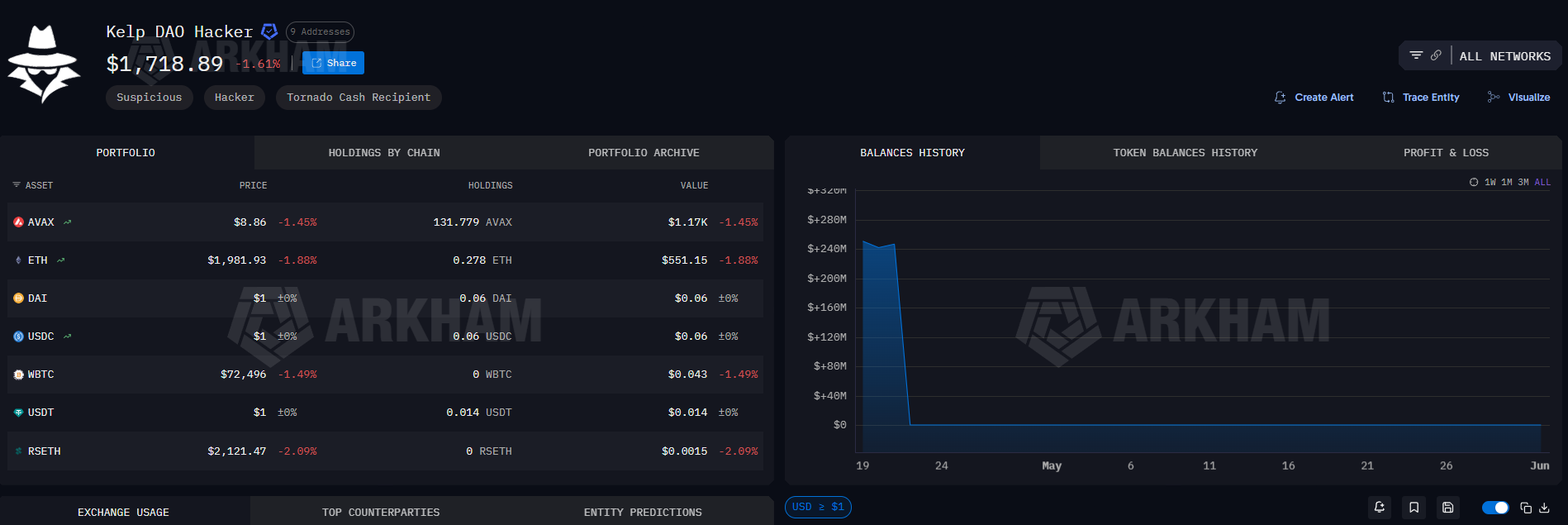
The malicious actor behind the massive $293 million Kelp DAO exploit has successfully laundered nearly all of the unfrozen stolen funds, moving approximately $220 million in just six weeks, according to onchain analytics and data provided by blockchain intelligence platform Arkham.
The wallet explicitly tagged by security researchers as belonging to the Kelp DAO hacker has systematically emptied its holdings, leaving a mere $1.7 million still traceable within the address. The breach initially took place on April 18, when the attacker drained 116,500 Kelp DAO restaked Ether (rsETH) tokens in a devastating stroke that single-handedly propelled total losses from cryptocurrency hacks to $630 million for the month of April alone, marking one of the most severe security lapses in recent decentralized finance history.
According to detailed breakdowns provided by onchain analyst Specter, the laundering operation was executed through a sophisticated, multi-layered evasion strategy designed to break transaction trails. The perpetrator first bridged the stolen assets over to the Bitcoin network utilizing the crypto mixer Wasabi. Following this cross-chain obfuscation, the funds were subsequently moved back to the Ethereum network before being broken down, withdrawn, and deposited repeatedly through the privacy-focused mixing protocol Tornado Cash. This meticulous laundering process has severely diminished the likelihood of recovering the remaining unfrozen portion of the stolen capital.
Despite the near-total loss of the unrecovered capital, authorities and protocol stakeholders managed to secure a partial victory shortly after the incident occurred. An additional $71 million connected to the Kelp DAO exploit was swiftly frozen by the Arbitrum Security Council on April 21. This defensive action was backed by a formal governance proposal and a United States court order, which previously authorized the transfer of these frozen assets into an Aave-controlled multi-signature wallet dedicated specifically to the ongoing rsETH recovery effort. Legal proceedings regarding the ownership claims tied to these frozen funds continue to move through the judicial system, with a scheduled court hearing in New York.

This alarming milestone in the laundering timeline unfolds just a week after Kelp DAO officially announced the complete restoration of its restaked Ether token supply. The milestone marked the culmination of a grueling five-week recovery effort following the compromise. The final tranche of 20,373.7 rsETH tokens was successfully transmitted back to the LayerZero smart contract, the specific infrastructure responsible for locking, minting, burning, and releasing the asset during cross-chain transfers.
Crypto Hacks Decrease by 90% in May, but DeFi Security Concerns Persist
The dramatic laundering of the Kelp DAO funds coincides with a broader, albeit temporary, cooling-off period in crypto-related exploits. The month of May saw a significant contraction in malicious activity across the digital asset ecosystem, though this statistical relief has done little to soothe lingering anxieties regarding the foundational security of the decentralized finance industry.
Losses stemming from cryptocurrency exploits plummeted to $68.3 million in May, representing an impressive 90% decline compared to the staggering capital losses recorded throughout April, according to data compiled by blockchain security and auditing platform CertiK. A closer examination of the May incident reports reveals that approximately $2.6 million of those losses were directly attributable to phishing attacks targeting individual users, while a total of $9.4 million was successfully intercepted, recovered, or voluntarily returned by exploiters.
Nevertheless, the sheer scale of the $293 million Kelp DAO breach has left a lasting psychological and structural scar on the market, catalyzing a widespread reevaluation of security architectures across the entire decentralized finance landscape. Specifically, the disaster forced numerous DeFi protocols to critically reassess the reliability and vulnerability of their chosen oracle and cross-chain bridge providers.
In the immediate three-week aftermath of the exploit, prominent players in the infrastructure space began jumping ship to more established alternatives. Bitcoin DeFi platform Solv Protocol and liquidity protocol Tydro both initiated migrations to Chainlink’s Cross-Chain Interoperability Protocol (CCIP), actively seeking a more rigorously tested and secure oracle and cross-chain communication framework.
Similarly, Kelp DAO itself initiated a migration of its flagship rsETH token to the Chainlink CCIP infrastructure, decisively moving away from its previous LayerZero-powered bridge setup. The protocol openly attributed the devastating security incident to underlying weaknesses and configuration vulnerabilities inherent in its previous cross-chain architecture.
The debate over accountability grew contentious shortly after the attack occurred. LayerZero publicly countered these assertions on April 20, releasing a statement maintaining that the exploit did not stem from a flaw in its core code, but rather from a single point of failure in Kelp DAO’s specific implementation. According to LayerZero, the protocol’s integration relied on a solitary Decentralized Verifier Network (DVN) as its sole verified path, bypassing standard security redundancies despite prior warnings issued against utilizing that particular configuration.