Cybersecurity researchers have uncovered a sophisticated cyber espionage campaign targeting high-profile entities in Israel and government cloud environments in the Kurdistan Region of Iraq. Active between August and October 2026, the operation has been attributed to an Iran-nexus threat actor known as DarkBlinders, a group that has demonstrated a steady evolution in its tactics, techniques, and procedures since it was first identified operating in late 2024.
According to a comprehensive report published by Dream Research Labs, the recent wave of attacks has successfully compromised a prominent individual in Israel, alongside breaches impacting critical government cloud infrastructure within the Kurdistan Region. Security analysts emphasize that the threat cluster, which is tracked by Elastic Security Labs under the moniker REF8685, exhibits distinct technical patterns that set it apart from other known state-sponsored hacking groups, marking it as a specialized and persistent cyberespionage unit.
Evolution of the DarkBlinders Threat Actor
DarkBlinders has maintained an active operational footprint since at least September 2024, initially drawing the attention of researchers due to targeted attacks directed at aviation infrastructure and telecommunications sectors across the United Arab Emirates and Iraq. Over the past two years, the group has continuously refined its initial access methodologies, moving away from simple delivery mechanisms toward multi-layered, highly deceptive social engineering campaigns designed to bypass modern security controls.
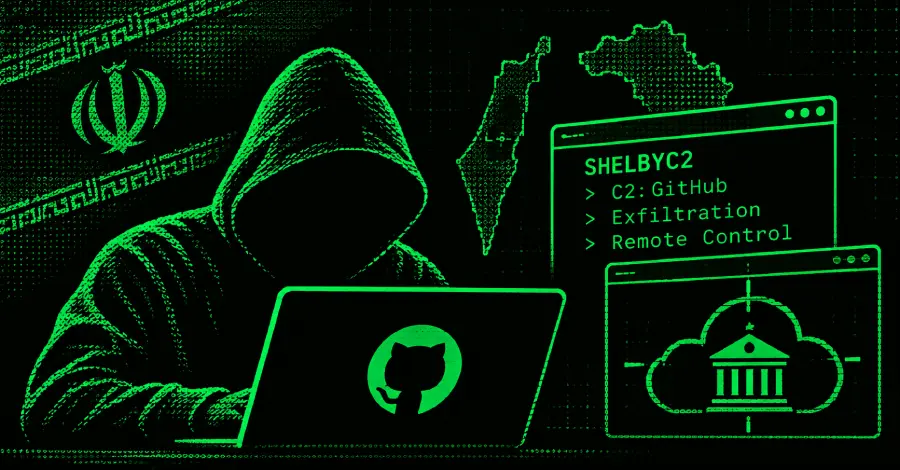
Historically, attacks mounted by the threat actor have relied heavily on spear-phishing campaigns to lure unsuspecting recipients into opening trojanized software utilities or visiting attacker-controlled websites hosting malicious direct downloads. Previous attack chains documented extensively by firms such as Elastic Security Labs and Group-IB have centered around the deployment of SHELBYLOADER, also known as HOTAIR. This malware is typically launched via DLL sideloading techniques to ultimately execute a robust backdoor designated as SHELBYC2, or AEROSTAT. This backdoor leverages legitimate cloud infrastructure, specifically GitHub, to facilitate command-and-control communications, data exfiltration, and remote administration capabilities.

In earlier campaigns, such as those analyzed by Palo Alto Networks under the designation "Blinder Tunnel," the threat group operated under the persona CL-STA-1178. In those instances, the operators brazenly masqueraded as the IT department of Dubai Airports to distribute malware-laced coding challenges to high-value targets. This bogus recruitment scheme, initially detected in early 2026 with preparation and testing phases stretching back to late 2025, relied on lucrative job offers to trick targets into executing self-contained applications that closely mimicked legitimate career portals.
Multi-Stage Attack Chains and Deceptive Tooling
The operational blueprint utilized by DarkBlinders typically begins with an elaborate social engineering facade. Victims are approached with enticing employment opportunities and instructed to complete an online questionnaire hosted on attacker-controlled infrastructure. Submitting the questionnaire generates no immediate external data exfiltration or obvious system response, acting purely as a harmless decoy designed to establish operational credibility before the delivery of the main payload.
Once the target is lulled into a false sense of security, the attackers deliver the next stage payload packaged as a Microsoft Visual Studio project archive disguised as a coding assessment. The subsequent attack chain employs a trio of advanced techniques to establish persistent access and evade detection. A malicious C# project file, bearing the ".csproj" extension, is utilized to trigger AppDomainManager injection. This is swiftly followed by DLL sideloading to deploy an updated variant known as ShelbyLoader V2, which subsequently instantiates the SHELBYC2 backdoor. In many observed instances, the attackers also deploy a tunneling utility called Blackwood via the SHELBYC2 framework.
Security analysts at Unit 42 highlighted the precision of these operations, noting that the threat actors frequently misuse built-in developer tools and execute AppDomainManager hijacking specifically to blind security monitors, including Event Tracing for Windows.

The latest findings from Dream Research Labs indicate that DarkBlinders continues to diversify its delivery vectors by combining credential phishing with sophisticated malware distribution. The campaign makes extensive use of lookalike domains mimicking government webmail and cloud-service providers to harvest credentials or host malicious file downloads. Furthermore, the group has been observed setting up elaborate decoy infrastructure for a counterfeit videoconferencing application named StarkMeet, using domains such as stark-meet.com, stark-meet.online, and stark-meet.website. Installing and launching this fraudulent application silently executes ShelbyLoader V2 and establishes the persistent SHELBYC2 connection, demonstrating the group’s flexibility in shifting between bespoke coding challenges and counterfeit commercial software.
Overlaps with Broader Iranian Cyber Operations
Investigators analyzing the infrastructure and victimology of the recent campaigns have drawn notable connections between DarkBlinders and other known Iranian threat clusters. Dream Research Labs assessed with medium confidence that the DarkBlinders activity cluster shares operational infrastructure and malware characteristics with UNC5795 and Dust Specter. Dust Specter was previously documented by Zscaler as an operation targeting Iraqi government officials by impersonating the country’s Ministry of Foreign Affairs.
Furthermore, historical server fingerprints and overlapping target profiles have led researchers to suggest that UNC5795 and related sub-clusters may operate under the broader umbrella of APT34, a well-known Iranian nation-state threat group. The concentrated focus on Iraqi government entities and critical infrastructure across these various operational names provides a cohesive picture of shared intelligence collection priorities orchestrated by state-sponsored actors in the region.
Prince of Persia Resurfaces with U.S.-Based Infrastructure
Adding to the evolving threat landscape, researchers have observed another Iranian-sponsored group, historically known as Prince or Persia or Infy, resuming operations after an unprecedented hiatus. The lesser-known threat group was tracked running a secondary command-and-control server on U.S. soil from an Internet Protocol address originating in the United States, a deployment likely established in July 2026.

The identified infrastructure functions as a second-stage command-and-control server associated with Tornado, a variant of the Tonnerre malware family. This malware is typically delivered through the exploitation of recent software vulnerabilities and relies on a combination of standard HTTPS traffic and the Telegram API for command-and-control communications. The sudden emergence of new infrastructure followed a three-month operational dormancy, which security experts described as the longest recorded downtime in nearly two decades of activity by the threat group.
Security researchers monitoring the exfiltration activity note that while the volume of victims remains relatively low, the geographical placement of the command-and-control server during a period of heightened geopolitical tensions underscores the evolving operational security and deployment strategies utilized by Iranian state-sponsored actors operating against regional and international targets.