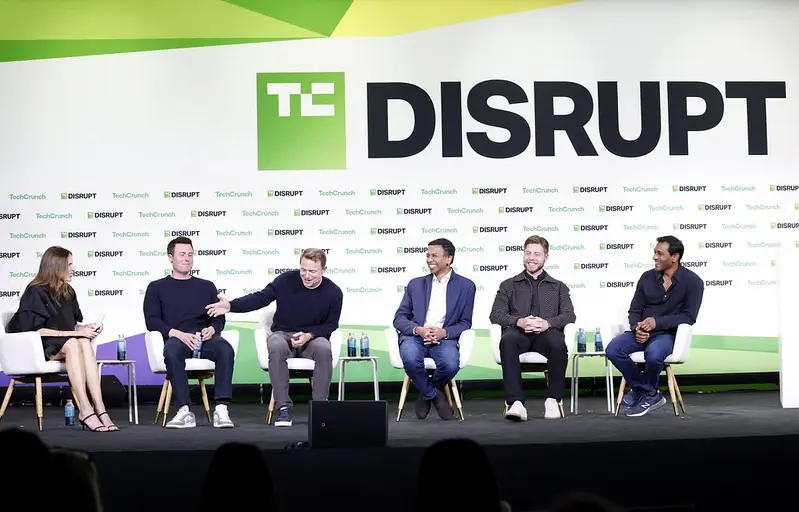
The players sometimes change. Sit down with a storied venture capital firm over a span of years, and you will notice that faces, names, and even capital commitments shift. Three years ago, a conversation with four of Benchmark’s partners would have revealed a different lineup; today, three of those individuals are no longer with the firm. The capital commitments have undergone a rare transformation as well. This summer, Benchmark announced a staggering $2 billion spread across two separate funds—marking only the second time in its 31-year history that the firm has veered away from raising a far smaller, tightly constrained vehicle.
Yet, at TechCrunch Disrupt, the venture firm’s current roster of five general partners convincingly portrayed a close-knit, highly disciplined team that has no intention of putting the pedal to the metal, even as many of their industry rivals do precisely that. The world around them may be speeding up, but Benchmark continues to invest at the measured pace it has maintained for decades: just two or three new bets per year per partner. The information age may have left markets drowning in real-time data, but the firm’s Monday partner meetings still run entirely without an agenda. And while economic indicators continuously point to trouble ahead, the partners do not seem overly bothered, viewing many prevailing warning signs merely as the products of social media-fueled hysteria.
Gathered together on stage, Benchmark’s five general partners offered a rare, unfiltered look inside how one of Silicon Valley’s most influential firms operates amid an unprecedented artificial intelligence boom.
Evolving the Core Without Losing the Craft
Benchmark has clearly evolved in recent years, introducing a larger core fund alongside a brand-new growth fund. Addressing how the firm manages to adapt without diluting the unique identity that defines Benchmark, Peter Fenton pointed directly to the timeless nature of their early-stage work.
The craft that hasn’t changed is the core fund, Fenton explained, which involves working closely with founders right at the beginning of their journey. It is typically a 10-to-15-year commitment, working shoulder to shoulder with entrepreneurs in a way that simply does not scale. At the same time, Fenton acknowledged the reality of economic inflation. The firm held its core fund steady at $500 million for 20 years before recently allowing it to inflate to remain consistent with the broader economy—a step he admitted was probably a tactical error to delay.
As for the newly minted growth fund, Fenton described it as an organic expansion of their mandate. In some ways, he noted, the ecosystem grants them permission to do more than just early-stage business. Not having a growth vehicle previously felt like a restriction, preventing them from participating in opportunities that crossed their path which ultimately went on to return anywhere between 10x and 1,000x to other investors.
When asked whether the firm plans to deploy its massive $1.25 billion growth fund across a large number of companies, Fenton emphasized the beauty of a partnership with diverse viewpoints. He expressed a personal preference for the agony and ecstasy of a highly concentrated portfolio, noting that if the fund proves successful, just one or two major investments will likely generate 90% of the returns, pointing to a target of perhaps four to six, or maybe seven to eight, total bets.
A Magnet for New Talent
Ev Randall joined Benchmark late last year, bringing with him deep experience from stints at Founders Fund, Bond, and Kleiner Perkins. Asked how Benchmark differs from his past environments, Randall explained that every firm is ultimately a collection of its people and how they collaborate. While some firms are highly hierarchical with massive investment teams and Byzantine corporate structures federated into product groups, small partnerships operate very differently. Early in his career, Randall was drawn to small partnerships because they allow for a higher level of throughput and conversational fidelity, making it feel less like corporate decision-making and more like a sports team going out onto the field together.
Beyond the structure, Randall stressed the importance of finding peers whom one not only likes but genuinely admires. With Benchmark, the mutual respect and the desire to learn from one another formed a rare mix of attributes that immediately drew him in.
That sentiment was echoed by Jack Altman, who joined the firm in February. Just a year prior, Altman had raised a second, $275 million fund for his own firm in what took a single week, while also running a hugely popular podcast. Explaining his decision to join Benchmark, Altman recalled doing a podcast with the partners earlier in the year where they discussed their strict commitment to remaining a small fund. More importantly, he heard a genuine desire to be the first people founders call—a team focused on concentration and deep care for entrepreneurs, cutting through the industry’s obsession with money and status. While he enjoyed being an individual investor, navigating a market as crazy as the current one alone felt daunting compared to learning alongside a group of exceptionally smart, driven peers.
Monday Meetings Without an Agenda
The culture at Benchmark famously eschews corporate bureaucracy, extending even to how the partners communicate internally. When asked about rumors of agenda-free Monday meetings, Chethan Puttagunta joked that Jack Altman had actually tried to introduce an agenda, prompting Altman to quip that he already had one lined up for the following Monday.
Eric Vishria described the practice as weirdly arbitrary, explaining that it is simply an ongoing, organic conversation. In an era of rapid technological transformation, the partners are constantly trying to figure out what has newly become possible over the past six months and which founders are truly bending light. They discuss the companies they are meeting, what piqued their interest, and what they are observing inside boardrooms. While one could try to systematize the process, Vishria noted that the beauty of a five-person team is that they do not have to. It is a decades-long conversation that only works because the group is small and genuinely enjoys spending time together. Following their public appearance, for instance, the partners planned to have dinner with an entrepreneur who built a multi-hundred-billion-dollar company—someone they are not even invested in—simply to stretch their collective thinking.
Puttagunta added that the absence of a rigid agenda provides the necessary space to remain reactive. If a founder urgently needs assistance landing a key executive or securing a strategic partnership, all five partners can instantly place themselves at the entrepreneur’s disposal.
When pressed on whether an individual partner holds veto power over a deal, Puttagunta admitted that nobody actually knows because the firm maintains no formal rules around the matter. Altman agreed, noting that he had been waiting to see how his colleagues would answer. Because the firm focuses on a low volume of deals, they deliberately avoid heavy-handed rigor and formal voting processes, which would only be necessary if they were backing hundreds of companies a year. Instead, the lack of structure remains a major asset.
Fenton expanded on this philosophy, noting that a key differentiator of the Benchmark brand is an absence of arrogance. They do not approach pitches like a television show to declare clear winners and losers, but rather maintain a sense of awe at the vast landscape of possibilities. Occasionally, an entrepreneur might prove polarizing, but Fenton emphasized that if someone in the room fundamentally dislikes a founder, Benchmark is simply not the right partner for them.
Navigating AI Volatility and Founder Dynamics
Despite companies growing faster than ever in the current technology cycle, Puttagunta maintained that Benchmark’s pace of investment remains entirely consistent. Venture capital, he noted, comes with the inherent reality that a firm cannot be part of every successful company, and that is completely acceptable. Their objective is to identify entrepreneurs with unique strengths, amplify those capabilities, and find a way to work together regardless of capital requirements or deal structures.
As AI startups rapidly evolve and expand into one another’s territories, questions of investor conflict inevitably arise. Vishria acknowledged that Benchmark makes a fundamental commitment to work closely with an entrepreneur on whatever path their company takes. However, the harsh reality of the current market is that companies pivot and evolve rapidly, creating natural overlaps and potential conflicts. While Benchmark maintains strict confidentiality and actively avoids the insane direct conflicts seen among some rival firms, Vishria conceded that boundaries are shifting.
Puttagunta observed that founders in the AI era are exceptionally ambitious. As the marginal cost of coding new products effectively drops to zero, entrepreneurs see massive surface areas to attack, making overlapping territories increasingly common. Nevertheless, he believes firms can navigate these dynamics respectfully and maintain healthy relationships.
Discussing his own transition to the firm, Altman revealed that he has already made several investments across chips, robotics, and infrastructure since joining, though some remain undisclosed. Reflecting on his onboarding, he joked that it was completely perfect because there was no onboarding at all. His partners had wisely advised him not to feel pressured by his first deal, reminding him that venture capital operates on power laws and that his first investment would not necessarily define his career.
Bold Bets and Public Market Realities
Benchmark’s history of backing unconventional companies was highlighted by its early investment in AI chipmaker Cerebras, a deal Vishria spearheaded in the spring of 2016 when the firm had not made a hardware investment in a decade. Vishria recalled that the night before the startup pitched the partnership, Fenton told him the idea went against everything he had learned about venture capital. Yet, after the Monday pitch, Fenton completely flipped.
Fenton described Cerebras co-founder Andrew and his team as heretics whose unorthodox vision remains polarizing even today, noting that such bold departures from consensus are precisely where early-stage investors belong. Vishria noted that navigating the company’s journey—marked by dramatic market swings following its public offering—requires a stomach of titanium, reminding both employees and investors that public equities frequently experience massive peak-to-trough volatility.
Addressing broader economic concerns, including rising borrowing costs, exhausted free cash flow among AI startups, and recent high-profile bankruptcies like Character.AI, Randall dismissed macroeconomic prediction as a fool’s errand. He argued that the information environment surrounding public tech equities has been heavily distorted by hyperactive social media echo chambers. While capital expenditures and market valuations are deeply intertwined with the projected health of private AI giants like OpenAI and Anthropic, Randall insisted that the underlying ecosystem remains fundamentally healthy, driven by immense customer demand and strong gross margins.
Finally, touching on the geographic center of gravity for the industry, the partners agreed that while exceptional companies can occasionally emerge elsewhere, San Francisco remains unmatched. Fenton noted that over 90% of historical capital returns have originated from companies founded in the region, driven by a compounding ecosystem of successful executives and ambitious talent. Randall added that virtually every non-local company he meets with eventually opens an office or spends half its time in the city, concluding that in the current era of artificial intelligence, iron truly sharpens iron.