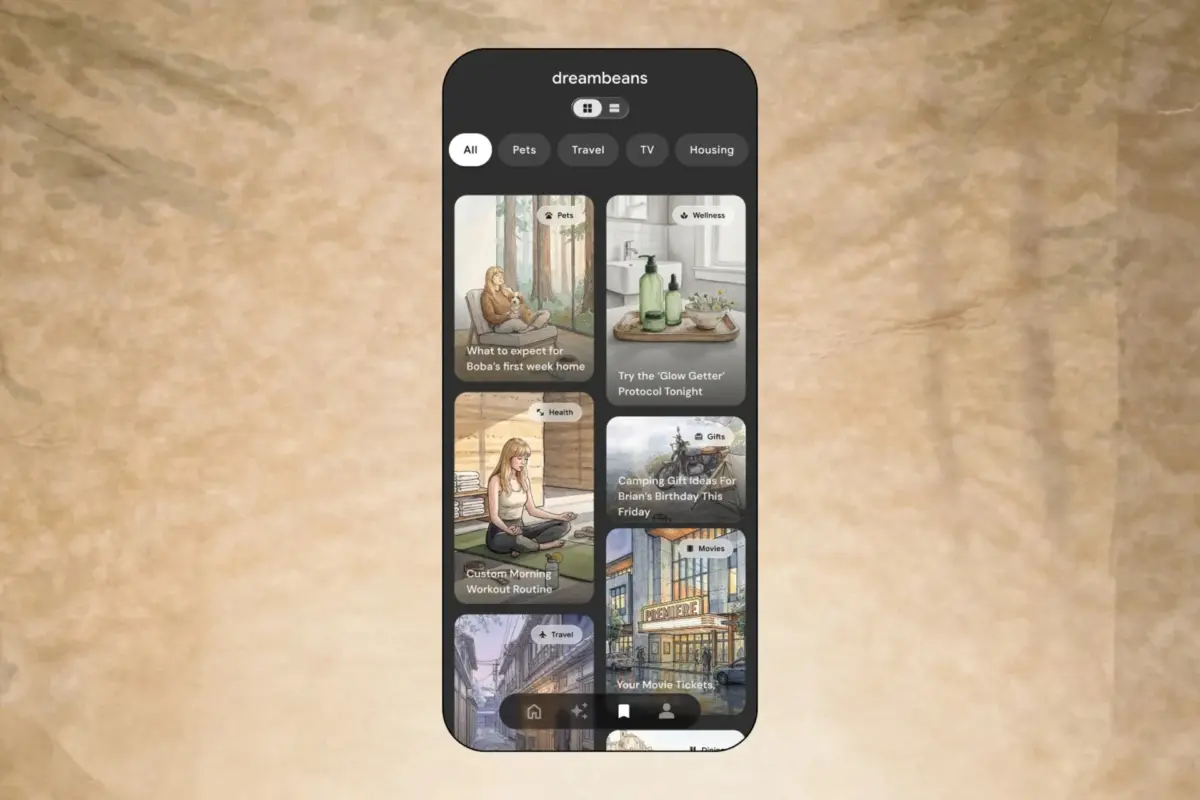
Google is taking its most unconventional experimental artificial intelligence application global, choosing India as its very first international market outside the United States. The tech giant has officially launched "Dreambeans"—an app that transforms a user’s everyday digital life into a personalized cartoon narrative—for Android and iOS users across the South Asian nation. This strategic expansion targets the world’s second-largest internet market, aiming to bring customized visual storytelling drawn from deep personal data ecosystems to a vastly broader audience.
The rollout, which went live on Monday, introduces robust support for 13 local languages alongside English. Indian users can now experience the application in Hindi, Punjabi, Tamil, Telugu, and Bengali, among other regional tongues. This international milestone comes less than two months after Google first made the experimental app broadly available to all eligible U.S. users aged 18 and older via Google Labs, following its initial debut in June.
Unlike general-purpose generative AI chatbots that wait for a prompt, Dreambeans operates proactively in the background. The application quietly pulls information from a wide array of connected Google services—including Calendar, Gemini, Gmail, Photos, Search, and YouTube—to synthesize personalized, illustrated stories about a user’s daily habits, routines, and personal interests. Initially limited to static, AI-generated illustrations, the application recently received a significant capability upgrade: Google integrated its Veo video-generation model, allowing the platform to animate images within select generated stories.
Google product manager Gozde Oznur explained during a press briefing that the company specifically selected India as Dreambeans’ debut international market due to overwhelming interest from local users eager to access the tool. Furthermore, the massive and widespread daily usage of core Google services across the country played a pivotal role. India stood out to the product team because of its exceptionally high overlap of active users engaging simultaneously with Gemini, Gmail, and Google Photos, creating an ideal data environment for the app’s personal intelligence features.
Market intelligence firm Sensor Tower shared early performance metrics with TechCrunch, illustrating the trajectory of the app since its summer introduction. Dreambeans has recorded nearly 55,000 total downloads in the U.S. market since June. Approximately 63% of those cumulative downloads occurred in September alone, a surge that directly coincided with Google removing waitlists and opening the app to all eligible U.S. adults. However, momentum slowed significantly following that initial wave, with U.S. downloads dropping by 84% month-over-month to roughly 5,500 in October.
Comparative data highlights the distinct nature of Dreambeans within the broader generative AI landscape. During the first 30 days following its opening to all eligible U.S. users, Dreambeans accumulated an estimated 29,000 downloads. In contrast, massive consumer-facing applications launched by competitors saw vastly higher initial adoption during their respective first 30 days on the market: Meta’s Muse reached an estimated 7.4 million downloads, OpenAI’s ChatGPT drew 2.8 million, xAI’s Grok Bot garnered 362,000, and Anthropic’s Claude recorded 155,000. Industry analysts note, however, that comparing Dreambeans to these platforms is an apples-to-oranges exercise. While general-purpose AI apps function as open-ended conversational assistants responding to a limitless variety of user queries, Dreambeans maintains a hyper-focused niche on crafting bespoke, proactive illustrated stories from personal archives.
Despite its expansive language support in India, the application currently enforces a strict single-language constraint per narrative. Oznur confirmed during the press briefing that while Dreambeans can pull underlying information from connected Google services across multiple languages, users must select only one specific language for their generated stories. The current architecture does not support stories that dynamically mix languages.
This technical limitation could potentially dampen the application’s immediate appeal in India, where multilingualism is a way of life. Millions of internet users in the country regularly switch between languages mid-conversation, frequently blending Hindi and English into the conversational hybrid widely known as Hinglish. The inability to seamlessly weave these linguistic crossovers into the app’s cartoon narratives may present a barrier to organic cultural integration.
Beyond linguistic constraints, Dreambeans’ deep dependence on private digital footprints brings complex questions regarding user privacy and data access back to the forefront. The application relies heavily on Google’s Personal Intelligence technology to scour and synthesize data from connected ecosystem accounts. Because these connected services—such as personal emails, private calendar entries, search histories, and personal photo libraries—frequently contain sensitive personal information, some privacy-conscious consumers may hesitate to grant an artificial intelligence application deep access simply to receive customized illustrated content.
Addressing these security and privacy concerns during the briefing, Oznur emphasized that user control remains a foundational element of the platform’s design. Users retain the absolute right to choose precisely which Google services are connected to Dreambeans and can disconnect those integrations at any given moment. Additionally, individuals can permanently delete their accumulated Dreambeans data directly from within the app interface. Oznur asserted that when information is deleted from the underlying connected Google services, it is simultaneously and permanently removed from the Dreambeans personalization system as well.
To give users further command over their generated narratives, Google has implemented preference safeguards. Users can explicitly instruct Dreambeans to avoid sensitive or unwanted subjects, such as business-related information, and the application will dynamically adjust its story generation algorithms accordingly. Furthermore, Google has restricted access strictly to personal Gmail account holders, keeping enterprise accounts entirely walled off from the experimental tool. To preserve privacy further, all generated stories remain strictly private, visible solely to the individual account holder.
The proactive, automated nature of the application also introduces emotional and psychological risks, particularly the possibility of unprompted surfacing of distressing memories. Oznur candidly acknowledged that Dreambeans could inadvertently generate stories involving sensitive topics, such as depicting people who have passed away. To mitigate this, Google has built manual override controls, allowing users to instruct the application to cease showing specific subjects. Oznur compared these safeguards to existing memory-filtering controls embedded within Google Photos, which allow users to curate and limit which past memories reappear on their screens.
Looking ahead, Google is already evaluating the next phase of evolution for the experimental platform. Oznur revealed to reporters that the product team is actively exploring ways to make Dreambeans more actionable. Rather than remaining confined to passive personalized stories and whimsical recommendations, future iterations could potentially help users actively execute tasks or take real-world actions based on the insights generated by the app.