The Unseen Insider Risk: Why Your Organization’s Biggest AI Threat Is Already Living on Endpoints
Right now, tucked away on a laptop somewhere within your corporate network, there is likely an autonomous artificial intelligence agent running without supervision. It may store sensitive API keys, critical database passwords, and have the kind of deep access to internal systems that normally requires strict authentication and continuous oversight. Yet, it operates entirely in the background, working silently while no one is watching.
Nobody in the security organization reviewed its access permissions. In fact, nobody within the enterprise even officially owns it.
If a human employee possessed that level of operational reach across company infrastructure with that little oversight, security teams would immediately flag it as a critical insider risk. They would audit access logs, review privilege levels, and implement strict monitoring protocols. Yet, organizations routinely overlook these same risks when the actor is an automated software utility, continuing to categorize these powerful systems simply as productivity tools.
Most contemporary discussions surrounding artificial intelligence security focus heavily on external threat actors, nation-state campaigns, and how malicious entities are weaponizing generative models. However, an expanding body of cybersecurity research suggests that the most pressing danger may already be residing securely inside the perimeter, introduced not by an external attacker, but by well-meaning employees trying to streamline their daily workflows.
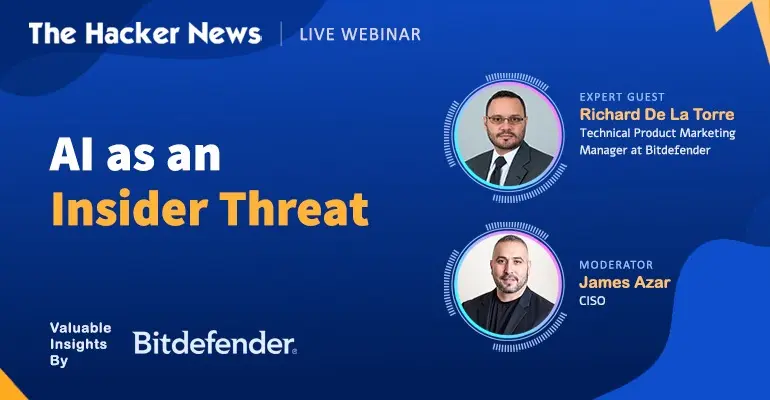
This emerging blind spot forms the central theme of an upcoming industry webinar titled "AI as an Insider Threat: From Shadow AI to Governed AI," featuring expert guest Richard De La Torre, Technical Product Marketing Manager at Bitdefender. The session aims to provide security professionals with a practical playbook designed to bring unseen artificial intelligence assets under corporate control before they can be exploited.
Where AI Is Hiding on Your Endpoints
The proliferation of artificial intelligence within modern enterprises extends far beyond traditional software developers experimenting with advanced code generation. Today, autonomous AI agents, intelligent coding assistants, Model Context Protocol (MCP) servers, and specialized browser extensions are quietly turning up across business units, deployed by marketing teams, finance departments, and human resources alike.
Crucially, the vast majority of these integrations never cross the network gateway in a way that traditional enterprise security tools can recognize. They bypass standard perimeter defenses because they often operate locally on user endpoints, interacting with cloud-based services directly through standard HTTPS traffic or executing inside local development environments.
The result is a striking security irony that many organizations are only beginning to comprehend: the artificial intelligence tools that possess the deepest access to sensitive corporate data are frequently the exact ones that security operations centers cannot see. Traditional network monitoring tools, asset management databases, and endpoint detection systems were not originally designed to catalog transient, user-installed extensions or locally running autonomous scripts, leaving a massive operational gap in corporate visibility.
The Visibility Gap, by the Numbers
This lack of comprehensive oversight is not merely a theoretical concern; it is backed by empirical data gathered across the cybersecurity industry. According to Bitdefender’s 2026 Cybersecurity Assessment report, only 51.8% of organizations currently report having full visibility into the artificial intelligence tools and applications utilized by their staff. That leaves nearly half of all enterprises operating without a complete picture of where artificial intelligence is integrated into their daily operations.
This pervasive blind spot carries a tangible financial and operational cost. Recent data compiled by technology giant IBM indicates that approximately 20% of all organizations that suffered a data breach or security compromise traced the incident back to shadow artificial intelligence—unauthorized and unmonitored AI tools deployed outside the purview of IT and security governance.
These statistics raise an urgent question for security leaders: what can organizations realistically do to mitigate risks they cannot even see? Finding actionable answers to this challenge is the primary focus of the upcoming Bitdefender webinar, which is designed to demonstrate what a lean security team can accomplish when faced with pervasive, unmonitored endpoints.
From Shadow AI to Governed AI
Recent telemetry and threat intelligence research conducted by Bitdefender Labs sheds light on what is actually executing on real-world enterprise endpoints. By analyzing actual machines in corporate environments, researchers have uncovered concerning trends, including the detection of malicious agent skills operating in the wild. These malicious components highlight how easily an unmonitored helper utility can be subverted or manipulated to exfiltrate sensitive data or execute unauthorized commands within a local environment.
When faced with the sprawling proliferation of unauthorized technology, the most instinctive corporate response is often to attempt a total ban. Organizations frequently try to block artificial intelligence tools outright through blanket firewall rules or endpoint restrictions. However, industry experience demonstrates that absolute prohibitions rarely succeed over the long term. Employees attempting to maintain productivity frequently find workarounds, turning to personal devices, alternative networks, or unsanctioned web services that push the activity even further outside the visibility of security teams.
The viable alternative to prohibition is governed adoption. Rather than attempting to halt innovation entirely, organizations must establish frameworks that provide visibility, risk assessment, and policy enforcement without stifling legitimate business use cases. The upcoming expert session is structured to show what governed adoption looks like in practice, moving security teams away from reactive firefighting and toward proactive management.
The AI already running quietly on your enterprise endpoints will not wait for corporate policy committees to draft guidelines or approve new software architectures. Security professionals looking to gain control over their environment can register for the expert session with Bitdefender’s Richard De La Torre to explore practical strategies for identifying and securing shadow artificial intelligence before it introduces critical vulnerabilities into the corporate network.