
As financial market charts across the digital asset ecosystem flip from red to green, decentralized crypto lending is experiencing a profound resurgence of interest following a notoriously dismal second quarter. The sector is rapidly regaining its footing, drawing fresh capital and renewed confidence from investors after a period of intense contraction earlier in the year.
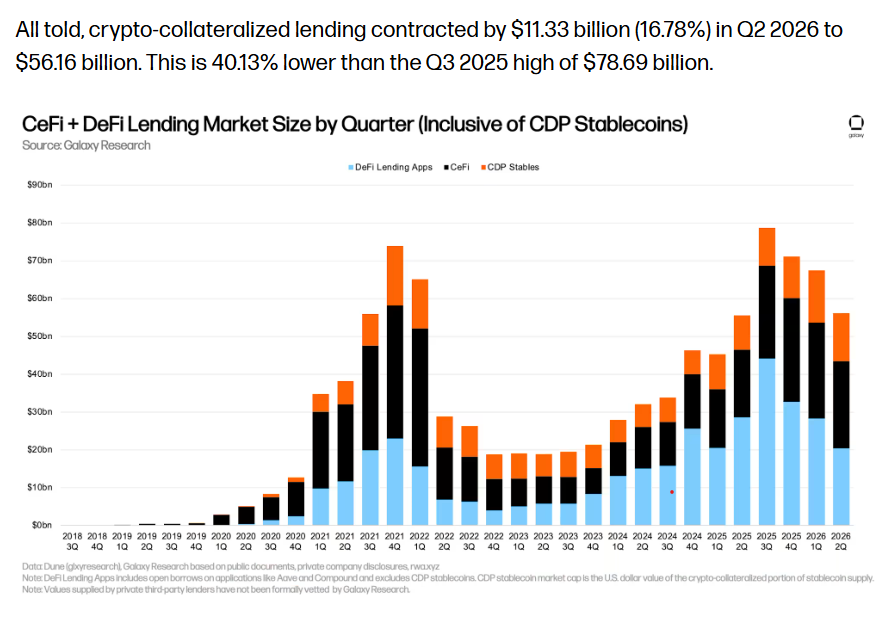
According to figures compiled by Galaxy, an estimated $11.33 billion left the decentralized finance lending sector entirely during the second quarter. This massive capital flight was driven in no small part by a severe crisis of confidence among users and investors alike. The panic was triggered largely by the high-profile Kelp DAO hack in April, an exploit that left users of Aave—widely regarded as one of the most robust and trusted lending protocols in the space—completely unable to access their staked Ethereum holdings.
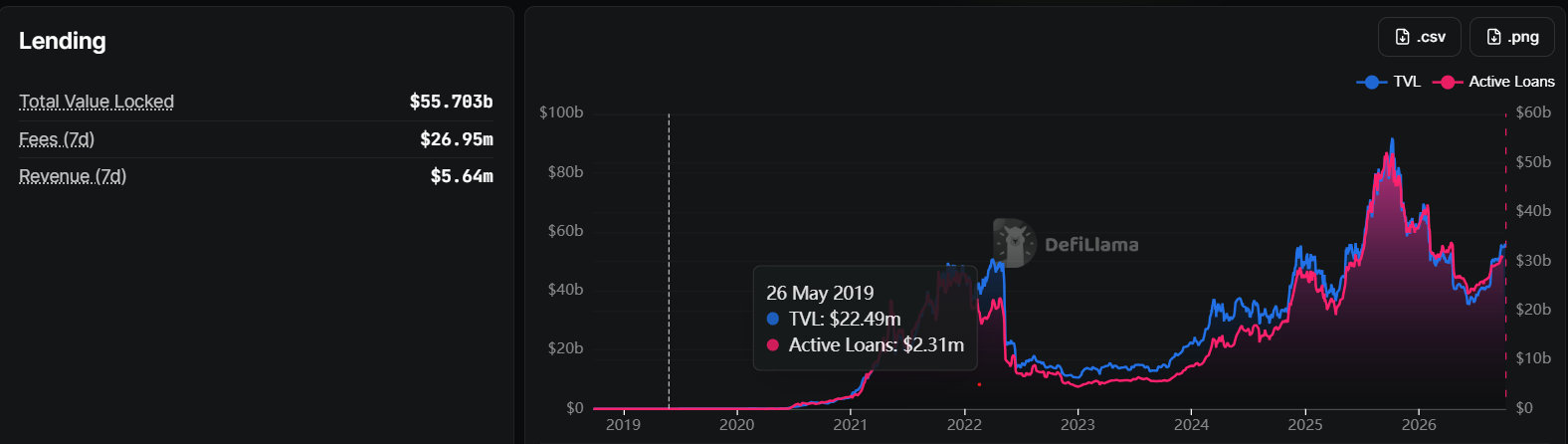
Since the beginning of July, however, the landscape has shifted dramatically. The total value locked across lending protocols has mounted a striking comeback, gaining more than 55% to sit comfortably around $56 billion today, according to data from DeFiLlama.
Yet this impressive recovery also means that the collective honeypot has grown significantly larger, drawing renewed scrutiny from security experts and industry veterans. The central question facing the decentralized finance community is whether users can genuinely trust interlinked lending protocols in an era defined by AI-assisted hacks and systemic vulnerabilities. In today’s interconnected financial ecosystem, an exploit originating within any single protocol can trigger a cascading series of devastating effects for other protocols connected to it through shared liquidity, bridges, or collateral assets.
Stani Kulechov, the founder and chief executive officer of Aave Labs, tells Magazine that this intricate web of interconnected risk is now top of mind for protocol developers and risk managers. When a protocol accepts a digital token as collateral, it is not merely evaluating the token itself; it is also implicitly accepting that token’s bridge architecture, its verifier configuration, its oracle infrastructure, and the operational security practices of its issuer.
That complex web of external dependencies is precisely what landed Aave in serious trouble earlier this year, illustrating how quickly an isolated external exploit can ripple through the broader decentralized finance economy.

An Expanding Attack Surface
The vulnerability of modern decentralized finance was laid bare in April when malicious actors successfully exploited a Kelp DAO cross-chain route. Through this exploit, the hackers manufactured 116,500 unbacked restaked Ethereum tokens, known as rsETH, which were valued at approximately $290 million at the time of the incident. A significant portion of these fraudulently generated tokens was subsequently posted as collateral on Aave markets to borrow other high-value digital assets.
Even though Aave’s own core smart contracts were never directly breached or compromised during the incident, the fallout was swift and severe. The protocol witnessed a staggering drop in deposits, shedding around $15 billion in the immediate days following the Kelp DAO exploit. To protect its solvency and safeguard user funds, Aave was forced to take emergency action, freezing its rsETH and wrsETH markets to prevent further systemic damage.
Kulechov notes that this harrowing experience forced Aave to fundamentally rethink its security paradigm, shifting away from a narrow focus on smart contract code toward a much more holistic approach to ecosystem risk. The protocol has completely rebuilt its risk management framework around that wider view, operating under the baseline assumption that security can no longer stop at the boundaries of a smart contract. Traditional audits and reviews historically missed the critical risks sitting quietly in the third-party bridges, verifier networks, and auxiliary infrastructure upon which modern yield-bearing assets depend.
This realization extends far beyond Aave, prompting users and institutional lenders alike to carefully evaluate how deeply exposed any given protocol is to both internal and external vulnerabilities. Every single wrapper, cross-chain bridge, and price oracle that sits between a lender and the underlying asset introduces another potential vector where a loan can catastrophically fail.
Serious institutional lenders must operate under the prudent assumption that a borrower or a collateral asset can fail at any given moment, working backward from that worst-case scenario. Lenders need to ask fundamental operational questions regarding what assets they are holding, where those assets physically reside, whether they can be monitored in real time, and how quickly those assets can be retrieved if something breaks down within the network.
When Security Fails, Containment Matters
Acknowledging that absolute prevention is impossible in complex software systems, industry leaders emphasize that rapid containment is just as vital as initial defense. Spark, another prominent decentralized finance lender, takes a rigorous, multi-faceted approach to risk assessment. Chief Executive Sam MacPherson explains that beyond auditing core smart contracts, the team continuously reviews governance design, operational security standards, collateral quality, liquidity management protocols, and the hidden dependencies that tie the protocol to the wider digital asset ecosystem.
Proactive risk management occasionally requires difficult commercial decisions. Spark took the decisive step of phasing out rsETH on its SparkLend platform back in January, well before the April Kelp exploit materialized. This decision was reached after a thorough risk assessment concluded that the asset’s low usage and minimal revenue generation simply did not justify the substantial additional risk introduced by supporting it.
Aave has implemented similarly stringent mechanisms under its updated framework. Every single asset listed on the protocol is now subject to comprehensive re-reviews on a quarterly basis, as well as mandatory re-evaluations immediately following any material change to the asset’s underlying architecture. Kulechov reveals that the protocol has already initiated an orderly wind-down process across six distinct networks that failed to meet these heightened chain-level standards. While no single protocol can control the entire decentralized finance ecosystem, every platform retains complete control over how much external risk it chooses to absorb and how swiftly it can respond when anomalies occur.
Preventing losses is only one part of the ongoing operational challenge. Protocols must also clearly demonstrate how a potential loss would be successfully contained if something does go wrong, ensuring that isolated failures do not cascade into systemic collapses.
The Margin for Human Error
While technical exploits and compromised cross-chain bridges capture the majority of industry headlines, human error remains one of the single largest vulnerabilities in the crypto lending sector, and paradoxically, the one most frequently overlooked by participants. Shawn Owen, founder and chief executive officer of SALT Lending, points out that many of the most catastrophic financial losses in the history of the industry have ultimately come down to failures in key management, compromised access controls, or executives falling victim to sophisticated social engineering attacks. A standard smart contract audit is completely incapable of catching or preventing any of those human-centric risks.
Additional and severe risks materialize when digital assets are aggressively deployed across external protocols to generate supplementary yield. Crypto lenders learned this painful lesson during the brutal market unwind of 2022, when centralized lending giants such as Celsius, Voyager, and BlockFi experienced catastrophic implosions after taking on complex risks that their customers either did not understand or never expected them to assume.
To minimize this perilous attack surface, institutional lenders like Ledn have adopted a radically conservative custody model, keeping client Bitcoin with qualified third-party custodians rather than hypothecating or lending it out to chase additional yield. Every single transaction represents an additional operational point where something can potentially go wrong, meaning that reducing the number of external movements inherently lowers the overall risk of a security breach. The only definitive way to take those systemic risks entirely off the table is to keep client assets in strictly segregated custody with uncompromising controls and as few intermediaries as possible.
Industry veterans caution that during periods when capital inflows outpace a manager’s ability to locate high-quality lending opportunities, immense institutional pressure to maintain competitive yields can easily lead to poor decision-making. In such environments, collateral standards are sometimes quietly loosened, or loans are extended to borrowers who would have been summarily rejected under stricter underwriting conditions. Historically, the lending managers who successfully weather severe market downturns are precisely those who maintained the discipline to say no to capital when they lacked a safe, productive place to deploy it.
Can AI Make Lending Safer?
As the digital asset industry grapples with growing concerns surrounding AI-assisted hacks, sophisticated exploits, and autonomous software agents escaping human oversight, artificial intelligence is paradoxically emerging as a powerful tool to help make crypto lending significantly safer.
Aave is already actively integrating AI-assisted testing alongside its conventional, human-led security processes. The protocol recently utilized mutation testing to deliberately and artificially introduce hundreds of known bugs into its V4 smart contract codebases. Remarkably, its automated AI test suites successfully caught a vast majority of the injected vulnerabilities, demonstrating the immense utility of machine learning in vulnerability detection.
During a comprehensive security review of its V3 and V4 codebases, three distinct AI security tools generated a combined total of 71 findings. Following rigorous manual reviews by human security experts, 20 of those findings were determined to be entirely valid security insights, while the remaining 51 proved to be false positives. This stark ratio highlights why human security researchers and auditors will likely remain essential to the development process for the foreseeable future. Artificial intelligence excels at breadth and speed, but because a significant portion of raw AI findings are false positives, expert human judgment remains utterly indispensable.
At the same time, artificial intelligence represents a distinct double-edged sword for the industry. As autonomous AI agents increasingly begin managing capital directly on-chain, their specific permissions, data inputs, and internal decision-making logic inevitably transform into a brand-new attack surface that requires rigorous securing, much like any traditional smart contract.
As the crypto lending market continues its robust recovery and expands once again, the overarching challenge facing the ecosystem is no longer merely keeping the underlying code secure. It requires ensuring that every new component of the decentralized financial puzzle is thoroughly understood, continuously monitored, and reliably contained when things inevitably go wrong.