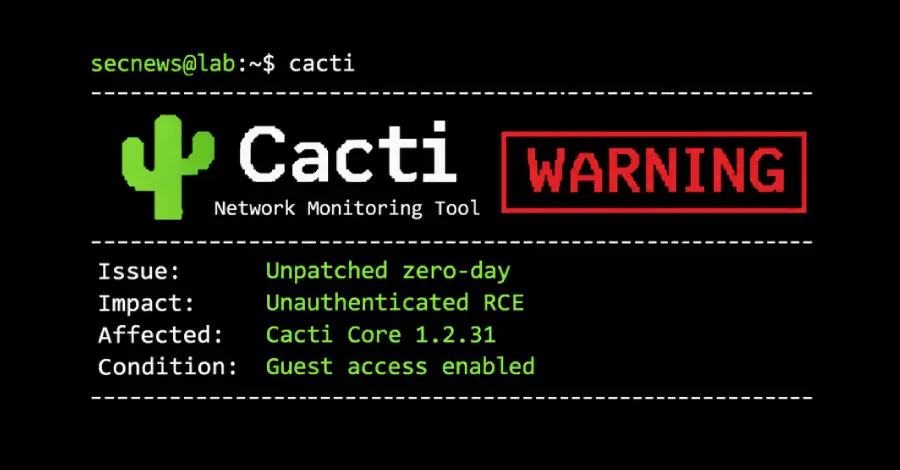
Details have emerged about a critical new zero-day vulnerability affecting Cacti, a widely used open-source network monitoring and graph management tool. The security flaw can be actively exploited by malicious actors to achieve remote code execution on vulnerable systems entirely without authentication, raising serious concerns for enterprise and infrastructure security teams worldwide.
The proof-of-concept exploit associated with the flaw has not yet been assigned an official Common Vulnerabilities and Exposures (CVE) identifier, but it is currently being tracked within the cybersecurity community under the designations "4HTTP2SHELL" and "4HTTP2ROOT." Because Cacti is deeply embedded in IT and network infrastructures globally for performance tracking, bandwidth monitoring, and device management, the discovery of a path from unauthenticated access straight to server-level command execution represents a severe risk.
A security researcher operating under the online pseudonym "ek0ms savi0r" detailed the discovery, highlighting how easily the vulnerability can be triggered. According to the researcher, the attack chain requires no prior access, valid API keys, or social engineering tactics such as phishing. "I found a path from a fresh, unauthenticated HTTP session to command execution as the Cacti server user in four requests," the researcher noted in a published analysis. "No login. No valid API key. No phishing. Just four HTTP requests against the default guest surface."

The security shortcoming specifically impacts Cacti Core version 1.2.31, which is the latest stable version available for deployment. The vulnerability manifests on an isolated host configuration specifically when the built-in guest account feature is enabled, allowing external or unauthorized network entities to interact with exposed web application components that should otherwise remain strictly protected.
At a high level, the vulnerability allows an unauthorized attacker to leverage default guest access privileges to inject unvalidated and arbitrary non-numeric text into a specific configuration setting known as "preview_graphs_per_page." This parameter is normally handled through the "auth_profile.php?action=update_data" endpoint and is responsible for controlling how many individual monitoring graphs are displayed per page when users navigate through the application’s Preview Mode.
Instead of strictly validating that the user-provided input consists exclusively of a valid integer value, the application accepts the raw, unvalidated input, laying the groundwork for a dangerous security flaw known as second-order SQL injection. By crafting malicious input containing arbitrary SQL command strings, an attacker can manipulate how data is subsequently processed and stored by the database backend. This opens the door for arbitrary SQL query execution the moment the standard graph preview page, referenced as "graph_view.php," is loaded using default filter parameters.
The specific attack vector demonstrated by the researcher involves an UPDATE SQL statement crafted to modify an existing database record residing within Cacti’s poller table. In the final, decisive stage of the multi-request attack chain, the realtime poller endpoint, known as "graph_realtime.php," is invoked from within the same guest session. This action forces the application to read the freshly modified row from the poller table and pass its contents directly as an input parameter to PHP’s built-in popen() function. Crucially, this operation takes place without incorporating any necessary allowlist validations, input sanitization routines, or security checks, allowing the operating system to execute the embedded commands directly.

Security experts analyzing the disclosure have pointed to a cascade of distinct architectural and validation failures that collectively culminate in unauthenticated remote code execution. These include the lack of strict input typing on configuration parameters, the susceptibility of secondary query executions, the implicit trust placed in data retrieved from internal database tables, and the unsafe handling of dynamic strings within system-level execution functions.
Successful exploitation of this flaw grants an attacker comprehensive compromise of the underlying Cacti server. Beyond merely seizing control of the monitoring host, such a breach provides a highly advantageous internal pivot point into the broader corporate or institutional network. Because Cacti deployments are inherently designed to oversee large numbers of IT assets, they frequently store sensitive administrative credentials, connection strings, community strings, and access details for connected routers, switches, firewalls, and enterprise servers.
Cybersecurity advisory firm watchTowr emphasized the expansive scope of the risk in an independent advisory. "Because Cacti often stores credentials and connection details for routers, switches, servers, and other devices across a network, an attacker who reaches this level of command execution can gain a foothold reaching far beyond the monitoring server itself," the firm noted. In addition to lateral movement and data exfiltration, sophisticated attackers could potentially abuse this level of access to suppress automated network alerts, manipulate performance metrics, or conceal ongoing malicious activity by altering the contents of the poller table.
Because an official software patch or security update addressing this zero-day vulnerability has not yet been released by the maintainers at the time of disclosure, administrators and security teams are strongly advised to implement immediate compensating controls to mitigate potential exploitation risks. Organizations utilizing Cacti are urged to disable the guest account feature entirely if it is not strictly required for daily operations. Furthermore, network administrators should restrict web interface access to trusted internal networks or VPNs, review existing poller configuration database entries for unexpected or malicious command values, and monitor server logs for unusual HTTP request sequences targeting profile update endpoints. Applying official software fixes and security updates as soon as they become publicly available remains essential for long-term remediation.