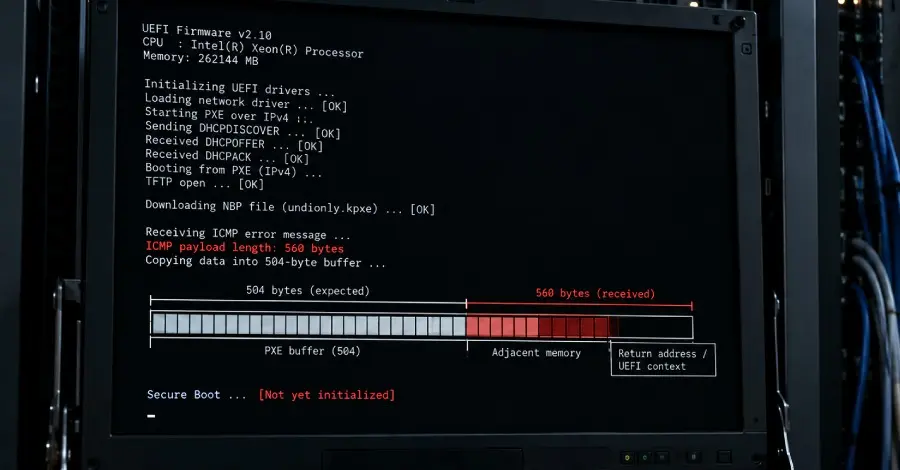
A severe, long-standing security vulnerability residing within EDK II—the foundational open-source code utilized by the vast majority of hardware manufacturers to construct UEFI firmware—poses a significant risk to servers and enterprise systems worldwide. Tracked as CVE-2026-97631 and assigned a staggering severity score of 9.5 out of 10, the flaw exposes machines to potential malicious code execution before their operating systems ever load. However, this threat is strictly confined to scenarios where a target system is actively booting over a local network.
UEFI firmware acts as the critical bridge between computer hardware and software, executing the foundational instructions necessary to initialize hardware components before handing off control to the operating system. Under specific conditions, an adversary capable of delivering a meticulously crafted network message during this delicate startup phase can disrupt the boot process. More alarmingly, with deep customization tailored to an exact firmware build, an attacker can manipulate the system into executing arbitrary code prior to the initialization of Secure Boot and other essential startup defenses.
Exploiting this vulnerability does not require administrative credentials, passwords, or any prior access to the targeted machine. Nevertheless, successful exploitation depends entirely on timing and network positioning. An attacker must be able to reach the target over the network during the exceptionally narrow window in which the machine undergoes a network boot. Major enterprise Linux distributors such as Red Hat and SUSE have evaluated the security hole, concluding that it is an adjacent network threat rather than an attack vector operable across the open internet.
TianoCore, the open-source community project responsible for developing and maintaining EDK II, officially published a security advisory addressing the vulnerability on October 22. While a code correction has been successfully developed and merged into the project’s source repositories, no stable release of EDK II incorporating the patch has been published as of yet. Consequently, system administrators and enterprise users currently lack a direct, stable package to install for immediate remediation.
What the Flaw Lets an Attacker Do
The vulnerability itself stems from a classic buffer overflow condition nestled within the network-boot code of EDK II, specifically handling Preboot Execution Environment (PXE) operations. During a standard PXE boot sequence, a client machine fetches its startup image directly across a local network rather than loading it from an internal storage drive.
To facilitate this network-based initialization, the PXE driver is programmed to listen for Internet Control Message Protocol (ICMP) error messages and compact status notifications transmitted by surrounding network devices. The driver then copies each received packet into a designated, fixed-size memory buffer measuring exactly 504 bytes.
An examination of the source history reveals that boundary size checks governing this memory copy operation were implemented incorrectly across both the IPv4 and IPv6 implementations of the code. Because the validation logic fails to properly restrict input lengths, incoming network messages exceeding the 504-byte limit spill past the allocated memory boundary. This overflow directly overwrites adjacent system memory regions with data explicitly supplied by the attacker.
To trigger the buffer overflow, a malicious actor needs only to transmit a specially crafted error message targeting the machine’s network address while it is in the middle of a network boot cycle. Because the procedure occurs before the operating system is initialized, traditional endpoint protection software is entirely non-functional.

The immediate and most common consequence of this memory corruption is an abrupt system crash, causing the boot sequence to hang and the machine to fail to start. Achieving arbitrary code execution, however, is significantly more complex and demands a high degree of precision. According to the project advisory, an attacker must possess precise knowledge of the target system’s exact firmware build to construct a counterfeit event that tricks the firmware into executing the malicious payload. Because of this requirement, any exploit must be meticulously customized for individual hardware and firmware configurations.
When an attacker successfully forces code execution at this stage, the instructions run directly within the firmware environment before Secure Boot and other boot-time verification mechanisms have authenticated the software stack. This timing represents the core danger of the vulnerability. While code planted in this transient manner executes only once and does not automatically survive a subsequent system reboot, that single window of execution is more than sufficient for a sophisticated adversary to drop persistent malware designed to infiltrate every subsequent boot cycle.
Who Is Affected
The underlying programming error impacts EDK II versions up to and including edk2-stable202608, the stable release distributed on August 21. Because EDK II serves as the upstream reference implementation for nearly all modern UEFI firmware vendors, the vulnerable codebase has proliferated widely. Independent BIOS developers such as AMI, Insyde, and Phoenix, as well as Microsoft’s hardened firmware fork known as Project Mu, all build upon this architectural foundation.
An investigation into the project’s revision history conducted by The Hacker News indicates that the flawed memory copy loop has persisted in the codebase since a commit was introduced in November 2010, meaning the security defect remained hidden within critical infrastructure for sixteen years.
PXE network boot functionality is enabled by default in standard EDK II configurations. Home users and typical office workstations that boot exclusively from local hard drives or solid-state storage are generally immune to the threat. Instead, the vulnerability primarily targets enterprise environments, corporate data centers, and institutional networks where servers and specialized computing assets routinely rely on network booting.
The precise magnitude of commercial products carrying the vulnerable firmware remains difficult to quantify. In statements to industry media, representatives for Intel clarified that none of its commercial products currently under active security support are known to be affected, noting that Intel does not include the specific EDK II functionality in its core reference code, though third-party OEM board vendors or system builders retain the autonomy to integrate it. Similarly, Arm stated that the vulnerability is not directly applicable to its primary product portfolio, despite both companies drawing upon EDK II principles for their hardware ecosystems.
Enterprise Linux vendors are actively tracking the flaw across their distributions. Red Hat has acknowledged that its edk2 packages in Red Hat Enterprise Linux versions 8, 9, and 10 contain the vulnerable code and currently lack an official patch. Equivalent assessments have been published by security trackers at SUSE and Debian, confirming that their respective software channels are similarly exposed. Other major industry stakeholders, including AMD, Phoenix Technologies, AMI, Microsoft, and Amazon, did not provide immediate clarification regarding the status of their products prior to publication, leaving the deployment footprint across various proprietary hardware lines partially obscured.
Is There a Fix?
Remediation efforts at the source level have already progressed. A code correction was merged into the primary EDK II development repository on October 15. The patch modifies the memory handling logic by enforcing strict truncation, ensuring that any incoming network message exceeding the designated limit is safely cut off at 504 bytes rather than overflowing the adjacent memory space.
Despite the fix being publicly available in the source tree, no stable release of EDK II has been tagged to include it. Verification of the project’s release tags indicates that the newest stable iteration, edk2-stable202608, predates the patch, and official project advisories continue to list the patched version status as currently unavailable. Notable exceptions include Microsoft’s Project Mu, which has already backported the fix into its active release branches and generated tagged builds.

For enterprise server operators, the availability of a source code fix does not immediately translate to system safety. Administrators must wait for individual hardware vendors and motherboard manufacturers to compile new BIOS and UEFI updates incorporating the updated reference code. However, industry experts view the deployment path as relatively straightforward. Jesse Michael, a principal firmware security researcher at Eclypsium, noted that unlike complex Secure Boot bypasses such as BootHole or BlackLotus, this particular vulnerability can be resolved through a traditional code update and does not necessitate disruptive cryptographic certificate or key revocations.
Until hardware vendors issue official firmware updates, system administrators have few direct mitigations available. Because the vulnerability can only be exploited during a network boot sequence, organizations that do not actively utilize PXE boot capabilities are advised to disable the feature entirely to minimize their attack surface. Security analysts also recommend monitoring network traffic and system initialization logs for anomalous behavior during the boot phase.
How It Became Public
The existence of CVE-2026-97631 was originally uncovered through collaborative security research conducted by Alex Matrosov of Anthropic and Dan Holmes-Mitra of Google, with a coordinated public disclosure initially scheduled for January 2027 to give manufacturers adequate time to prepare patches.
That timeline was disrupted on September 28 when a routine pull request submitted to the EDK II repository, reviewed and signed off by an engineer from AMI, publicly described the vulnerability using its assigned CVE tracking identifier and bundled the remediation code into the open pull request. Upon discovering that the technical details had entered the public domain, TianoCore expedited the release of its formal security advisory on October 22, well ahead of the original target date.
With the patch details exposed in public repositories, security researchers note that motivated attackers can analyze the code changes to reverse-engineer the exact mechanism of the flaw and develop functional exploit payloads.
Despite the public availability of the technical details, there is currently no evidence indicating that the vulnerability has been actively exploited in the wild. The flaw was absent from the Cybersecurity and Infrastructure Security Agency (CISA) Known Exploited Vulnerabilities catalog, and no external research teams have reported observing active exploitation campaigns.
Security analysts emphasize that the flaw does not provide a remote backdoor into an otherwise secure network perimeter. Instead, the realistic threat model involves an insider threat or an attacker who has already achieved low-level access to a local corporate network and seeks to escalate their privileges or compromise neighboring hardware.
Describing the tactical implications of the bug, HD Moore, creator of the Metasploit framework and chief research officer at Dragos, explained that an adversary targeting a nearby enterprise server could potentially leverage the flaw to hijack program execution flow at a juncture when the boot routine still retains direct access to sensitive system components, such as a Trusted Platform Module. Such an exploit could theoretically be weaponized to bypass disk encryption mechanisms in scenarios where an attacker possesses temporary local network access or physical proximity.
This discovery highlights ongoing security challenges within foundational firmware utilities. In January 2024, researchers disclosed PixieFail, a collection of nine separate vulnerabilities concentrated within the same EDK II network-boot subsystem. While subsequent automated fuzzing initiatives were launched across the security community to hunt for lingering defects in the PXE codebase following those disclosures, this particular 16-year-old oversight managed to evade detection until now.