

The corporate adoption of stablecoins is entering a transformative new phase, with usage projected to climb sharply over the next twelve months as digital currencies transition firmly into the financial mainstream. According to a comprehensive new report released by payments infrastructure firm Cybrid, businesses are increasingly bypassing traditional financial rails in favor of blockchain-based alternatives to optimize their global operations, slash overhead costs, and drastically accelerate cross-border settlement speeds.
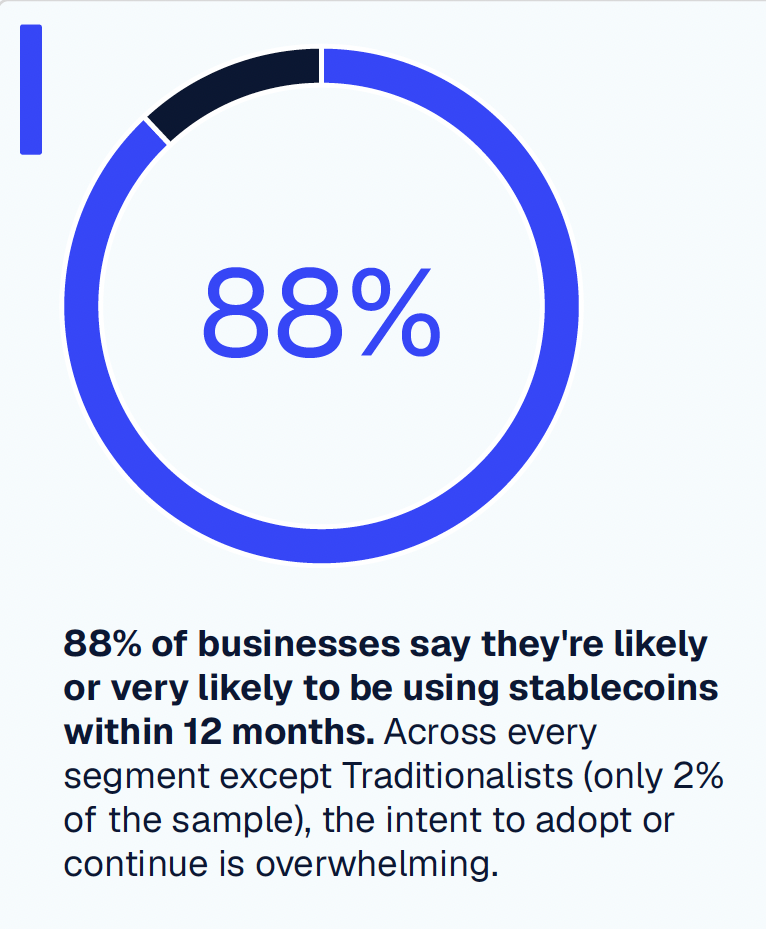
The findings reveal that 42% of surveyed businesses are already actively utilizing stablecoins for cross-border payments. Furthermore, an overwhelming 88% of respondents indicated that they are either likely or very likely to integrate stablecoins into their financial workflows within the coming year. Strikingly, the data highlights a severe erosion of confidence in legacy banking infrastructure for international transactions, with only 2% of surveyed executives identifying as committed users of traditional payment rails.
For companies navigating the complexities of global commerce, the financial incentives driving this shift are difficult to ignore. Businesses currently utilizing stablecoins reported average cross-border payment cost savings of 35%. Even more dramatic figures were recorded among high-volume enterprises; companies processing more than $100 million in monthly payment volume reported average cost reductions of up to 47%. These savings stem primarily from the elimination of intermediary fees, reduced foreign exchange spreads, and the near-instantaneous settlement times inherent to distributed ledger technology, contrasting sharply with the days-long delays and multiple correspondent banks typical of legacy wire transfers.
This corporate migration coincides with a broader expansion of the global stablecoin market, which has swelled to a total market capitalization of $307.64 billion, according to data from CoinGecko. The market continues to be dominated by industry giants, led by Tether’s USDT at $184.7 billion and Circle’s USDC at $73.51 billion. At the same time, recent legislative milestones have created a specialized ecosystem for compliant digital assets. Stablecoins compliant with the GENIUS Act have surpassed a collective market capitalization of $76 billion, a milestone driven by the establishment of the first federal regulatory framework specifically designed for payment stablecoins in the United States.
The Cybrid report is built upon comprehensive empirical data gathered from a survey of 468 executives and business leaders, conducted between April 28 and May 4. The surveyed cohort comprised C-suite executives, finance and treasury managers, and payments and operations leaders representing the technology, financial services, and e-commerce sectors across the United States, Canada, and the United Kingdom.

Varied Users Look for Regulatory Clarity to Gain Confidence
The practical applications for stablecoins within modern enterprises span a wide array of financial operations. Among survey respondents, payroll and contractor payments emerged as the single most common use case, reflecting the urgent demand for fast, frictionless cross-border compensation for remote workforces. This was followed closely by supplier payments, customer transactions, investment and yield generation strategies, vendor disbursements, and overarching treasury and liquidity management frameworks.
Despite the rapid pace of adoption, businesses are clear-eyed about the hurdles that remain before digital currencies achieve absolute ubiquity in the corporate world. Regulatory clarity emerged as the single most critical factor that would increase executive confidence in expanding stablecoin deployment. Specifically, 71% of respondents identified regulatory certainty as more important to their long-term planning than the availability of trusted infrastructure providers or the seamless integration with existing enterprise software systems.
This emphasis on regulation underscores the cautious approach institutional players must maintain regarding compliance, accounting standards, and legal liability. While the passage of legislative measures like the GENIUS Act has provided a foundational structure in the U.S., businesses operating across international borders continue to advocate for harmonized global standards that can protect them from regulatory arbitrage and enforcement uncertainty.
The institutional push toward stablecoins is further corroborated by broader market data from across the financial technology sector. In June, payments infrastructure provider Paybis released figures indicating that business customers accounted for nearly 98% of the stablecoin payout volume processed through its platform during the first four months of 2026, marking a monumental leap from just 36% in 2023. Paybis also highlighted independent research from McKinsey, which estimated that business-to-business transactions accounted for roughly 60% of the staggering $390 billion in global stablecoin payment volume recorded throughout 2025.
Companies Expand Infrastructure for Stablecoin Payments
To accommodate this surging commercial demand, traditional financial institutions and digital asset companies are rapidly scaling their underlying infrastructure to bridge the gap between traditional banking and decentralized networks.
In May, Anchorage Digital Bank launched fUSD, a dollar-backed stablecoin developed by Falcon Finance, utilizing Anchorage’s federally regulated digital asset issuance platform. This initiative was specifically engineered to cater to institutional trading desks, collateral management needs, and complex corporate treasury workflows that demand bank-grade security and regulatory oversight.
The integration of stablecoins into mainstream financial architecture gained further momentum when BNY expanded its digital asset custody platform to support Circle’s USDC. This development allows institutional clients to securely store, transfer, mint, and redeem the stablecoin directly through the bank’s established custody environment, effectively removing operational barriers for legacy financial institutions wishing to interact with digital dollars without abandoning their trusted institutional custodians.
As payment providers, custodians, and legislative frameworks continue to evolve in tandem with corporate demand, the operational friction that once defined international business transactions is steadily giving way to an era of instant, cost-effective digital settlement. With nearly nine out of ten businesses signaling an intent to adopt stablecoins within the year, the financial sector appears poised for a permanent structural shift in how capital moves across borders.