
The corporate world is on the cusp of a major transformation in how it moves money globally. According to a comprehensive new report released by payments infrastructure firm Cybrid, business adoption of stablecoins is poised for a dramatic surge over the next 12 months as the digital currency transitions firmly into the mainstream financial ecosystem.
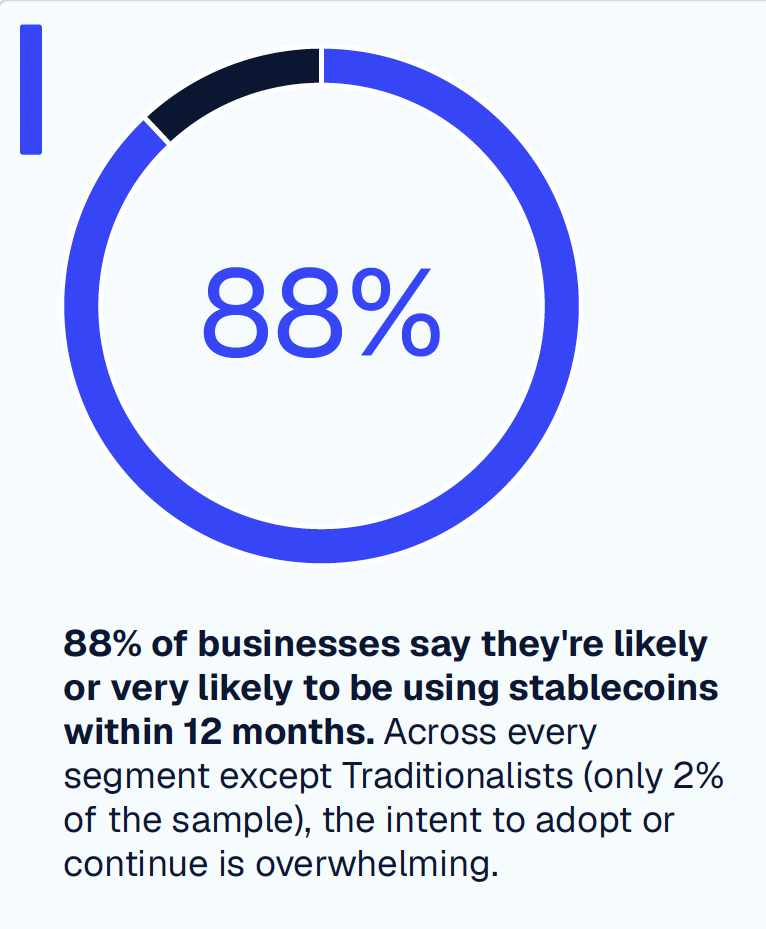
The findings underscore a rapidly shifting landscape where traditional banking rails are increasingly viewed as slow, expensive, and outdated for modern commerce. Cybrid’s research revealed that 42% of businesses surveyed are already actively utilizing stablecoins to execute cross-border payments. Even more telling of the trajectory ahead, an overwhelming 88% of respondents indicated that they are likely or very likely to integrate stablecoins into their operational workflows within the coming year. In stark contrast, only 2% of the surveyed business leaders identified themselves as committed users of traditional payment rails, highlighting an impending wholesale migration toward blockchain-powered alternatives.
The primary driver behind this mass corporate migration is straightforward: efficiency and bottom-line savings. Companies currently leveraging stablecoins for their international transactions reported average cross-border payment cost savings of an impressive 35%. For larger enterprises operating at scale—specifically those processing upwards of $100 million in monthly payment volume—the financial benefits are even more pronounced, with average savings soaring up to 47%. These substantial reductions in friction and fees are turning heads in corporate boardrooms, compelling finance executives to rethink legacy treasury operations.
This corporate momentum is unfolding against the backdrop of a booming broader market. Data from CoinGecko places the global stablecoin market capitalization at an imposing $307.64 billion. The sector continues to be dominated by Tether’s USDT, which commands a market cap of $184.7 billion, followed by Circle’s USDC at $73.51 billion. Furthermore, legislative advancements are reshaping the regulatory perimeter. Fuelled by recent regulatory milestones, stablecoins compliant with the GENIUS Act have surpassed a market cap of $76 billion, establishing the first formal federal regulatory framework for payment stablecoins in the United States and providing a vital baseline of legitimacy for risk-conscious corporations.

Cybrid’s insights are drawn from a targeted survey of 468 executives and business leaders conducted between April 28 and May 4. The surveyed cohort comprised C-suite executives, finance and treasury managers, and payments and operations leaders hailing from the technology, financial services, and e-commerce sectors across the United States, Canada, and the United Kingdom.
Varied Users Look for Regulatory Clarity to Gain Confidence
As businesses experiment with and expand their reliance on digital currencies, their use cases have grown increasingly diverse. According to the survey data, payroll and contractor payments emerged as the most common stablecoin use case among respondents. This was followed closely by supplier payments, customer payments, investment and yield generation, vendor payments, and treasury and liquidity management.
Despite the widespread enthusiasm and proven cost savings, businesses are navigating their expansion cautiously, keeping a close eye on the regulatory horizon. Regulatory clarity was identified as the single most critical factor that would increase executive confidence in expanding stablecoin use. In fact, 71% of respondents cited clear regulations as more important to their decision-making process than partnering with trusted infrastructure providers or achieving seamless integration with existing internal software systems.
This emphasis on regulatory backing reflects the cautious approach institutional players must maintain regarding compliance, anti-money laundering protocols, and cross-border legal frameworks. As governments around the world continue to grapple with how to supervise digital assets, the creation of predictable rules remains the ultimate catalyst required to unlock the remaining segments of corporate hesitation.
Companies Expand Infrastructure for Stablecoin Payments
Independent industry data from various corners of the financial and crypto ecosystem consistently points to the exact same secular trend, confirming that Cybrid’s findings are part of a broader, macroeconomic shift rather than an isolated phenomenon.
In June, payments infrastructure provider Paybis released figures indicating that business customers accounted for nearly 98% of the stablecoin payout volume processed through its platform during the first four months of 2026. This represents a monumental leap from just 36% in 2023, illustrating how rapidly corporate demand has swallowed up retail-dominated transaction volumes. Paybis also highlighted independent research from McKinsey, which estimated that business-to-business transactions accounted for roughly 60% of the staggering $390 billion in global stablecoin payment volume recorded in 2025.
To keep pace with this exponential surge in demand, financial institutions and technology providers have been aggressively expanding their supporting infrastructure. In May, Falcon Finance debuted its dollar-backed stablecoin, fUSD, utilizing Anchorage Digital Bank’s federally regulated issuance platform. The product was specifically engineered to target institutional trading, collateral management, and complex treasury workflows.
Traditional banking heavyweights are also making significant moves to capture institutional stablecoin flow. BNY expanded its digital asset custody platform to provide full support for Circle’s USDC. This integration empowers institutional clients to securely store, transfer, mint, and redeem the stablecoin directly through the bank’s established custody infrastructure, bridging the gap between traditional banking security and the speed of decentralized ledger technology.