Bitcoin fell to its lowest levels in over three weeks on Thursday, slipping alongside broader macroeconomic declines as the cryptocurrency market tracked fresh, sharp losses on South Korean stock exchanges and absorbed the impact of hotter-than-expected United States inflation data.
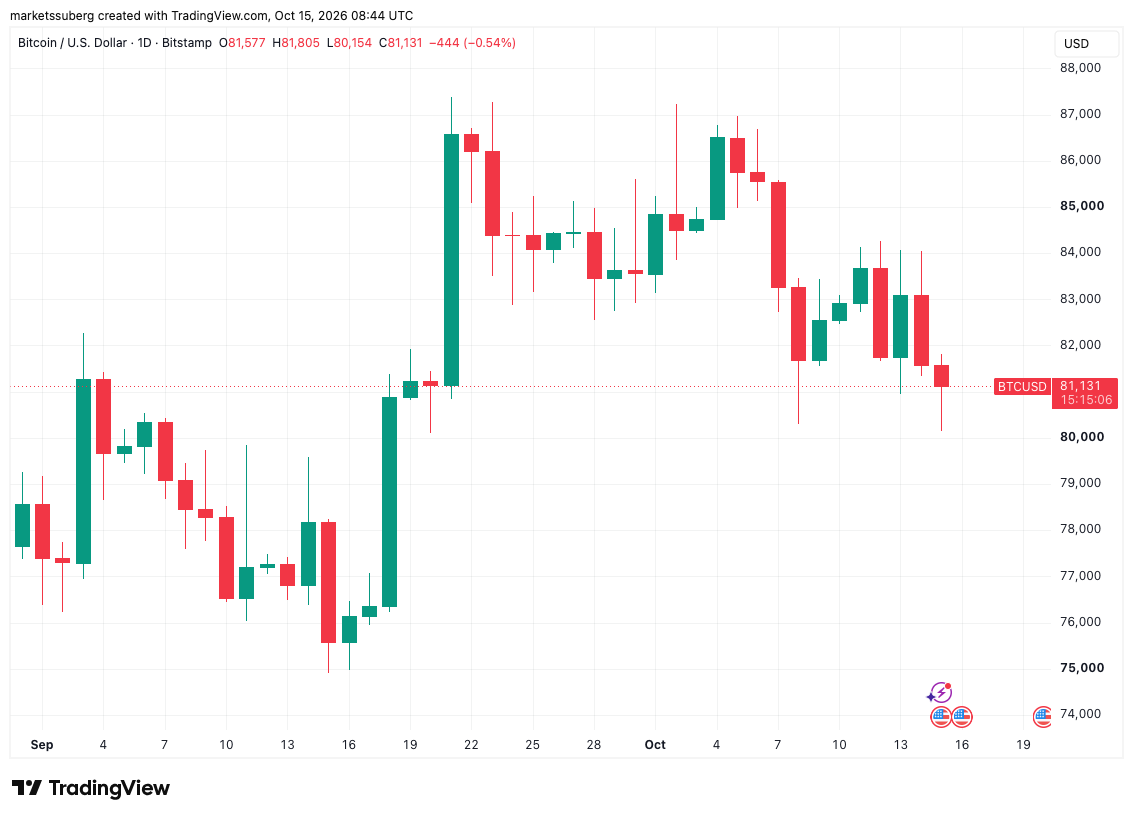
Data from TradingView showed the benchmark cryptocurrency, BTC/USD, hitting $80,154 on Bitstamp, touching a valuation floor that had not been recorded since September 20. The downward pressure highlights the ongoing sensitivity of digital assets to traditional macro indicators, foreign capital flows, and localized equity turbulence in key Asian markets.
Bitcoin Price Nears $80,000 as KOSPI Falls 7.5%
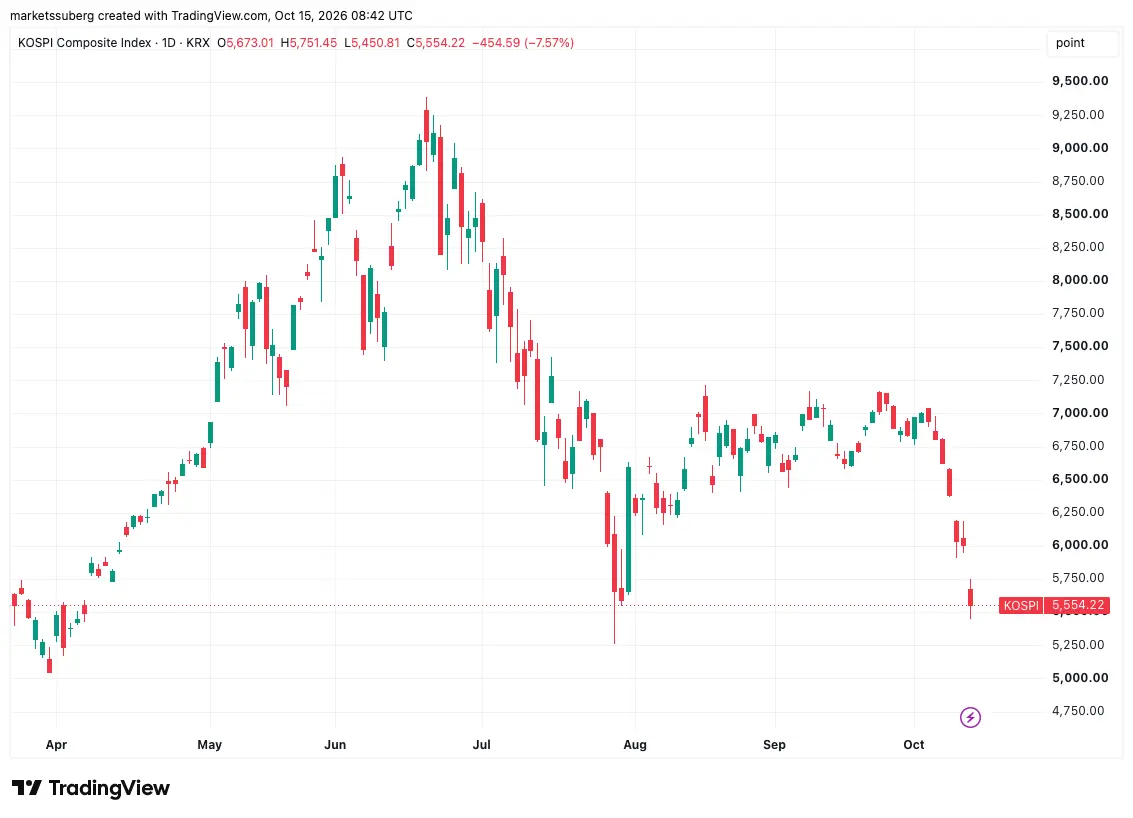
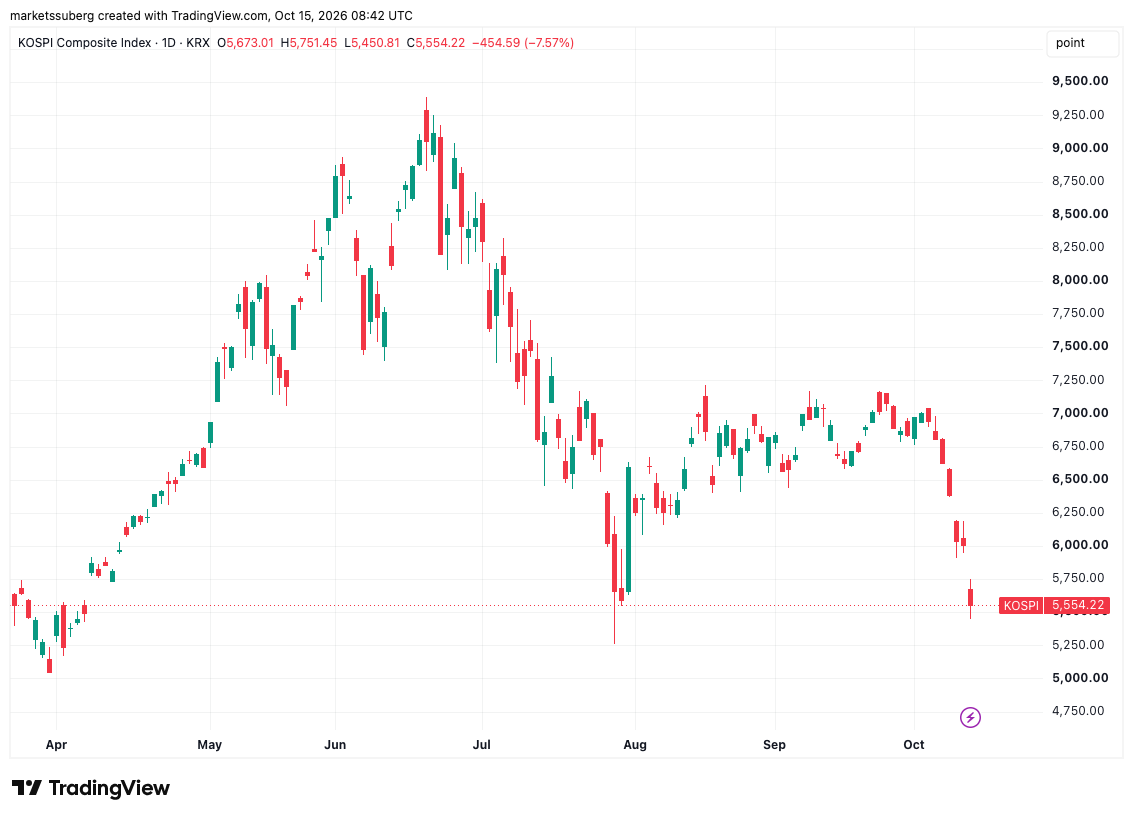
The sharp crypto pullback followed a brutal session for South Korea’s benchmark equity index. The Korea Composite Stock Price Index, commonly known as the KOSPI, finished the trading day down 7.5%. This steep single-day drop extended the index’s week-to-date losses to a staggering 15.5%, catching regional investors off guard and triggering risk-off sentiment across multiple asset classes.
As was the case earlier in the week, South Korea’s dominant technology giants bore the absolute brunt of the aggressive sell-off. Semiconductor titan SK Hynix closed the session down 11%, while industry bellwether Samsung Electronics finished 9.5% lower on the day.

Market observers and analysts have pointed to a convergence of compounding factors behind the South Korean market rout. Growing concerns over corporate artificial intelligence debt obligations, persistent foreign capital outflows, and intensifying technological competition from China have severely dented domestic market confidence.
Reflecting this profound shift in momentum, the KOSPI’s 200-day moving average dropped as low as 5,450 points during the session, marking a technical threshold not witnessed since late July. The index ultimately ended Thursday’s trading session at 5,554 points, securing its lowest daily close since April 8.
Speaking to local media publication The Korea Herald, Mirae Asset Securities analyst Kim Seok-hwan warned that persistent global macroeconomic headwinds would likely introduce further friction for investors moving forward.
"Volatility is expected to persist in the near term," Kim said, highlighting the structural challenges facing the region. "As domestic supply-demand conditions deteriorate, the market has become more sensitive to external risks, while a near-term improvement in the global environment appears unlikely."
Adding to the cautious market atmosphere, SK Hynix and Samsung are scheduled to release their third-quarter corporate earnings data on October 28 and October 29, respectively. These upcoming financial disclosures have the potential to introduce additional downside volatility into investor sentiment surrounding the technology sector, particularly if the final numbers fail to meet elevated market projections. Ahead of the reports, Samsung is widely expected to confirm third-quarter sales of 195 trillion won, equivalent to approximately $145 billion, alongside an operating profit of around 107 trillion won, or roughly $80 billion.
Oil Falls Despite Singapore Tanker Sinking
The downside pressure weighing heavily on Bitcoin was further compounded by macroeconomic developments in the United States, following Wednesday’s release of higher-than-expected consumer inflation data.
The September print of the Consumer Price Index (CPI) came in at 3.7% on a year-on-year basis. This stronger-than-anticipated reading immediately sparked a hawkish shift in market expectations regarding the future trajectory of interest rates, prompting renewed anxiety that the United States Federal Reserve might feel compelled to implement further monetary tightening.
"Does the beat force further hiking — or does credit stress prompt policy recalibration?" quantitative trading firm QCP Capital asked clients and market observers alongside its macroeconomic analysis released on Thursday.
Interestingly, even though stubbornly high energy prices accounted for a notable portion of the upward tick in the latest CPI print, both West Texas Intermediate (WTI) and Brent crude oil prices actually fell on Thursday. This decline occurred despite mounting geopolitical tensions in the Middle East, most notably following an incident in which a Singapore-registered oil tanker was sunk in the strategic Strait of Hormuz on Wednesday. The attack prompted the Maritime and Port Authority of Singapore to issue a formal statement describing the event as entirely "unjustifiable."
Despite the severe disruption to a critical global energy chokepoint, market reaction remained relatively subdued due to alternative supply routes and strategic buffers. Speaking to CNBC, Firas Bechwaty, head of business development at online trading platform ICM, expressed skepticism that transit volumes through the Strait of Hormuz would return to pre-conflict levels anytime soon, given the ongoing fallout from the broader United States-Iran conflict.
"At the same time, Saudi crude continues to reach international buyers through alternative routes, while accelerated emergency stock releases by International Energy Agency members provide an additional buffer, preventing a sharp rise in prices, even as tensions remain elevated," Bechwaty observed.
At the time of writing, WTI crude traded below $95 per barrel, reflecting a daily loss of 0.5%, while international benchmark Brent crude was down 2.2%, changing hands at $103.7 per barrel.