
Crypto protocols and open-source software projects are facing an unprecedented operational bottleneck as the widespread adoption of artificial intelligence triggers a massive surge in bogus and low-quality bug bounty submissions. Industry leaders warn that the influx of AI-assisted vulnerability reports is overwhelming development teams, severely straining their capacity to identify and remediate genuine threats to decentralized networks and digital infrastructure.
Bug bounty programs have long served as a cornerstone of cybersecurity in the digital asset sector. Operating as crowdsourced defensive mechanisms, these systems reward ethical hackers—often referred to as "white-hats"—for discovering and privately disclosing potential code vulnerabilities before malicious actors can exploit them. Because blockchain protocols manage billions of dollars in decentralized finance (DeFi) assets under immutable smart contracts, robust bug bounty initiatives are widely considered essential to safeguarding the ecosystem.
However, the rapid democratization and advancement of artificial intelligence tools have radically altered this dynamic. While AI models have made it significantly easier for security researchers to analyze massive repositories of complex code to locate potential vulnerabilities, these same tools are notorious for generating hallucinations, misinterpreting contextual logic, and churning out superficial analyses. The result is an unprecedented volume of speculative, inaccurate, or entirely fabricated security reports hitting the inboxes of protocol maintainers.
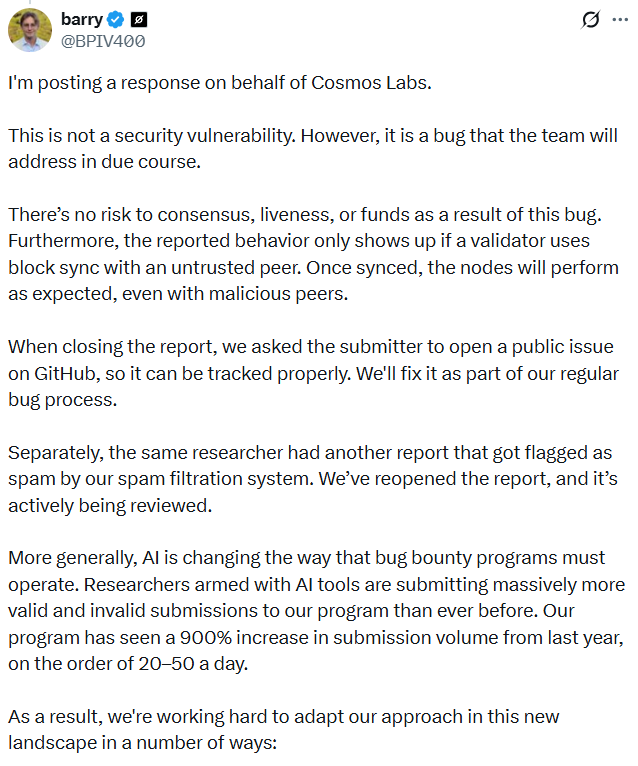
The disruptive impact of this shift was highlighted this week by Barry Plunkett, co-CEO of Cosmos Labs. Responding publicly to a bug bounty hunter who accused the protocol of ignoring a vulnerability report, Plunkett detailed the staggering administrative burden facing modern crypto projects.
"AI is changing the way that bug bounty programs must operate," Plunkett stated, noting that his organization has experienced an exponential escalation in report volume. "Our program has seen a 900% increase in submission volume from last year, on the order of 20-50 per day." He added that this dramatic multiplication in traffic has created an overwhelming tide comprising both legitimate discoveries and an immense mass of invalid noise.
This sentiment is echoed across the broader blockchain development landscape. Kadan Stadelmann, a veteran blockchain developer and the chief technology officer at Komodo Platform, confirmed that organizations throughout the industry are grappling with similar pressures. According to Stadelmann, the economic equation of vulnerability hunting has been fundamentally rewritten by automated tooling.

"There has definitely been an increase in low-quality bug bounty submissions, some of which have been false positives, potentially suggesting AI sourcing," Stadelmann told Cointelegraph. "One potential explanation is that AI has caused a decrease in the cost to produce a report, resulting in an influx of submissions."
When generating reports becomes cheap, fast, and heavily automated through machine learning scripts, the barrier to entry drops to near zero. Consequently, platforms and protocols are inundated with speculative submissions from individuals who use AI to scan codebases without conducting the rigorous, manual validation necessary to confirm whether a theoretical vulnerability is actually exploitable in a live production environment.
The strain is not confined strictly to the cryptocurrency sector; it is bleeding into critical foundational software utilized across global digital infrastructure. In January, Daniel Stenberg, the creator of curl—the ubiquitous open-source data transfer tool relied upon by countless software applications, enterprise systems, and blockchain infrastructure components—made the dramatic decision to terminate his project’s long-running bug bounty program. Stenberg cited an exhausting influx of what he termed "AI slop in vulnerability reports," explaining that he could no longer justify the grueling time and mental energy required to sift through mountains of automated nonsense to find authentic security flaws.
The broader security ecosystem is tracking similar upward trends in overall submission metrics. HackerOne, one of the world’s largest crowdsourced security and bug bounty platforms, released research data indicating that platforms processed approximately 85,000 valid bounty submissions globally in 2025. This figure represents a 7% increase from the previous year, highlighting a persistent compounding growth in participation that, when combined with AI-generated drafts, creates an unmanageable administrative load for smaller recipient teams.
AI could be both the cause and the solution
Faced with this escalating wave of automated noise, crypto protocols and open-source maintainers are being forced to rethink their security operations from the ground up. Plunkett noted that Cosmos Labs has already initiated strategic adjustments to regain control of its workflow. These changes include tightening the scoring criteria used to evaluate incoming vulnerability claims, prioritizing submissions from trusted researchers with established, verifiable track records, and partnering with specialized bug bounty management providers capable of delivering more sophisticated initial triage.
At the same time, industry veterans argue that abandoning bug bounty programs entirely is not a viable option for decentralized networks that depend on continuous external auditing. Instead, experts suggest that the very technology causing the crisis may ultimately provide the tools needed to resolve it.
Stadelmann emphasized that decentralized systems remain uniquely vulnerable because smart contracts, once deployed, are notoriously difficult to patch without complex governance procedures or migration events. Because of this high-stakes environment, blockchain projects cannot afford to simply close their doors to security researchers. However, smaller development teams face an acute existential threat if human engineers are forced to spend the majority of their working hours manually reviewing unverified AI outputs.
"Blockchain teams will have to create AI deterrents to sift through incoming bug bounties," Stadelmann said, pointing toward automated filtering as an unavoidable necessity. "The smaller the team, the bigger the problem of increased bug bounties will become. Software engineers won’t have the capacity to examine everything."
To adapt, projects will likely need to deploy defensive artificial intelligence systems programmed to automatically analyze incoming reports, cross-reference them against known false-positive patterns, and discard low-quality submissions before they ever reach human reviewers. Additionally, protocol maintainers are expected to implement much stricter submission guidelines, higher friction for new submitters, and economic penalties or reputation systems for researchers who repeatedly submit unverified, AI-hallucinated claims.
As the digital asset industry continues to mature and mature software supply chains face the growing pains of generative automation, the ability to effectively filter out the digital static will become just as critical to protocol survival as the code itself.