
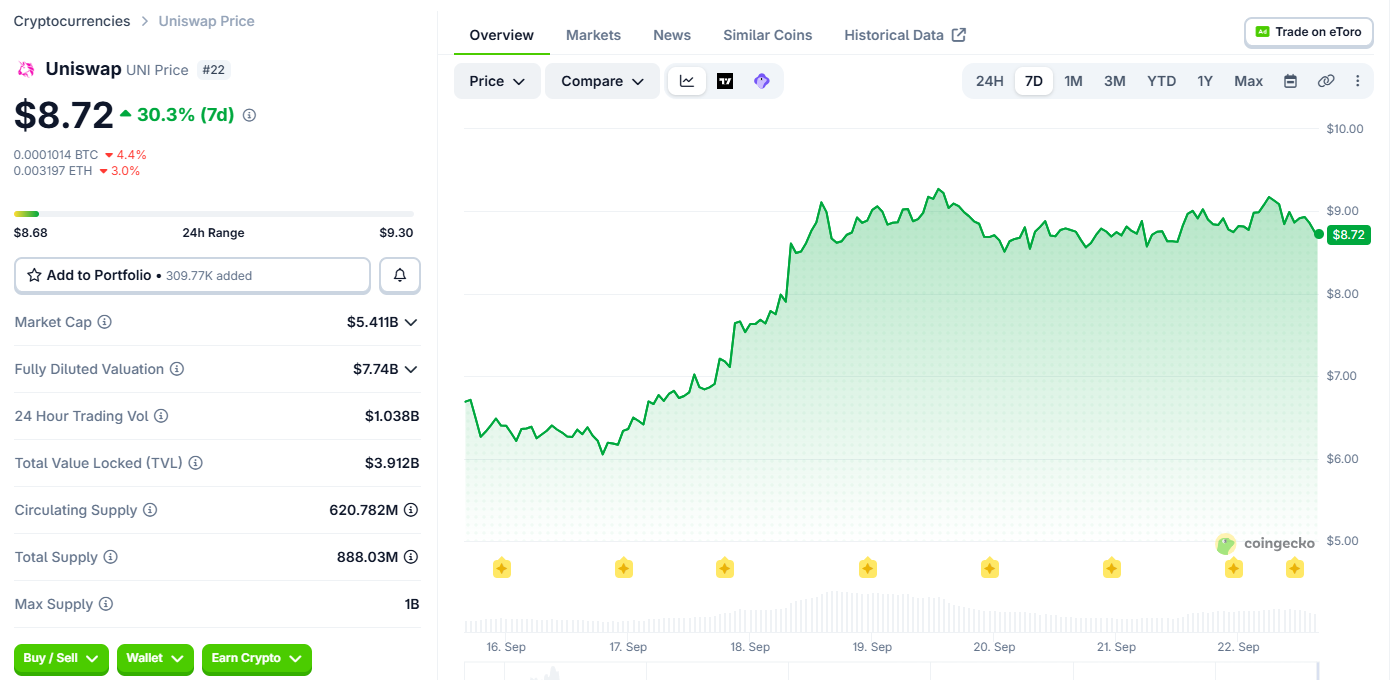
"Tokenization is coming to America," declared Robinhood Chief Executive Vlad Tenev after the United States Securities and Exchange Commission announced its landmark Innovation Exemption. The broader financial markets appeared to look quite kindly upon the regulatory development, reacting with immediate enthusiasm across the digital asset ecosystem. Bitcoin and Ether surged by more than 10% in the immediate aftermath, while Uniswap’s UNI token—representing a protocol increasingly viewed as prime real estate for potential tokenized stock trading—gained more than 30% over the following days as traders weighed the protocol’s architectural compatibility with the new rules.
While the Securities and Exchange Commission has indeed greenlit tokenized stocks in America under this fresh framework, a closer examination reveals that the vast majority of existing stock tokens currently circulating in the global market fall well outside the boundaries of the new rules.
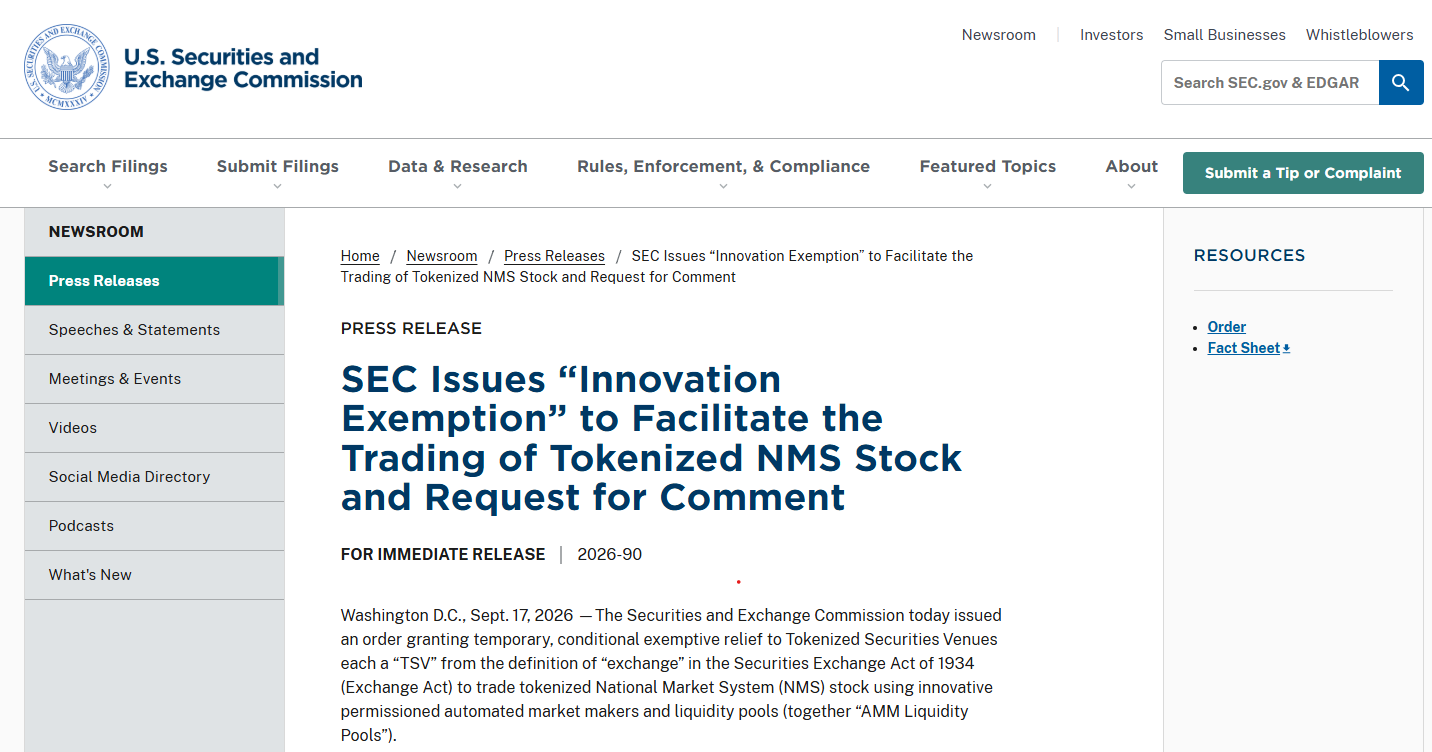
The commission’s new five-year Innovation Exemption creates a deliberate pathway for certain venues to trade tokenized National Market System stocks onchain without needing to register as a traditional securities exchange, and it allows third parties to tokenize equities under a very specific and rigorous set of conditions.
To maintain compliance, these digital tokens must grant holders the exact same legal "rights and privileges" as the underlying traditional shares, while the trading venues themselves are required to strictly permission both users and liquidity pools.
Not all tokenized stocks are created equal in the eyes of regulators. A digital token can easily look like a share and track the exact price of a share without actually providing the foundational shareholder rights of that share. Under the new SEC rules, that arrangement is classified as a synthetic stock, and it remains completely non-compliant.
That crucial distinction means some of the industry’s biggest players may already possess a structural head start, while others will be forced into an expensive and rapid game of catch-up. As Ondo Finance’s head of global regulatory affairs, Peter Curley, noted, "Not everything we do will fit, and that’s fine. What matters is that the SEC acted instead of waiting on Congress to finish the job."
The SEC’s Tokenization Lane is Narrow
The SEC’s Sept. 17 order grants specific trading venues temporary relief from having to register as traditional exchanges when they facilitate the trading of tokenized National Market System stocks through permissioned automated market maker (AMM) liquidity pools.
In other words, the regulatory agency has officially opened a lane for onchain stock trading, but it is a remarkably specific one, and the underlying architecture of the token itself becomes just as critically important as the venue where it is traded.
To qualify under the exemption, a tokenized stock must guarantee that holders receive the exact same dividends, corporate actions, and voting rights associated with the underlying security.

While a third-party entity is permitted to tokenize a stock without being directly affiliated with the original corporate issuer, the actual issuer is granted the explicit opportunity to veto or block the token before trading can legally commence.
That strict requirement effectively rules out synthetic exposure models, which represents distinctly bad news for Robinhood’s Stock Tokens and Kraken’s xStocks in their current operational formats.
Securities and Exchange Commissioner Hester Peirce stressed during statements surrounding the order that the exemption covers one particular, highly defined model rather than every possible conceptual way of trading tokenized securities, although she noted that the agency remains open to exploring other models outside of the tokenized stock venue structure.
The Products Closest to the SEC’s Model
Coinbase’s existing stock tokens appear to reside relatively close to the ballpark of the SEC’s vision.
On Sept. 14, Coinbase Chief Executive Brian Armstrong stated that the company had "set the standard" with its tokenized stocks, emphasizing that they are neither synthetic nor debt instruments, but are instead "real fully-backed securities, redeemable for the underlying shares, with dividends integrated," and voting rights "coming soon."
However, Coinbase’s current tokenized stock offering is aimed primarily at non-US customers, and its core exchange infrastructure is traditionally built around a central limit order book. By contrast, the SEC’s new exemption is purposefully built around tokenized stock venues providing permissioned AMM liquidity pools. Nevertheless, because Coinbase operates the Base network, it maintains strategic options in that regard.
Ondo Finance successfully launched tokenized US securities in June, utilizing an architecture where the underlying shares are held securely in traditional custody, while the digital token directly represents the investor’s legal entitlement onchain.
The firm also acquired Oasis Pro, bringing an SEC-registered broker-dealer, alternative trading system, and transfer agent into its corporate fold, thereby establishing infrastructure spanning both the traditional and onchain sides of the financial market.
Curley points out that the SEC’s exemption heavily favors "exactly the model we’ve already proven out: custodial, entitlement-based, with real shareholder rights and corporate actions passing through to the holder." However, he adds a note of caution, stating, "We’re not assuming anything clears automatically."
Both Coinbase and Ondo currently possess critical pieces of the technological and legal infrastructure that the SEC appears to desire. Neither company can simply assume that its existing setup qualifies without some degree of adjustment, but they likely face far less heavy lifting than competitors forced to rebuild from scratch.
Uniswap’s Permissioned Pools Could Open the Door
Because the SEC exemption is specifically engineered around permissioned AMM liquidity pools, the regulatory shift appears to represent a major net positive for decentralized finance protocols like Uniswap.
The protocol officially introduced Permissioned Pools for its v4 architecture in July, allowing regulated assets to trade seamlessly through AMMs while having compliance checks enforced directly onchain.
While that technical achievement does not automatically make Uniswap itself a formal tokenized stock venue, its v4 infrastructure could easily be utilized by external operators looking to build one. These Permissioned Pools give issuers direct control over who is allowed to trade or provide liquidity, which aligns closely with the SEC’s stringent requirements.
Permissioned access of this nature inherently requires robust Know Your Customer verification, meticulous record-keeping, public notices, and transaction transparency.
If that underlying decentralized infrastructure can be successfully bridged with the shareholder rights and regulatory reporting frameworks required for US securities trading, Uniswap potentially possesses a flexible framework that can be adapted to the SEC’s newly minted model.
Robinhood Has the Users, But Not the Right Product
Robinhood already boasts roughly 200 stock tokens trading actively on Robinhood Chain, a network which Tenev has previously described as being backed one-to-one and fully composable within the decentralized finance ecosystem.
However, Four Pillars Head of Research Jaewon Kim pointed out that the SEC’s order explicitly excludes synthetic exposure, a crucial limitation that immediately rules out popular products like Robinhood’s Stock Tokens and Kraken’s xStocks.
Robinhood’s Stock Tokens operate structurally as tokenized debt securities issued by Robinhood Assets (Jersey) Limited. This means they successfully provide economic exposure to the underlying equities, but they do not provide holders with direct legal or beneficial shareholder rights. Furthermore, these tokens are not registered under US securities laws and remain entirely unavailable to US persons.
Yet, while Robinhood’s current product does not neatly fit the SEC’s narrow rules, its massive retail user distribution and proprietary blockchain infrastructure could still grant the firm a significant competitive advantage if it decides to adapt its underlying model to meet the new compliance requirements.
Kraken’s xStocks are fully backed by underlying equities, but they similarly fail to grant holders the exact same legal rights as conventional corporate shares. Under the new guidance, simply being backed by shares is not enough to qualify for this particular regulatory exemption.
Bryan Choe, head of research and operations at real-world asset market intelligence platform RWA.xyz, notes that while most existing tokenized equity products are currently third-party sponsored, he expects a substantial market shift over the coming year.
As Choe observes, the exemption effectively "aligns the token issuers with the stock issuers," a dynamic that could ultimately bring much greater structural balance between different market issuance models.
Five Years to Prove Tokenized Stocks Are Actually Better
The SEC has explicitly described the new exemption as a temporary measure, with Chairman Paul Atkins explaining that the five-year evaluation period will allow the wider market to "develop" safely while the commission thoughtfully evaluates future rulemaking.
Beyond the corporate race to establish the first fully compliant trading venue, the ultimate test for the industry will be whether tokenized stocks can genuinely capture market share and prove their utility over legacy financial infrastructure.
As Curley emphasizes, retail and institutional investors must ultimately end up with a product that is "faster, cheaper, or more useful than a conventional brokerage position." Significant questions have already been raised across the financial sector regarding whether fragmented liquidity for stock tokens will be able to consistently provide competitive pricing or a seamless user experience.
The regulatory exemption theoretically clears the path for true round-the-clock trading, fractional ownership, instantaneous settlement, onchain composability, and uncompromised shareholder rights. Ultimately, however, those advanced technological advantages will only matter if everyday market participants find tangible value in them.