As the cryptocurrency ecosystem transitioned into the final month of 2025, the overarching mood stood in stark contrast to the speculative fervor of previous market cycles. Rather than introducing another frenetic decentralized finance (DeFi) summer or a wave of non-fungible token (NFT) euphoria, 2025 ushered in a slow, deliberate, and sober pivot toward genuine utility. The industry spent the year less concerned with chasing breakout application trends and more focused on building the foundational infrastructure required to support sustainable, real-world adoption.
Decentralized applications, commonly known as DApps, represent software programs that execute on decentralized blockchain networks instead of relying on centralized servers. Utilizing self-executing smart contracts, these applications enable users to interact directly for payments, financial services, gaming, or social media while retaining significantly greater control over their digital identities and underlying assets.
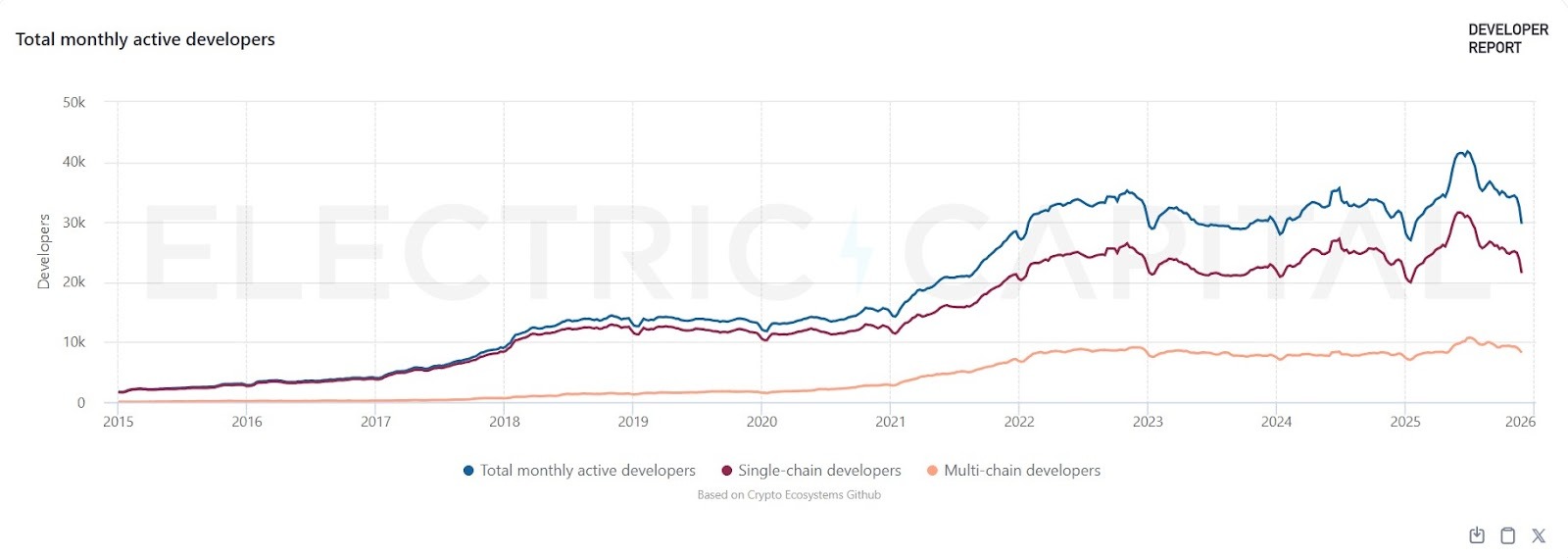
Despite the lack of explosive market manias, the pool of active builders held remarkably steady throughout 2025. Crucially, these developers shifted their operational priorities toward a much longer-term outlook. According to data compiled in Electric Capital’s Developer Report, the number of full-time crypto developers—defined strictly as contributors committing code at least 10 days per month—rose by 5% year-on-year, even as total developer headcounts dipped slightly.
This divergence indicates that speculative, transient participants have steadily waned, while a core group of dedicated professionals continues to pursue crypto development as a full-time career. In practice, this shift highlights a smaller yet considerably more committed developer base. Sustained development efforts are increasingly concentrated among long-term, well-resourced teams rather than ephemeral, short-term projects designed purely to capture immediate market hype.
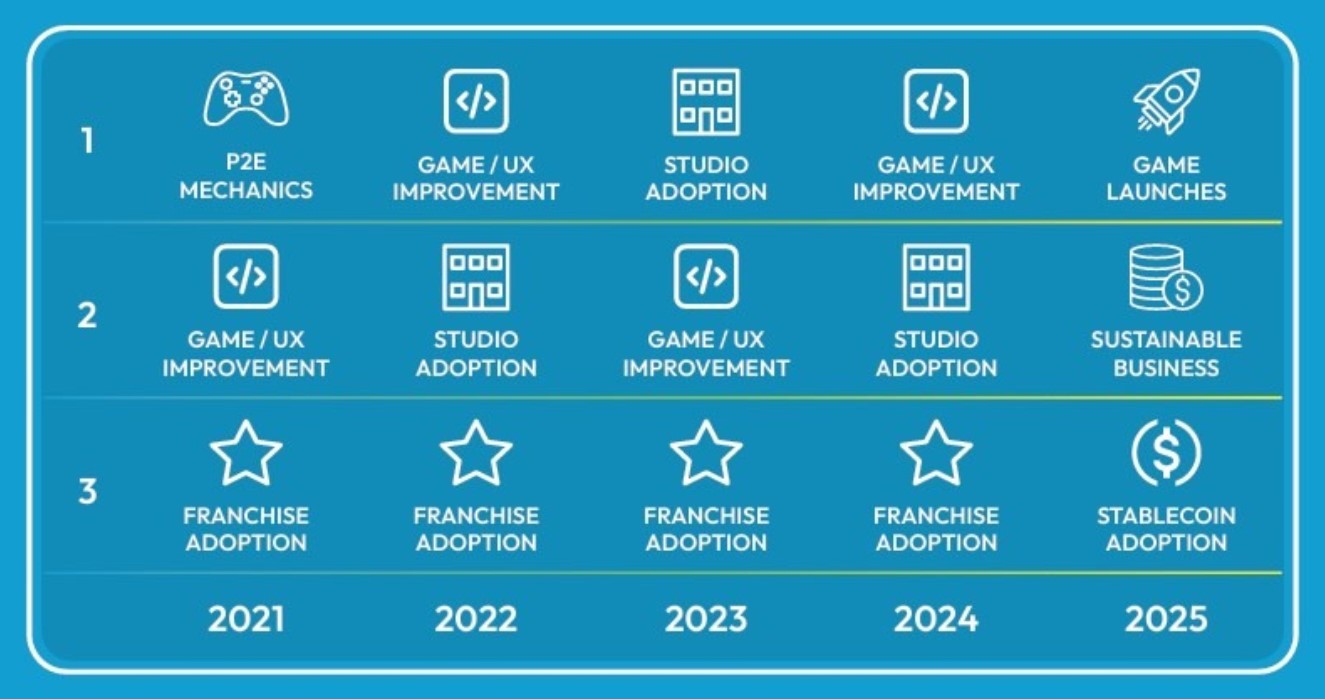
Web3 gaming developers are similarly rethinking the primary drivers of success for gaming DApps. According to comprehensive survey data published by the Blockchain Gaming Alliance (BGA), Web3 game developers are increasingly tying their long-term viability to polished gameplay experiences, sustainable monetization models, and robust economic infrastructure capable of supporting seamless in-game spending.
Consequently, builders are placing less reliance on external macro forces—such as traditional gaming giants making sweeping entries into the Web3 space—and are instead focusing heavily on controllable factors. These internal elements include the implementation of cross-chain interoperability, the integration of artificial intelligence tools, and the creation of vibrant, player-driven economies that incentivize retention through engagement rather than mere financial speculation.

If the preceding year of 2024 was primarily defined by layer-2 scaling paths and throughput optimization, 2025 firmly established itself as a year of operational preparation. Builders channeled their energy into making crypto usable for everyday audiences, systematically pushing account abstraction into active production, tightening wallet user experiences, and developing direct mobile distribution channels. Notable examples include ecosystems like Solana’s Saga hardware initiatives and The Open Network’s deep, native integration within the messaging platform Telegram.
Simultaneously, regulatory bodies across major global jurisdictions, including the United States, Europe, and Asia, established much clearer boundaries regarding stablecoins, digital asset custody, and compliance reporting. This regulatory clarity provided developers with a predictable framework within which they could safely build without constantly navigating legal gray areas. The cumulative result was a twelve-month period dedicated to establishing critical groundwork rather than manufacturing temporary hype cycles around fleeting applications.
This extensive preparation sets up 2026 as a decisive test of long-term market relevance. With the necessary developer tooling largely in place and compliance pathways streamlined, decentralized applications face a challenging and critical question: Can they successfully attract and retain everyday users without relying on unsustainable, speculative financial incentives?
While the industry spent much of 2025 heavily discussing a pivot toward utility, 2026 represents the period where those bold claims must face market reality. If everyday consumers fail to stick around once high yields fade and temporary reward pools dry up, the underlying problem will no longer be technical limitations, but rather the quality and appeal of the applications themselves.
How DApps Can Compete With Web2 in 2026
While decentralized applications spent previous years primarily competing against one another for user attention and liquidity, 2026 may well become the definitive year when they must stand shoulder-to-shoulder against entrenched Web2 applications and their massive scale.
For DApps to stand any realistic chance of capturing mainstream market share, they must systematically erase the historical barriers that have continuously caused friction for ordinary users—and this transition is already actively underway. Account abstraction is steadily moving closer to becoming the default experience across major blockchain ecosystems, enabling smart accounts that behave much more like familiar web logins than intimidating cryptographic tooling.
Furthermore, gas sponsorships—where applications pay transaction fees on behalf of the user—have dramatically reduced one of the single biggest pain points in blockchain interaction. Simultaneously, social logins and multi-party computation (MPC) wallets have successfully removed the absolute necessity for complicated seed phrases. In addition, sub-second transaction finality on high-performance blockchains like Solana and advanced modular rollups on Ethereum have successfully narrowed the latency gap between decentralized and centralized networks.
The emerging layer of autonomous artificial intelligence agents capable of interacting directly with smart contracts could ultimately make DApp usage feel significantly less like actively managing a crypto wallet and more like operating a standard, frictionless digital application.
This dynamic highlights a stark contrast between the fragmentation fatigue seen in 2025 and the consolidation trends expected in 2026. Last year frequently exposed users to thousands of isolated DApps, each demanding separate accounts, isolated assets, and convoluted user journeys that created an overwhelming cognitive load for newcomers.
Because of this historic friction, the next major evolutionary leap for the sector may stem from modular, interoperable super apps that neatly bundle multiple functional needs into a single, cohesive interface—mirroring how platforms like WeChat and Grab achieved dominant market positions in the traditional Web2 space.
Within such an environment, payments, savings protocols, and stablecoin settlement rails could sit comfortably alongside NFT creator tools, gaming assets, loyalty tokens, and decentralized social identities. This setup would allow users to transition smoothly across vastly different digital experiences while remaining safely inside a unified ecosystem. If 2025 was the year underlying protocols built the foundational architecture, 2026 will serve as the testing ground to prove whether these systems function effectively in daily consumer routines.
Which Ecosystems Are Positioned to Win in 2026?
Several prominent blockchain ecosystems enter 2026 equipped with distinct competitive advantages, spanning not only raw throughput or developer tooling, but also expansive distribution networks, reliable user funnels, and tangible real-world relevance.
Ethereum firmly retains its position as the center of gravity for smart contract development, though its software upgrades throughout 2025 remained relatively incremental in nature. Improvements tied to the Fusaka upgrade focused heavily on advancing Ethereum’s foundational data availability capabilities and its broader zero-knowledge proof roadmap.
These enhancements include early steps toward more efficient cryptographic proof systems and shared sequencing concepts rather than immediate, drastic fee reductions directly on the mainnet. Combined with the continued maturation of layer-2 rollups, these technical adjustments position Ethereum to support cheaper and faster transaction settlement over time without ever compromising its gold-standard security model.
Meanwhile, Solana continues to aggressively carve out the dominant consumer lane, powering sub-second transactions for everyday payments, in-app micro-purchases, and mobile-native user experiences that mirror traditional Web2 applications far more closely than legacy crypto interfaces.
On the other hand, The Open Network stands out by possessing arguably the strongest user acquisition funnel anywhere in the crypto industry. The massive scale of Telegram’s user base, combined with its embedded Mini Apps and seamless wallet integrations, has forged a formidable distribution channel that competing ecosystems will find exceptionally difficult to replicate.
Beyond individual layer-1 and layer-2 networks, thematic sectors are also emerging to define what could dominate the crypto landscape in 2026. Decentralized physical infrastructure networks, known as DePIN, gained massive traction throughout 2025 by firmly anchoring crypto mechanics to tangible real-world workflows such as decentralized bandwidth, compute marketplaces, mobility networks, and energy credit management.
These networks provided sustainable revenue streams that do not rely on traditional yield farming or speculative bubbles. In June, a report published by the World Economic Forum predicted that the DePIN sector could expand to reach a staggering $3.5 trillion by 2028, heavily accelerated by the simultaneous adoption of blockchain infrastructure and artificial intelligence.
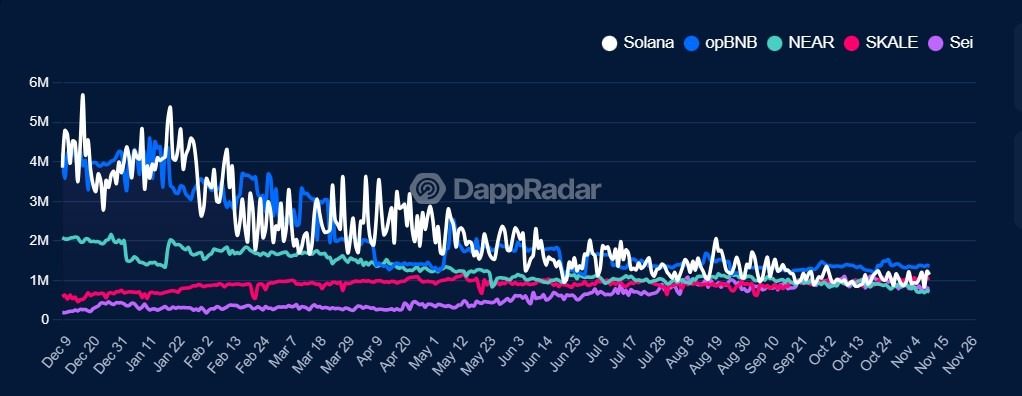
Simultaneously, creator-focused decentralized applications are maturing far beyond simple NFTs and speculation toward micro-intellectual property ownership, direct music royalties, and fan-powered monetization models. If these converging trends hold firm, the blockchain ecosystems best positioned to succeed in 2026 will likely be those that effectively combine broad distribution, robust scalability, and clear everyday use cases—capturing not just the fastest network speeds, but the highest volume of genuinely active users.
2026 Will Be a Turning Point for Utility
The cryptocurrency industry has already spent years diligently building, scaling networks, tightening cryptographic security, refining user onboarding experiences, and establishing necessary regulatory foundations to support institutional and retail developments alike.
With underlying infrastructure finally reaching consumer-grade readiness, the upcoming phase of industry growth will likely focus less on which individual blockchain can process transactions with the greatest raw speed, and far more on which practical products consumers are genuinely willing to return to without the artificial stimulant of token incentives.
If 2025 was a year primarily spent in heavy construction, 2026 is rapidly shaping up to be a critical year of evaluation—one where decentralized applications must deliver tangible practical value rather than speculative promises. The ultimate market winners will undoubtedly be those platforms that feel indistinguishable from everyday consumer applications, featuring effortless onboarding, invisible transaction fees, and stable, predictable cost structures.