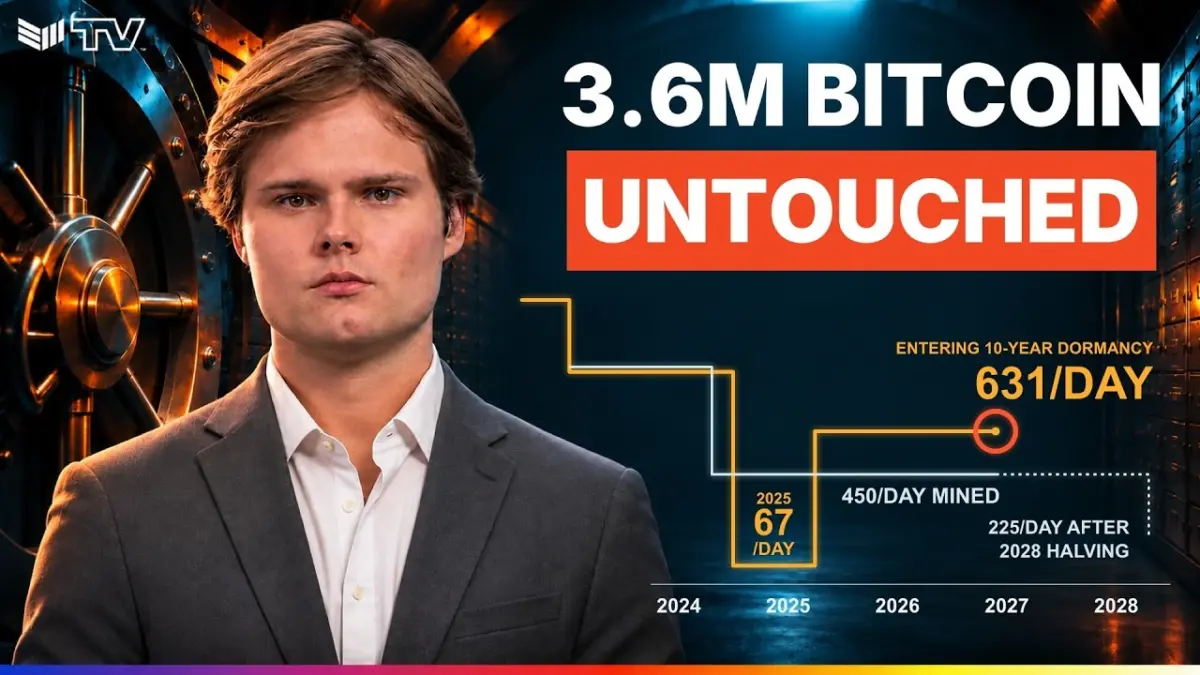
The dynamics governing Bitcoin’s circulating supply are undergoing a profound and historic shift, driven by a growing class of long-term holders whose conviction appears entirely unshakable. According to recent market analysis shared by Sean Hagan, the rate at which legacy coins are retreating into deep storage has significantly outpaced the daily issuance of newly minted Bitcoin, highlighting an evolving supply squeeze that continues to reshape the macroeconomic landscape of the digital asset.
While Bitcoin miners currently generate an average of approximately 450 new coins per day, blockchain data reveals a far larger volume disappearing from active circulation. Over the past year, an average of roughly 630 coins per day have moved into wallets that have remained dormant for a decade or more. This means that for every single newly minted coin introduced into the ecosystem by miners, approximately 1.4 coins are being systematically locked away in long-term cold storage. This stark divergence underscores a persistent trend where aging, immobile capital eclipses fresh issuance, even as the market navigates fluctuating price cycles and broader macroeconomic pressures.
To understand the weight of this trend, it is necessary to examine the foundational mechanics of Bitcoin’s supply schedule. The network operates under a strictly enforced monetary policy dictated by its code, where new issuance is cut in half roughly every four years through events known as halvings. The most recent halving reduced miner block rewards to 312.5 Bitcoin per day, which has since averaged out to the current baseline of around 450 coins daily when accounting for slight variations in block times and mining difficulty adjustments. This predictable, downward-sloping issuance curve is widely celebrated by economists and investors as a definitive counter to inflationary fiat currencies. However, the true scarcity of Bitcoin is increasingly being dictated not just by the halving schedule, but by the behavior of veteran participants who refuse to sell.
The acceleration of this deep-storage phenomenon highlights a fascinating shift in holder psychology. For a long period leading up to 2025, the accumulation trend of dormant coins experienced periods of stagnation or readjustment, as some legacy holders chose to capitalize on market highs by distributing portions of their holdings. Yet, as recent data indicates, this hesitation has given way to a renewed wave of long-term conviction. Coins that have sat untouched for ten years or more now represent a record-shattering accumulation milestone, with the so-called "10-Year Club" commanding a staggering 3.6 million BTC.
This monumental figure illustrates that a massive portion of the total circulating supply is effectively walled off from daily market liquidity. When coins remain dormant for a decade, they transition from speculative instruments into generational wealth reserves or deep-freeze assets. The sheer magnitude of the 3.6 million BTC benchmark demonstrates that early adopters and long-term believers are not only holding their ground but are increasingly treating Bitcoin as a permanent sovereign asset rather than a short-term trading vehicle.
Looking ahead, the market must also account for the looming pipeline of supply transition. The cohort of coins sitting in the seven-to-ten-year dormancy bracket represents the next wave of potential deep-storage veterans. As these coins age past the decade mark, they will further solidify the structural illiquidity of Bitcoin’s supply base. This continuous maturation of older coins creates a compounding effect, particularly when viewed in tandem with future supply reductions, such as the anticipated 2028 halving. With fewer new coins entering the market with every passing four-year cycle, the disproportionate absorption rate of dormant coins points toward a structurally tighter market.
Naturally, the movement and behavior of dormant coins invite differing interpretations from market analysts, offering both bullish and bearish lenses through which to view network activity. From a bullish perspective, the relentless absorption of supply into wallets that show no intent of selling creates a severe supply-side constraint. If institutional demand, corporate treasury adoption, and retail interest continue to grow while millions of coins remain locked away in decade-long hibernation, the basic laws of supply and demand suggest substantial upward pressure on valuation. In this view, the "Great HODL" is the ultimate vote of confidence in Bitcoin’s long-term monetary thesis.
Conversely, some market observers approach the analytics of dormant coins with caution, noting that sudden awakenings of older supply can occasionally signal distribution phases or profit-taking by early whales who possess the power to influence short-term market sentiment. However, the aggregate data over the past year suggests that the overarching vector leans overwhelmingly toward accumulation and deep freeze rather than widespread liquidation. The net flow continues to favor the vaults of long-term preservation over active exchange order books.
As the ecosystem prepares for the next phases of its monetary evolution, the interplay between miner issuance and deep-storage accumulation remains one of the most compelling metrics in crypto analytics. With historical supply vanishing into the hands of decade-long veterans at a rate that outpaces fresh production by a ratio of 1.4 to one, the structural scarcity of Bitcoin is no longer just a theoretical talking point—it is an observable, quantifiable reality inscribed onto the public ledger.