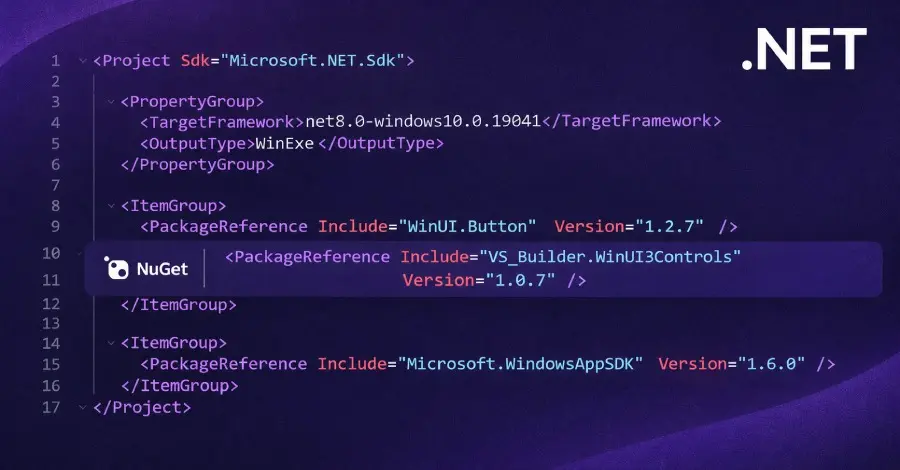
According to a detailed technical write-up by Socket security researcher Kush Pandya, the campaign revolves around a set of fraudulent NuGet packages that masquerade as standard user interface components, specifically WinUI 3 and WPF button controls. In the analyzed versions, simply building or running a project that references these packages triggers a sequence of malicious behaviors. These actions include downloading unauthorized files from GitHub, staging DLL sideloading pairs around legitimate system components such as the Microsoft On-Screen Keyboard utility, or directly downloading and executing arbitrary binaries on the victim’s machine.
The investigation revealed that a total of 13 malicious NuGet packages were associated with this campaign, all of which have since been removed from the official NuGet gallery. The timeline of the campaign indicates a persistent effort by the attackers to evade detection by continuously updating and republishing their malicious payloads. The first identified package, WinUI3IconButton, was uploaded to the registry as early as July 23, 2026. As older packages were flagged and removed by registry maintainers, the threat actors quickly adapted by releasing new iterations under different names. For instance, after NuGet removed packages under the "VS_Builder" publisher namespace in early November 2026, the operators promptly republished similar functionality under the "HappyOne" namespace.

The attack vector typically begins with a decoy GitHub repository designed to mimic a legitimate technical recruitment assessment. One such repository, created in early November 2026 under the name "stevenleedig-ux/WinUI3_Home_Assessment," presents candidates with a series of programming tasks focused on enhancing a FileButton control and improving exception handling. The assessment instructs applicants to complete the work within a constrained timeframe of three to four hours. Interestingly, the repository’s documentation even permits participants to utilize artificial intelligence development assistants like GitHub Copilot, ChatGPT, or Claude, while discouraging them from blindly copying and pasting entire solutions without understanding them—a subtle psychological tactic designed to make the assessment appear authentic and rigorous.
Within this assessment repository, the project configuration file references specific malicious packages from the threat actor’s registry footprint. Security analysis of these packages uncovered a multi-step execution chain. For example, packages shipping with MSBuild target files execute a bundled dynamic-link library after every build. This DLL proceeds to download a secondary payload from GitHub, placing it into a local application data directory alongside a copied instance of the Windows On-Screen Keyboard executable. When another component of the package launches this binary via user interaction, it triggers a classic DLL sideloading technique, allowing malicious code to run under the guise of a trusted system application.
Other packages identified in the campaign employ alternative execution methods, such as background routines that query the GitHub API using embedded access tokens to download executables into the user’s temporary directory before executing them. These methods consistently rely on deceiving developers into trusting standard UI controls that secretly harbor malicious payloads.

Beyond the .NET ecosystem, researchers uncovered deeper connections linking this campaign to broader threat actor infrastructure, including bogus repositories impersonating the popular Axios JavaScript library. These repositories served as carriers for malicious Node.js packages containing shell access and remote code execution capabilities. Commit histories across these fake repositories pointed to specific GitHub accounts, which were also observed releasing single-file .NET applications marketed as crypto wallet analyzers. These desktop applications, presented to candidates or freelancers as initial project deliverables, contained hidden loaders designed to harvest information from browser profiles and establish connections with command-and-control infrastructure.
Further investigation into the operational infrastructure revealed that the fraudulent job lure was actively advertised on a Web3 freelance marketplace in November 2026. The job listing offered a substantial financial reward for a C# WPF developer capable of building a lightweight desktop application designed to inventory installed cryptocurrency wallets and browser extensions. Social media profiles associated with the threat actor posed as Miami-based blockchain and DeFi specialists, though technical indicators revealed operational origins inconsistent with the stated locations.
While security analysts have not formally attributed the campaign to a specific named threat actor or state-sponsored group, industry experts note that the tradecraft shares strategic parallels with previous recruitment-themed campaigns observed across the cybersecurity landscape. Despite these operational similarities, specific code structures and malware families recovered in this campaign diverge from previously documented toolsets, underscoring the continuous evolution of supply chain threats targeting software engineers through social engineering and professional pretexts.