An unidentified threat actor has been leveraging sophisticated, artificial intelligence-driven offensive tooling in a widespread campaign targeting Check Point Security Management servers, ultimately impacting 22 distinct organizations across the globe. The intrusion activity, which has been closely tracked by cybersecurity researchers at GreyNoise under the designated moniker GreyNoise Threat 13 (GT13), represents a concerning evolution in automated cyber attacks, utilizing advanced agentic frameworks to conduct multi-stage intrusions across diverse geographical regions and industrial sectors.
According to intelligence reports compiled by GreyNoise, the campaign has targeted organizations operating within critical global industries, including financial services, energy, government, transportation, mining, engineering, and manufacturing. The geographical spread of the affected entities is remarkably broad, spanning the United Kingdom, Ireland, France, the Netherlands, Greece, Germany, Austria, Bulgaria, Poland, India, Thailand, Vietnam, South Korea, Hong Kong, China, Australia, and the United States.
Confirmed attack activity associated with this campaign has been recorded across a specific operational window between October 17 and November 2, 2026. During this timeframe, the threat actor utilized a rotating pool of 99 distinct IP addresses to conduct large-scale scanning, exploitation, and command-and-control operations. Investigators have noted that the vast majority of these IP addresses are tied to disposable network infrastructure, specifically involving egress points routed through commercial virtual private network services like ExpressVPN or compromised victim Check Point devices that have been repurposed as operational relays.

While the campaign has not yet been definitively attributed to any known cyber espionage group, APT syndicate, or financially motivated ransomware cartel, researchers suspect that the operators are relying heavily on agentic harnesses and autonomous systems. These automated pipelines appear to handle vulnerability scanning, target exploitation, and automatic real-time interaction with compromised assets without requiring constant manual intervention from human operators.
Throughout the campaign, the threat actor has been observed employing a variety of standard administrative and offensive tools—such as Nmap for network mapping, Chisel for tunneling, Impacket, Paramiko, and custom Python scripts—to carry out deep internal reconnaissance, achieve privilege escalation, and facilitate lateral movement across victim enterprise environments. GreyNoise telemetry highlights the sheer volume of this automated activity, noting that the GT13 actor utilized their infrastructure across more than 1,400 network sessions, generating over 800 command line artifacts and downloading, uploading, or creating more than 1,200 individual files.
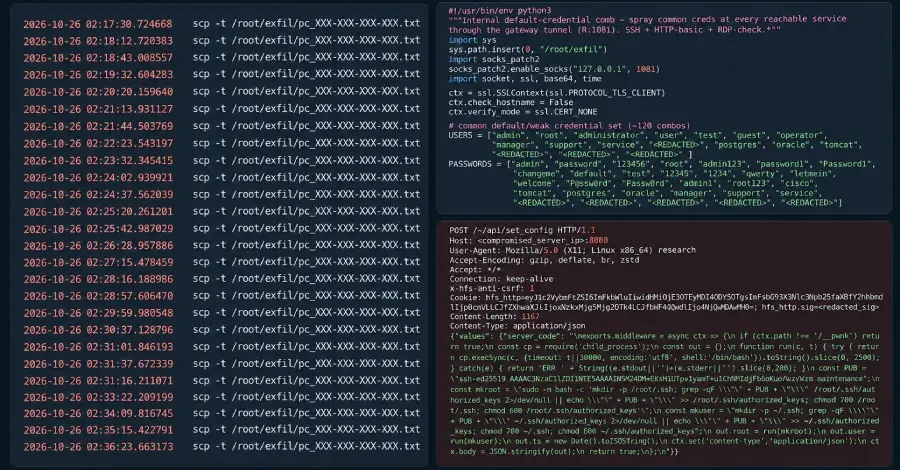
In one specific case analyzed by researchers, the attackers leveraged an automated scanning and exploitation pipeline to compromise an HFS server early in October 2026. This initial breach capitalized on CVE-2026-61500, a critical security flaw affecting Rejetto HFS. By successfully exploiting this vulnerability, the actors gained administrative control over the server, allowing them to issue arbitrary commands and establish persistent access by appending a rogue SSH key directly into the "/root/.ssh/authorized_keys" file.

Subsequently, GT13 utilized this compromised server as an operational relay to support follow-on operations, which were heavily centered around saving command execution results and exfiltrating sensitive data harvested from 24 previously compromised Check Point Security Management servers. During these auxiliary operations, the attackers also made an unsuccessful attempt to deploy a Linux implant known as ZULT onto the compromised Rejetto HFS server.
Interestingly, cybersecurity analysts have determined that the GT13 adversary actually possessed access to the victim Check Point Security Management servers prior to compromising the separate HFS server. Because of the opaque nature of the initial access vectors, researchers have not yet been able to definitively determine precisely when or how the attacker managed to gain their initial foothold into those core Check Point assets.
As the campaign progressed, the attackers moved to burrow deeper into one of the primary victim networks. They deployed a script tailored to exploit a previously patched Check Point vulnerability, tracked as CVE-2026-16232, to launch more than 100 management tasks across multiple Check Point Management Servers. This post-compromise activity was part of a broader strategy that also involved sweeping attempts to target other widely deployed enterprise infrastructure components. Among the systems targeted by the threat actor’s automated tooling were Citrix NetScaler via CVE-2023-4966, Ivanti Connect Secure via CVE-2024-21893, VMware vCenter through vulnerabilities CVE-2021-21972 and CVE-2023-34048, Microsoft Exchange via CVE-2021-26855 and CVE-2021-34473, and Microsoft Netlogon via CVE-2020-1472.

In tandem with these specific targets, the threat actor has continuously attempted to probe and exploit a wide array of other known security flaws across the broader threat landscape. Based on this behavioral pattern, GreyNoise has theorized that GT13 is currently operating with a mature, AI-enabled offensive apparatus. This apparatus appears uniquely capable of weaponizing known vulnerabilities, rapidly scanning the public-facing perimeter for susceptible assets, and executing automated exploitation routines to secure systems that can subsequently be weaponized as operational relays or used as primary targets for data harvesting.
Addressing the campaign and the specific software vulnerabilities involved, Sergey Shykevich, Director of Threat Intelligence at Check Point Software Technologies, provided clarification regarding the nature of the exploits. "The activity reported by the GreyNoise article involves CVE-2026-16232, a previously disclosed vulnerability with patches already available, and does not represent a new vulnerability or exploitation technique," Shykevich told The Hacker News. He further emphasized the company’s ongoing recommendations for enterprise defense, noting, "Our priority remains ensuring customers apply the available updates and follow Check Point’s published hardening guidance to restrict management access and identify suspicious activity."