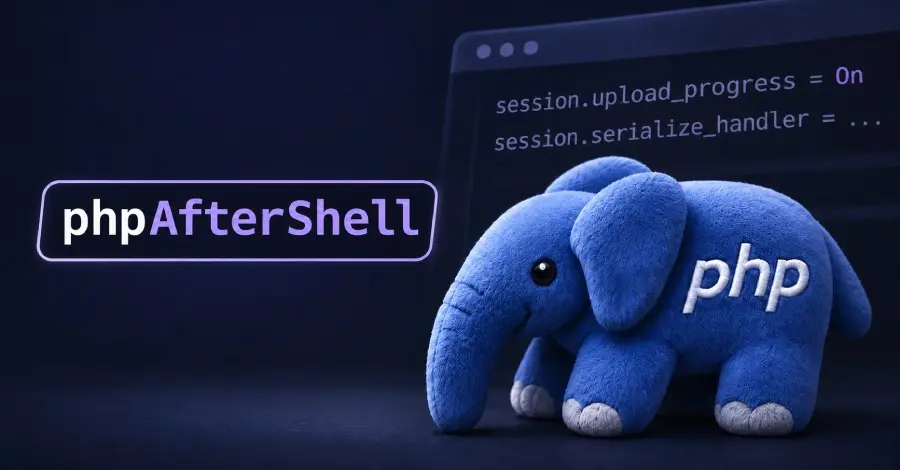
PHP maintainers have rolled out a comprehensive set of security updates to address a critical flaw in the language’s default file-based session storage mechanism. Tracked as CVE-2026-126714 and branded as "phpAfterShell," the vulnerability carries a severity rating of 9.2 out of 10 on the CVSS 4.0 scale. When successfully exploited in combination with a secondary weakness—such as a suitable gadget chain within an application—the flaw can enable malicious actors to execute arbitrary code on vulnerable servers.
The vulnerability was discovered by cybersecurity firm Depthfirst, which promptly reported the issue to the official PHP maintainers. Although emergency patches were previously released on October 21 to mitigate a related set of critical flaws known as "PHP2Shell," those updates did not fully resolve the underlying mechanics that enable phpAfterShell. As a result, servers that were patched during the October cycle remain vulnerable until administrators apply the latest round of software releases. At the time of disclosure, neither the maintainers nor the security researchers had observed any active exploitation of phpAfterShell in the wild.
Understanding the Mechanics of phpAfterShell
The root of the vulnerability lies within PHP’s native files session handler, which serves as the default storage mechanism for user sessions across countless web applications. Alternative session stores, such as Redis or external database systems, are not directly impacted by this specific file-handling defect, though administrators utilizing alternative backends must still evaluate how those platforms handle interrupted or cut-off data updates.

According to Depthfirst’s technical analysis, the attack relies on manipulating session writes that occur before an application’s custom code even begins to execute. A standard PHP session file records data by storing variable names alongside their respective serialized values. Because these records depend on strict length fields to dictate where strings end, and because native files lack an explicit transaction marker to signify a completed write, an interrupted process can leave a session file in a dangerously fragmented state.
PHP implements file locking mechanisms during write operations, but a lock cannot automatically reverse a write that is forcibly terminated midway. If a worker process dies abruptly—such as through a hard memory-limit failure in a threaded environment—the underlying file can retain the beginning of the newly written data combined with the stale tail of the older data. By carefully calibrating the length parameters within the incoming data stream, an attacker can trick the system into interpreting harmless text from the older record as an entirely new data structure, including a serialized object.
When a subsequent request calls the session_start() function, PHP loads this corrupted record and instantiates the injected object. While the researchers demonstrated that a harmless built-in object like stdClass could be successfully planted to prove the concept, a full compromise requires additional vectors. Specifically, code execution depends on leveraging a gadget chain within the application, or alternatively, exploiting underlying memory corruption flaws within PHP’s built-in classes. The researchers noted that their own testing successfully bypassed application-level gadgets entirely by utilizing a secondary memory corruption bug, details of which are currently being withheld pending coordinated disclosure.
Attack Vectors and the Role of Upload Progress
The path to triggering an interrupted session write can vary, but researchers identified upload progress as a prominent vector. Upload progress is a native PHP feature designed to track the status of file uploads within a user’s active session. When this feature is enabled, a specially crafted multipart form upload containing the appropriate progress field forces PHP to write to the session data file before any application-level scripts are processed. Consequently, an attacker does not need access to a dedicated file upload page; any public-facing page that eventually invokes session handling can serve as an entry point.

The previous PHP2Shell patches implemented in October attempted to restrict which object classes could be loaded while PHP recorded upload progress. However, those measures focused strictly on limiting class instantiation during the write phase rather than fixing the underlying file write mechanics. Because the malformed object data could still be written to disk, it would quietly become active later during ordinary application requests that subsequently called session_start().
Furthermore, the researchers cautioned that this technique is not strictly limited to executing remote code. The same manipulation can be leveraged to overwrite ordinary session variables prior to application verification checks, potentially allowing malicious actors to alter user permission levels, manipulate authentication states, or subvert cross-site request forgery (CSRF) protections.
Affected Versions and Immediate Remediation Steps
The security advisory issued by PHP maintainers confirms that multiple active branches are affected by CVE-2026-126714. Specifically, installations running versions of PHP 8.2 prior to 8.2.36, PHP 8.3 prior to 8.3.37, PHP 8.4 prior to 8.4.28, and PHP 8.5 prior to 8.5.13 require immediate updates. In addition, PHP 8.6.0 has been released with the necessary fixes integrated into the codebase. Older iterations, including PHP 8.1 and earlier, have reached end-of-life status, though official security maintenance branches for legacy versions are similarly impacted if unpatched builds are deployed.
To address the vulnerability comprehensively, system administrators are strongly encouraged to update their PHP installations to the latest respective fixed versions. Once applied, the updated releases modify the session handling logic to clear session files prior to each write operation and halt execution if the clearance step fails. While an interrupted write may still result in lost session data, it can no longer preserve stale data fragments that attackers rely on for object injection.

As part of the defensive updates, PHP maintainers have also chosen to disable the upload progress feature by default across newly released versions. A direct comparison of source code between the October patches and the current releases reveals that built-in settings governing upload progress have been switched off in the updated packages. Applications that genuinely rely on upload progress functionality will need to manually re-enable the feature within their configuration settings after applying the updates.
For organizations that cannot immediately apply the software patches, temporary mitigations are available. Administrators can disable the vulnerable feature by explicitly setting session.upload_progress.enabled = 0 within their php.ini configuration file or server settings, followed by restarting all associated PHP worker processes. Additionally, developers should audit their codebases to minimize the storage of untrusted or user-controlled data within sessions.
Security experts emphasize that switching off upload progress is merely a partial defense that closes a specific entry point; applications that introduce attacker-controlled data into sessions through alternative mechanisms remain at risk until the core software updates are installed. Organizations relying on Linux distribution packages should also verify whether their package maintainers backported the security fixes independently, as version numbers alone may not fully reflect the security posture of a given server deployment.