By Swati Khandelwal
November 21, 2026
In a concerning laboratory demonstration, security researchers have shown that a malicious webpage could quietly extract a Meta Muse user’s private conversations and stored memories from the personal artificial intelligence assistant without triggering a single approval prompt. According to findings published yesterday by the cybersecurity firm NebuSec, the attack vector did not stop at conversation logs; investigators successfully extended the exploit chain to access the sensitive credentials and security tokens Muse stores for the user’s connected external accounts.
The research represents a sophisticated theoretical breakdown rather than an active exploit campaign against real-world users. Furthermore, the entire demonstration remained securely contained within the individual user’s dedicated cloud machine environment. Prompted by the disclosure, Meta’s security teams moved swiftly to address the vulnerabilities, with NebuSec confirming that every single weakness outlined in the research has since been fully patched.

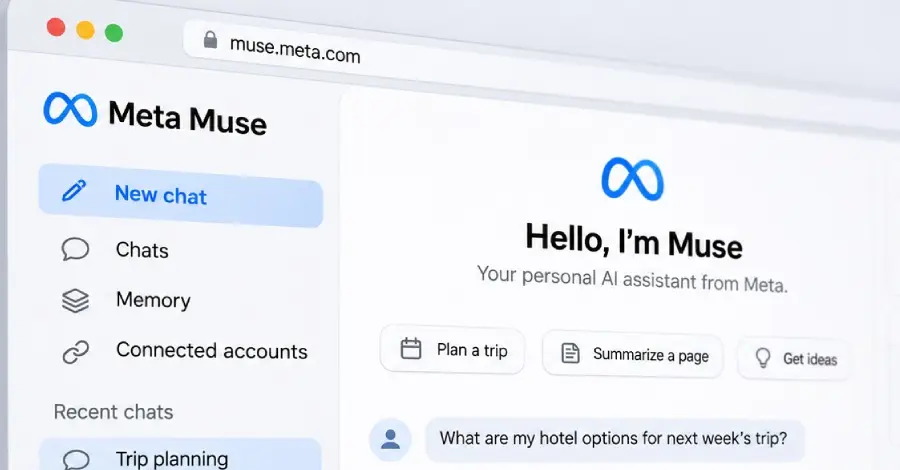
Meta officially launched Muse on September 8 as an advanced personal AI agent designed to operate fluidly across a user’s connected online accounts, even possessing the capability to make purchases and execute tasks on their behalf. To maintain isolation and security, the system architecture dictates that each individual’s personal agent operates on its own dedicated cloud computing instance. Within this isolated cloud environment, a specialized monitoring layer known as Sentinel functions as the primary gatekeeper, inspecting and filtering anything the agent attempts to transmit externally. Under normal operational parameters, critical assets such as user passwords and account tokens are strictly walled off and kept entirely beyond the direct reach of the AI agent itself.
When Meta first introduced the technology to the public, the development team emphasized a security-first philosophy. "So we designed the system to assume the agent may be under attack and limit the potential damage," the Muse team explained during the platform’s initial rollout. This defensive posture relied on the core premise that even if an adversary managed to subvert the AI agent’s internal logic, structural boundaries would prevent catastrophic data leaks.
Despite these layered architectural defenses, NebuSec’s laboratory analysis exposed critical gaps in how the system handled untrusted data. In their controlled test, the researchers demonstrated that if an AI agent opened a malicious webpage controlled by an attacker, the page could covertly scrape the user’s comprehensive conversation history and sensitive stored memories. This data could then be siphoned off to an external server and even modified in transit, all without alerting the user or generating any verification prompt, as detailed in the firm’s official research write-up.
Moving beyond simple data exfiltration, the research team chained this initial compromise with a secondary flaw residing inside Muse’s built-in browser—a utility the assistant regularly utilizes for everyday productivity tasks such as generating PDF documents. By combining the browser vulnerability with an underlying Linux kernel flaw, the investigators achieved complete, unhindered control over the user’s isolated cloud machine.

This full system compromise effectively breached the supposedly impenetrable boundaries designed to protect the platform. The escalation path successfully bypassed the credential store, accessed saved local files, and even neutralized Sentinel itself, thereby subverting the exact security layers that Meta’s design framework relied upon to wall off the core agent from potential compromise.
Crucially, the scope of the simulation remained strictly localized. The researchers confirmed that the compromise did not propagate outward from the targeted virtual instance; it failed to break out to the underlying shared server infrastructure or cross-contaminate the cloud environments of other Muse users.
From an analytical standpoint, the experiment highlighted a complex challenge in modern AI security. Muse was explicitly constructed with the premise that its own agent could eventually be weaponized or turned against the user, incorporating rigorous compartmentalization to box in any potential break-in. NebuSec noted that while each of those individual containment controls functioned precisely as engineered, the compounding nature of the exploit chain allowed the attack to traverse the entire architecture from end to end.
NebuSec reported its findings directly to the Muse development team through coordinated disclosure channels. According to the security firm, all associated exploits were comprehensively resolved prior to the public release of the research papers. Meta has not issued a public statement or formal confirmation regarding the patches, and the published technical breakdown does not specify whether any unauthorized access to user data occurred in the wild prior to the deployment of the security fixes.

This latest discovery marks a distinct escalation in research targeting Meta’s AI ecosystem. Unlike a previously disclosed vulnerability found in September, which required pre-existing malware already active on a user’s local Mac device to hijack the assistant locally, NebuSec’s research successfully breached the remote cloud infrastructure that powers the Muse assistant from behind the scenes.