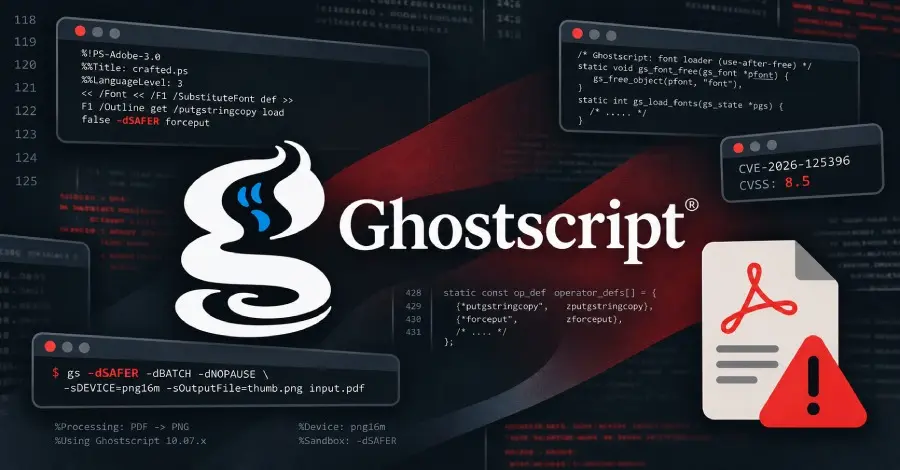
A severe security flaw discovered in Ghostscript, the widely utilized interpreter for processing PDF files, PostScript documents, and images on Linux servers, has exposed numerous applications to remote code execution risks. Tracked as CVE-2026-125396, the vulnerability enables specially crafted files to successfully break out of the software’s security sandbox, allowing unauthorized command execution on the underlying host processing the data.
Security researchers at pwn.ai publicly demonstrated the exploit vector, revealing that routine features integrated into approximately ten common applications—such as file uploads, image previews, and print functions—can be inadvertently manipulated to feed malicious documents into the interpreter. Although Artifex, the developer behind Ghostscript, swiftly released a patch to remediate the issue, the discovery underscores the precarious nature of indirect software dependencies in modern server architecture.
The core danger of the vulnerability lies in how frequently Ghostscript operates invisibly behind the scenes. Many applications do not invoke the interpreter directly. Instead, common document and image processing libraries—including ImageMagick, Pillow, libvips, and various Qt plugins—routinely hand off PostScript or EPS content to Ghostscript for rendering, regardless of whether the file extension is disguised as a standard PNG, JPEG, or PDF. Routine server operations like generating image thumbnails, cropping pictures, or processing print jobs can inadvertently trigger the interpreter, setting off a chain reaction dictated entirely by the specific libraries embedded within the host application.

At the technical root of the incident is a use-after-free memory vulnerability residing within the font-loading component of Ghostscript. A meticulously structured malicious document exploits this memory flaw to systematically disable the security checks enforced by -dSAFER. This specific flag acts as the primary sandbox barrier designed to prevent incoming files from executing arbitrary system commands or accessing unauthorized local files on the server.
During their security testing, researchers fed crafted documents through roughly ten different applications, successfully triggering remote commands on the target servers each time. Crucially, these commands executed under the privileges of the low-privileged account normally assigned to handle routine rendering tasks.
Several of the identified attack paths required no user authentication whatsoever. Among them were anonymous print jobs sent directly to shared Debian 13 print queues, incoming email attachments processed automatically by Roundcube webmail the moment a recipient opened a message, and public upload interfaces housed within popular WordPress extensions like the Forminator and Essential Addons for Elementor plugins.
Meanwhile, WordPress Core required a slightly higher threshold of interaction—specifically an authenticated account possessing file upload capabilities, a privilege granted by default to user roles such as Authors and above. Although official vulnerability classification frameworks categorized the issue as a local flaw, the empirical tests conducted by pwn.ai proved that attackers could reach the Ghostscript interpreter entirely from the network through standard web uploads, emails, and print requests. The precise tested versions and distinct access requirements for each vulnerable application have been documented in the research firm’s impact index.

Artifex moved quickly to address the architectural weakness, issuing a fix in Ghostscript version 10.08.0 on September 8. The update migrates the vulnerable internal code path into a safer architectural framework. Ken Sharp, the developer responsible for overseeing the fix, acknowledged in official bug tracking reports that the problematic routine was an ancient piece of code long recognized as a historical vulnerability, albeit one that proved exceptionally difficult to eradicate entirely. Security advisories subsequently assigned the vulnerability a severe CVSS score of 8.5 out of 10.
Before the official Ghostscript patch was deployed, WordPress had independently closed its own specific upload vector in version 7.0.4 on August 12 under a separate identifier, CVE-2026-65640. Security analysts have emphasized that because the WordPress fix and the Ghostscript patch target entirely different points within the same overarching execution chain, applying just one update does not eliminate the underlying risk, necessitating comprehensive updates across the entire software stack.
Mitigating the threat presents unique logistical challenges for system administrators, primarily because updating the host operating system does not automatically patch separate copies of Ghostscript that may be bundled internally inside container images or isolated application environments. Consequently, a document processing worker can easily continue running vulnerable legacy code long after the host package itself has been refreshed.
Furthermore, vulnerability coverage across various Linux distributions has proven uneven. Security surveys conducted shortly after disclosure indicated that several operating system distributions still shipped with vulnerable versions of Ghostscript or had official patches pending implementation. Testing confirmed that package status updates varied widely, while the status of packages across Red Hat, Rocky Linux, AlmaLinux, Oracle Linux, and stable Fedora distributions remained unverified by the research team at the time of publication.

Until comprehensive renderer updates can be reliably deployed across all affected environments, administrators can significantly reduce their exposure by enforcing strict authentication requirements on shared print queues and heavily restricting the specific file types accepted by underlying image processors. System-level security controls have also proven effective as a secondary defense layer; during testing, properly configured AppArmor profiles successfully prevented compromised interpreters from spawning unauthorized command shells.
A published proof-of-concept file detailing the research demonstrated the core memory manipulation technique by modifying and subsequently restoring an internal value within the running interpreter without launching external shell commands or interacting with host files. Against the patched version 10.08.0, this proof-of-concept fails well before reaching the vulnerable execution stage.
Beyond standard server software, the scope of the firm’s research also touched major production web services, including Google, which successfully remediated the affected processing path. Researchers noted that separate reports involving similar vulnerabilities at Dropbox and other unnamed technology services stemmed from distinct Ghostscript bugs rather than this specific vector.