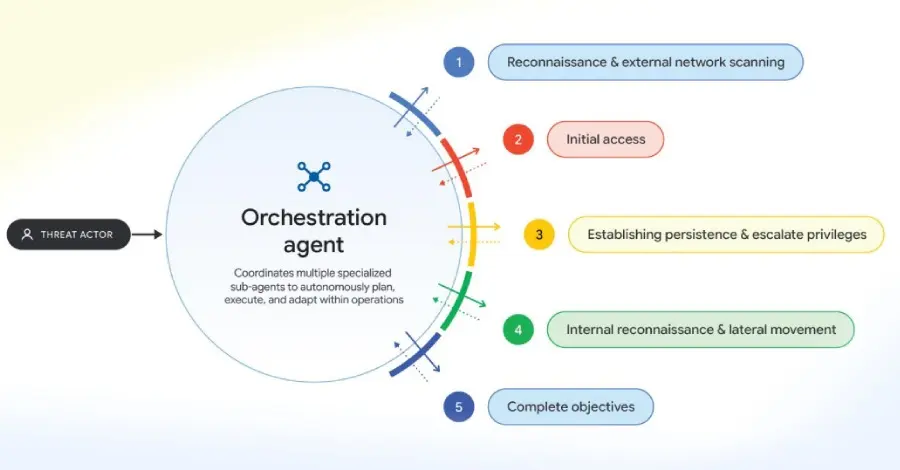
The adversarial use of artificial intelligence has crossed a significant operational threshold, shifting away from basic manual prompting toward the deployment of autonomous, multi-agent offensive frameworks that execute complex cyber intrusions at machine speed. According to a comprehensive threat intelligence report released on Monday by the Google Threat Intelligence Group (GTIG), malicious actors are increasingly leveraging large language models and agentic architectures to automate multi-stage attacks, dramatically scaling their capabilities and compressing the timeline between vulnerability disclosure and active exploitation.
The evolution marks a profound paradigm shift in modern cybersecurity. While the underlying mechanics of network intrusions and software exploitation remain fundamentally similar to past tactics, the integration of autonomous agents allows threat groups to chain together varied attack paths, scale operations significantly, and execute discrete phases of an attack with minimal human intervention. Google’s researchers noted that a diverse range of threat actors—spanning financially motivated cybercriminal syndicates to suspected state-sponsored espionage groups aligned with China—have begun experimenting with these advanced harnesses and frameworks.
Among the prominent tools identified in the GTIG report are autonomous open-source offensive frameworks such as ARTEX, CAIRN, CyberStrikeAI, and PentAGI. These frameworks are being abused by malicious actors to automate specific operational tasks and discrete phases during live intrusions. Additionally, threat groups are utilizing infrastructure components like ZeroHollow, a specialized inference service heavily relied upon for rapid exploit development and intelligent LLM routing, alongside Agent Zero, an open-source agent framework characterized by its autonomous code execution capabilities and dynamic tool generation.
Beyond live network intrusions, a critical area of concern involves the weaponization of LLM-driven pipelines to automate labor-intensive tasks such as vulnerability analysis and proof-of-concept development. This capability was vividly demonstrated earlier this September during attacks leveraging PaperCut NG/MF flaws. By deploying LLMs to perform differential analysis, threat actors can rapidly reverse engineer software patches shortly after they are made public.

This automated approach allows attackers to collapse the window of vulnerability management. Rather than conducting exhaustive manual research, bad actors can focus their computational resources on a finite and targeted set of source materials. This includes comparing software source code versions across preview and pre-release channels, as well as scrutinizing release notes, security advisories, and newly published proof-of-concept code related to specific software flaws. Consequently, organizations face drastically reduced windows to patch their systems before automated exploitation vectors are deployed against them.
The democratization of these advanced capabilities through open-source frameworks has effectively lowered the technical barrier to entry. This shift enables lower-skilled threat actors to easily integrate new exploits, autonomously scale their operations, and mount highly convincing phishing campaigns. Google highlighted a Chinese-language phishing platform known as Jieyou, which has integrated an innovative LLM chatbot assistant designed to streamline the creation of deceptive digital infrastructure.
The Jieyou platform allows customers to configure sophisticated phishing panels and modify existing templates using simple natural language commands, removing the prerequisite of deep technical expertise. This evolution highlights a broader, troubling industry trend where Phishing-as-a-Service providers are successfully weaponizing LLMs as modular force multipliers. Instead of manually writing and editing malicious payloads, less experienced affiliates can now dictate their requirements through conversational interfaces, dynamically customizing pretext lures and phishing user interfaces on the fly.
In tandem with orchestrating attacks using AI, threat actors are also directly targeting the underlying infrastructure of artificial intelligence to generate illicit profits. Google’s security researchers have warned about a surge in "LLMjacking" attacks. In these scenarios, malicious actors infiltrate enterprise environments to steal sensitive LLM credentials and hijack valuable cloud computing resources. Once acquired, this unauthorized access is resold through underground proxy services and specialized marketplaces—known colloquially as LLM mixers—such as APIMart and JetNight, where compromised computing power is traded at heavily discounted prices.
The findings compiled by the Google Threat Intelligence Group underscore an increasingly complex and fast-moving threat landscape. As cyber adversaries continue to refine and adopt agentic AI frameworks, security teams must contend with automated attacks that operate with unprecedented velocity and scale, necessitating an equally adaptive and automated defense strategy across the global digital ecosystem.