Government cybersecurity agencies across Europe have issued urgent warnings urging operators to immediately disconnect commercial refrigeration management interfaces from the public internet. The advisory follows the discovery of six severe vulnerabilities in widely used Danfoss refrigeration controllers, flaws that could potentially allow remote attackers to execute arbitrary code with root privileges without requiring any authentication.
The security weaknesses were uncovered by researchers at Midnight Blue, a Dutch security consultancy. According to the firm, the newly identified flaws affect the Danfoss AK-SM800A system, a specialized hardware controller responsible for managing large-scale commercial refrigeration units, including industrial fridges and freezers found in supermarkets and cold-storage facilities. Maintenance firms frequently rely on these management interfaces to oversee temperature controls and system operations remotely.
However, the discovery of these zero-day flaws has heightened concerns across the critical infrastructure and retail sectors. Cybersecurity authorities in Belgium, Ireland, and Germany have stepped forward to warn facility operators that leaving these management interfaces exposed to the open internet creates an unacceptable risk of remote takeover. Furthermore, researchers and regulatory bodies have confirmed that no official software patch is currently available to resolve the issue, leaving disconnection as the primary immediate defense.
Growing Threat Landscape and Recent Attacks
The security warnings arrive amid a troubling backdrop of cyberattacks targeting supermarket cooling systems across Europe. Over recent weeks, commercial refrigeration infrastructure has increasingly found itself in the crosshairs of malicious actors. On October 11, attackers targeted refrigeration controllers at a French supermarket, triggering unauthorized defrost cycles that intentionally ruined perishable stock and disrupted store operations.
A second wave of coordinated cyberattacks struck similar facilities across Europe just last week. Germany’s federal IT security agency, the BSI, noted in a formal security advisory that the AK-SM800A controllers were implicated in these earlier multi-country incidents where commercial refrigeration units were unlawfully manipulated.
While government agencies and security researchers have emphasized that there is currently no evidence linking the six newly discovered Midnight Blue vulnerabilities directly to the recent French or pan-European supermarket attacks, the timing has intensified industry-wide anxiety. Previous incidents primarily affected older models that no longer received regular security updates or modern units running outdated legacy firmware. Nonetheless, the vulnerability of cold-chain infrastructure has proven to be a lucrative and disruptive vector for malicious actors seeking to cause physical and financial damage.

Deep Dive Into the Controller Flaws
Midnight Blue researcher Carlo Meijer identified all six vulnerabilities in less than an hour of manual review, utilizing publicly available firmware downloaded directly from the vendor’s support portal. The investigation focused primarily on firmware version 5.3.2, which was the newest release available at the time of the analysis, though researchers confirmed that every preceding version up to that point is similarly impacted.
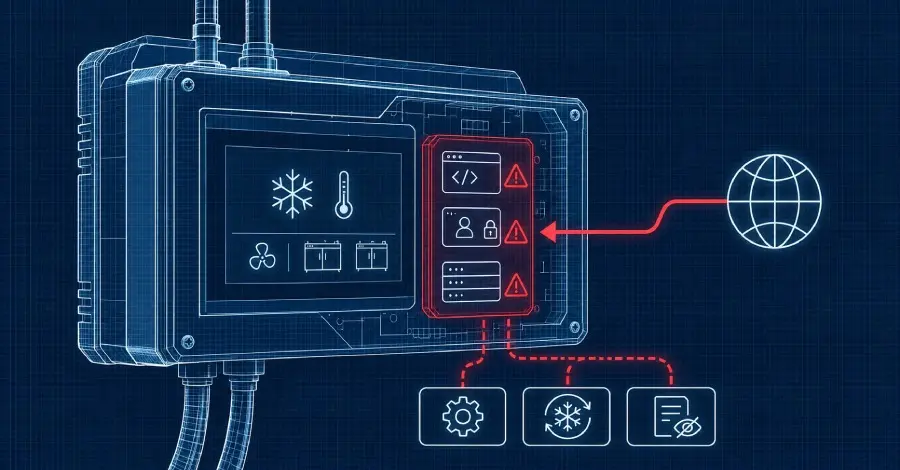
Five of the six vulnerabilities reside directly within web request handlers that process incoming traffic without requiring a user to log in. These handlers operate within a program running with total root privileges. By exploiting just one of these unauthenticated handlers, researchers successfully executed arbitrary code as root during testing on older firmware version 3.3.0, and subsequently verified that identical bugs persist in version 5.3.2.
To mitigate such risks, Danfoss previously introduced a security feature known as "Strict mode." When activated, Strict mode is designed to close nearly all of the controller’s external web attack surface to unauthenticated users, forcing encrypted connections and validating session tokens before allowing access. However, Midnight Blue’s analysis revealed that the sixth vulnerability targets the gateway program itself—the very security component responsible for enforcing Strict mode by blocking unauthorized web traffic.
During testing, when researchers ran firmware 5.3.2 inside a controlled emulator with Strict mode actively enabled, the sixth flaw triggered a complete crash of the gateway. The research team noted that this crash condition could potentially be weaponized into full remote code execution with additional engineering effort. Compounding the risk, the gateway program itself lacks basic modern binary exploitation defenses, such as stack canaries.
With unrestricted root access to a refrigeration controller, an adversary could systematically alter operational parameters, initiate unauthorized defrost cycles to spoil inventory, and deliberately manipulate or erase system activity logs to cover their tracks. Moreover, researchers discovered that the AK-SM800A controllers lack secure boot functionality. This architectural limitation means an attacker could plant persistent malicious code capable of surviving both standard factory resets and subsequent firmware updates, potentially rendering the affected hardware entirely unusable until physical replacement.
Vendor Response and Firmware Limitations
Danfoss offers a software update package, version 5.4.0, dated November, which represents the most recent firmware release for the AK-SM800A line. However, Midnight Blue and independent analysts have confirmed that version 5.4.0 fails to patch the six newly disclosed vulnerabilities.

According to file timestamps analyzed by researchers, the 5.4.0 firmware build was compiled on October 29. This date falls squarely after the second wave of European supermarket cyberattacks and significantly before Midnight Blue formally disclosed its technical findings to the manufacturer. While the accompanying release notes and November update guide detail upgrade instructions and introduce a stricter default password policy, they contain no mention of a fix for the underlying remote code execution flaws.
The BSI initially stated in a public press release that firmware version 5.4.0 was unaffected by the issues, but later issued a corrected statement clarifying that it could no longer rule out potential vulnerabilities in the latest software package. As of publication, the vendor’s official security advisory page lists no specific advisory for the six flaws, and no official timeline for a comprehensive software patch has been announced.
Recommended Mitigation Strategies for Operators
Given the absence of a verified software patch and the severity of the flaws, European cybersecurity authorities are urging operators to act immediately. Government agencies stress that simple defensive measures—such as updating firmware to version 5.4.0, modifying default credentials, or enabling Strict mode—are entirely insufficient if the management interface remains accessible via the public internet.
The Centre for Cybersecurity Belgium and Ireland’s National Cyber Security Centre emphasize that removing direct internet exposure must be the immediate priority for any facility utilizing the controllers. Operators have been advised to isolate the management interfaces behind secure, restricted-access networks, virtual private networks (VPNs), or dedicated administrative gateways.
Before severing remote data feeds utilized by maintenance and refrigeration service contractors, operators are advised to review relevant service contracts and insurance obligations to ensure compliance. Furthermore, organizations should establish securely encrypted remote access alternatives to ensure ongoing system monitoring and safety checks can continue without exposing hardware to public network threats.
The BSI has similarly recommended that any facility operator suspecting unauthorized access or tampering immediately rotate all administrative credentials and conduct comprehensive physical checks on all connected refrigeration and cooling equipment to verify normal functionality.