The recent supply chain attack that hit the official Claude Code extension for the AI-powered coding platform Cursor has been traced back to a cascading security incident originating from a breach at artificial intelligence infrastructure provider Fireworks AI.
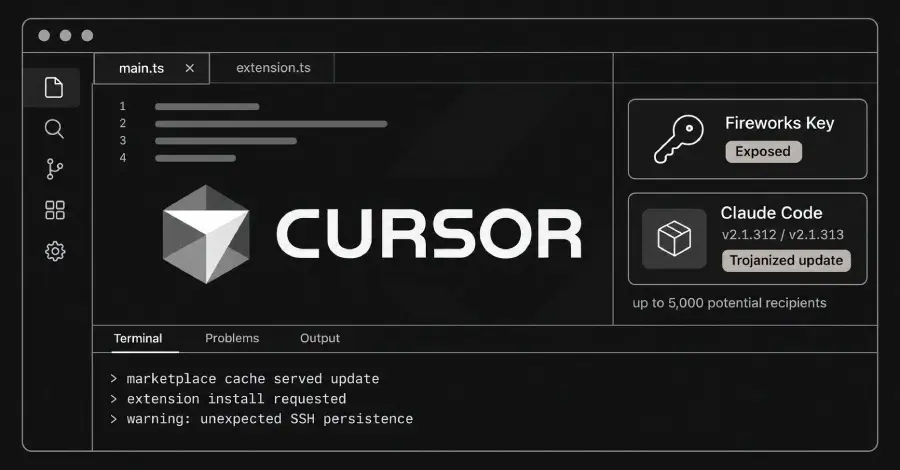
According to an update published by Cursor, an unauthorized actor managed to obtain an access key that the platform had previously issued to Fireworks AI. This access key had been inadvertently exposed during the broader security breach that impacted Fireworks AI. Armed with this credential, the attacker successfully accessed a read-only storage
bucket that Cursor used to facilitate data sharing with its vendor, setting off a chain reaction that ultimately affected thousands of developers and software development tools.
The disclosure sheds light on an incident that began unfolding weeks earlier, when users discovered a trojanized version of Anthropic’s official Claude Code extension distributed through the Cursor Marketplace. Marketed as a legitimate update, the malicious version attempted to quietly install a persistent Secure Shell (SSH) backdoor onto the systems of unsuspecting developers.
Inside the Data Exposure and the Upstream Breach
In its detailed security update, Cursor explained that the read-only storage bucket compromised in the attack contained limited coding agent traces. These traces originated from sessions where users had not enabled Privacy Mode, a platform-specific setting that allows developers to explicitly opt out of having their interaction data utilized for model training purposes.
The exposed data primarily consisted of legacy sessions dating back to 2025 that were legally permitted to be used for model training under standard usage agreements. Unfortunately, among these recorded traces were credentials that had not been properly redacted. As a result, the breach exposed the API credentials of a small fraction of Cursor customers, specifically impacting less than 0.01% of the platform’s user base.

The threat actor leveraged these unredacted API credentials as a critical stepping stone. Using the stolen access vectors, the attacker navigated further into select software-as-a-service and internal tools utilized by Cursor. Recognizing the unfolding unauthorized activity, Cursor security teams moved swiftly to deactivate the vendor’s compromised key, revoke and rotate affected credentials, and launch a comprehensive forensic investigation to hunt for deeper signs of access and contain the intrusion.
During the containment phase, Cursor took the aggressive step of temporarily disabling various internal and product services. This emergency action inevitably disrupted access to several features for the platform’s user community, but it was deemed necessary to halt the lateral movement of the threat actor within the internal ecosystem.
The Extension Marketplace Attack and Developer Impact
The most visible phase of the security incident struck on October 29, 2026. Armed with a stolen internal system credential unearthed during the earlier data access phase, the attacker managed to bypass integrity controls and place trojanized versions of Anthropic’s Claude Code extension directly into the cache infrastructure used to serve Cursor’s extension marketplace.
According to platform telemetry, the malicious build was available for approximately eleven hours before engineers detected the anomaly and took swift remedial action. During that brief window, at most 5,000 users who specifically requested cached versions of the extension on October 29 potentially received the compromised build.
Upon realizing the marketplace had been poisoned, Cursor immediately removed the malicious extension, took the entire extension marketplace offline, and coordinated directly with the cloud service provider hosting the attacker’s server to have the malicious infrastructure taken down.
In the aftermath, the company proactively notified all affected users who had installed versions 2.1.312 or 2.1.313 from the marketplace during the narrow exposure window. The platform assisted these developers in revoking any exposed credentials and securing their environments. Furthermore, Cursor severed its ties with the compromised infrastructure provider by moving all inference traffic entirely off Fireworks, permanently deactivating the key originally issued to them, and cutting off their access to any shared datasets.

Cursor emphasized that its security telemetry has shown no evidence of additional malicious activity since November 1, 2026. Furthermore, the company reassured its user base that there is no indication the incident impacted developers who had enabled Privacy Mode, customer code repositories, Cursor’s core production environment, the main Cursor desktop application or its official software updates, any of its other independent applications, or any alternative extensions and plugins downloaded from the marketplace.
Broader Industry Ripple Effects of the Fireworks AI Incident
The supply chain compromise affecting Cursor is not an isolated event, as the ripples of the Fireworks AI security breach continue to impact major technology companies across the software ecosystem.
In a parallel development, ride-hailing giant Uber confirmed that unknown threat actors managed to steal sensitive personal information, including the driver’s license details of thousands of drivers, after obtaining internal credentials through a third-party service provider. In a mandatory data breach notification filing submitted to the Office of the Attorney General in California, Uber explained that it was alerted by a service provider on October 9, 2026, regarding an unauthorized third party compromising the vendor’s internal credentials to access Uber’s account.
Subsequent investigations by Uber’s security team determined that the threat actor utilized those compromised credentials to access internal data connected to the service provider. While Uber initially withheld the specific identity of the vendor in its formal regulatory filings, reports from technology publications confirmed that the third-party service provider at the center of the Uber breach is also Fireworks AI. Uber has not yet publicly disclosed the precise number of drivers affected by this unauthorized data access.
The growing list of organizations impacted by the cascading vendor breach also includes online productivity startup Notion, which confirmed last week that proprietary data was similarly stolen as a result of the security lapses at Fireworks AI. As investigations by affected companies and independent cybersecurity researchers continue, the incident serves as a stark reminder of the systemic risks posed by third-party vendor dependencies in modern software development and cloud infrastructure supply chains.