A recent cybersecurity investigation has revealed a sweeping security blind spot involving thousands of applications generated automatically
through xAI’s Grok AI assistant. According to findings published by security firm Claroc, tens of thousands of web applications built using Grok’s conversational chat interface were left publicly accessible online without requiring any form of user authentication or sign-in mechanism.
The research highlights a rapidly growing enterprise security challenge as organizations increasingly adopt generative artificial intelligence tools that allow non-technical staff to deploy fully functional web applications instantly. While these tools empower employees to create simple productivity aids, calculators, games, and landing pages with minimal effort, they also introduce significant governance and data leakage risks when default platform settings fail to prioritize stringent access controls.

Out of 37,571 Grok-built applications identified by Claroc researchers across the public web, an overwhelming majority—specifically 35,578 apps—were found to be completely open to any internet user without requiring credentials. Among these exposed projects were 24 applications developed internally by employees working at social media platform X and at SpaceXSI, the aerospace and AI company responsible for creating the Grok assistant.
While the vast majority of the discovered applications served relatively innocuous functions, approximately one in ten contained sensitive internal business information or personal data. The internal staff applications that leaked included a confidential onboarding plan designed for a new sales hire, a comprehensive sales territory map tracking 594 active accounts, and a high-level advertising proposal directed at a United States federal agency, which had been explicitly marked as confidential. In response to the researchers’ disclosures, SpaceXSI has successfully taken down all 24 of the identified staff-created applications, though millions of other user-generated apps remained unaddressed by the company at the time of the report.
Beyond the internal files belonging to the AI developer and its sister social media platform, the exposed applications harbored internal data originating from 30 other distinct organizations identified by the security researchers. These affected entities spanned a wide array of critical industry sectors, including construction, energy, healthcare, and defense. The scale of the exposure was notably corporate, with 26 of the impacted organizations employing more than 1,000 workers, and six belonging to the prestigious Fortune 500 list.
Claroc’s analytical report estimates that roughly 2% of all open applications contained material sensitive enough to be classified as high or critical severity. Among the most alarming discoveries were a searchable hospital network database listing the personal details of over 3,500 employees, an intensive care medical briefing detailing the condition of a single patient, a live operational shift board for a municipal fire department, and a contractor’s employee timesheet whose underlying source code inadvertently stored every staff member’s password in plain text.

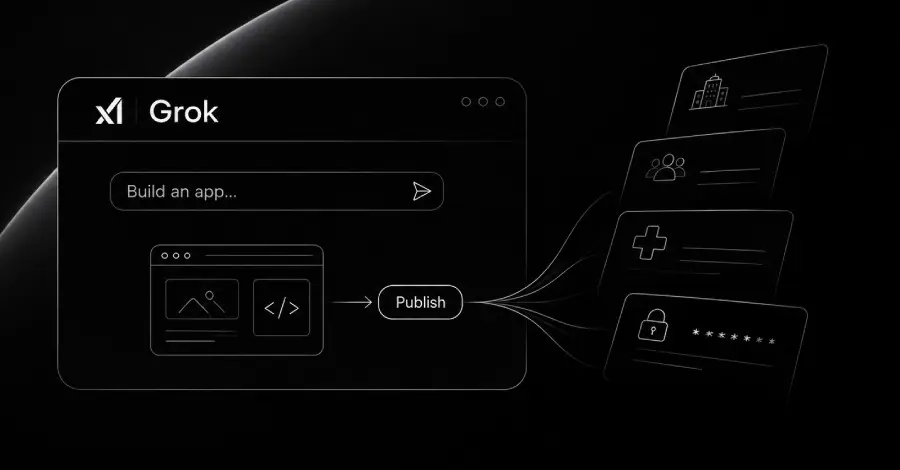
The root of the vulnerability lies in Grok’s chat-based application builder, a feature that allows users to generate fully functioning web apps simply by typing descriptions into a conversation window. This capability, which was rolled out to all Grok subscription tiers, assigns each newly published application its own unique subdomain under the primary domain grok.me. The platform leaves the choice of access permissions up to the creator during the publishing workflow.
Security researchers observed that when using a paid account to test the publishing process, the platform offered three distinct access configurations: "Anyone with the link," "Invited users," and "Only you." However, the configuration for "Anyone with the link" was selected by default, creating a scenario where creators could easily publish an application globally without realizing the broad accessibility of the link.
Furthermore, the researchers pointed out that an application’s URL does not remain hidden simply because it is obscure. When any user opens a newly published Grok app, their browser performs a Domain Name System lookup for that specific subdomain. Passive DNS monitoring services actively record these routine lookups, enabling malicious actors or security analysts alike to query historical DNS records and discover active subdomains using pattern recognition.
Although Grok assigns four random words as a default naming convention for each application—making raw guessing difficult—about half of the apps discovered by Claroc followed predictable naming patterns or were indexed through passive DNS logging. By contrast, researchers noted that alternative AI platforms, such as OpenAI’s ChatGPT app builder, default to a much stricter privacy posture where newly generated apps are restricted exclusively to the creator’s private account until explicit permission changes are made by the user.

To evaluate how the platform handled data security and access enforcement, the researchers conducted controlled tests using two custom-built applications populated with artificial data. In the first test, a simple contact list application was created with a database backend but no authentication layer. The researchers demonstrated that adding a new entry to the database from a private browsing window immediately populated the data for any subsequent visitor viewing the public link.
In the second test, a customer list built for a small sales team automatically generated sign-in buttons for Google and X accounts. However, the underlying code generated by the AI automatically authorized any incoming Google account without verifying whether the user actually belonged to the authorized sales team. As a result, an uninvited external Google account was able to successfully bypass security checks, view every customer record, edit one entry, and delete another. The researchers emphasized that these live tests were strictly confined to their own experimental applications and that they did not attempt to interact with or modify data inside any third-party applications discovered in the wild.
Claroc formally reported the vulnerabilities to SpaceXSI through the security contact channel listed in the organization’s security.txt file, submitting two of the staff applications on Sunday and the remaining 22 on Monday. While company representatives did not immediately reply directly to the researchers prior to publication, they did respond to inquiries from journalists, emphasizing that Grok applications are designed to remain entirely private until their creators intentionally choose to share them. The company noted that the publishing process involves multiple steps, including a legal disclaimer and a selection between private and public settings, and stated that employee accounts are supposed to default to private access.
Despite these platform safeguards, the discovery of dozens of internal corporate apps left wide open online underscores the persistent human error factor in generative AI development. Claroc has urged the platform operators to modify their default settings so that newly created applications default strictly to private access, while also introducing organizational controls that restrict app sharing to verified corporate email domains.

As software supply chains and internal data flows increasingly intersect with consumer-facing AI agents, security experts stress that automated code generation tools must enforce robust default security boundaries to prevent sensitive corporate and personal information from leaking into the public domain through obscure subdomains.