
Business adoption of stablecoins is on the verge of a dramatic expansion over the next 12 months, as digital currencies transition firmly into the mainstream financial ecosystem. According to a comprehensive new report released by payments infrastructure firm Cybrid, enterprises are increasingly turning to blockchain-based currencies to optimize their operations, reduce friction, and bypass the high costs and sluggish speeds traditionally associated with legacy financial rails.
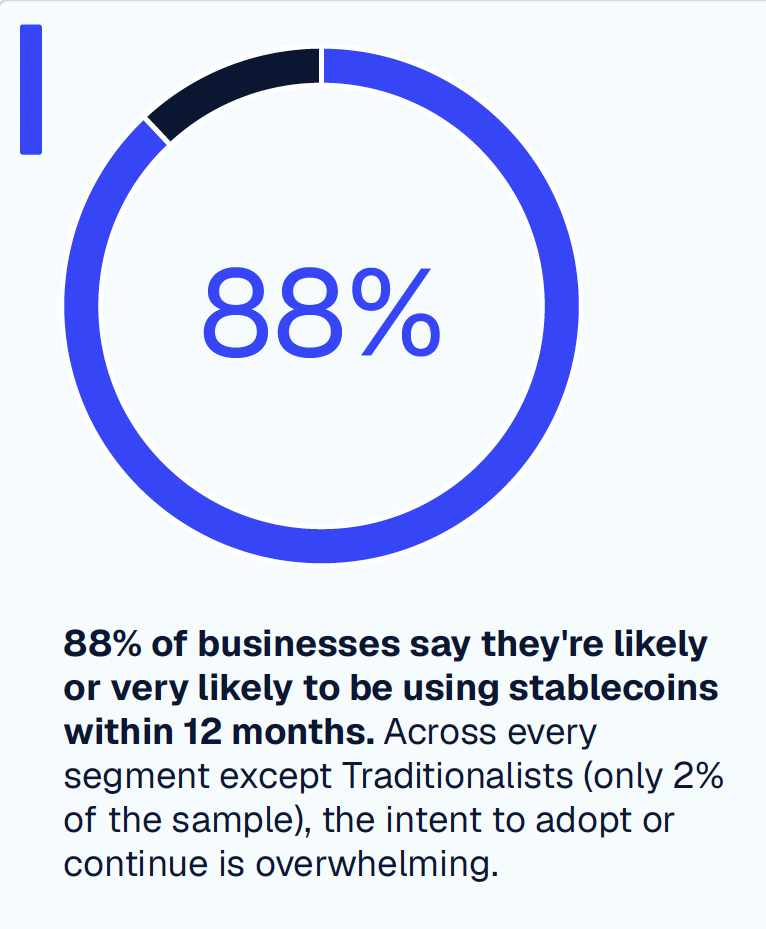
The Cybrid report reveals that 42% of businesses surveyed are already actively utilizing stablecoins for cross-border payments. Furthermore, an overwhelming 88% of respondents indicated that they are either likely or very likely to integrate stablecoins into their financial workflows within the coming year. In a striking indictment of legacy systems, only 2% of survey respondents identified as committed users of traditional payment rails, highlighting a profound shift in corporate sentiment regarding how money moves globally.
The primary driver behind this rapid migration is straightforward: significant, measurable cost reduction. Businesses currently leveraging stablecoins reported average cross-border payment cost savings of 35%. Even more compelling, larger enterprises processing more than $100 million in monthly payment volume reported average cost savings of up to 47%. These efficiency gains are fundamentally altering how corporate treasuries view international transactions, transforming what was once a costly and cumbersome administrative burden into a streamlined, high-speed operation.
This corporate momentum arrives against the backdrop of a booming global stablecoin market. Total market capitalization for stablecoins has climbed to $307.64 billion, according to data from CoinGecko. The sector continues to be dominated by Tether’s USDT, which commands a market cap of $184.7 billion, and Circle’s USDC, sitting at $73.51 billion. Additionally, the regulatory landscape has experienced a major evolution. Fueled by recent legislative developments, GENIUS Act-compliant stablecoins have surpassed a market cap of $76 billion, establishing the first comprehensive federal regulatory framework for payment stablecoins in the United States and providing enterprises with a clearer legal foundation upon which to build their digital asset strategies.

The insights from Cybrid’s research are derived from a targeted survey of 468 executives and business leaders, conducted between April 28 and May 4. The participant pool offered a broad cross-section of corporate leadership, hailing from the technology, financial services, and ecommerce sectors across the United States, Canada, and the United Kingdom. Respondents included C-suite executives, finance and treasury managers, and critical payments and operations leaders who manage the day-to-day liquidity of modern enterprises.
Varied Users Look for Regulatory Clarity to Gain Confidence
As businesses expand their digital asset horizons, the applications for stablecoins are diversifying well beyond simple money transfers. According to the Cybrid report, payroll and contractor payments emerged as the single most common use case among respondents. This was followed closely by supplier payments, customer payments, investment and yield generation, vendor payments, and broader treasury and liquidity management functions.
Despite the enthusiasm and clear financial incentives, corporate leaders remain vocal about what is needed to unlock the next wave of adoption. Regulatory clarity stood out as the paramount factor that would increase executive confidence in expanding stablecoin operations. An impressive 71% of respondents identified clear government regulation as more critical to their long-term confidence than trusted infrastructure providers or integration capabilities with existing enterprise systems. This underscores that while technology and cost-savings open the door, regulatory certainty remains the key to widespread institutional embrace.
The demand for stablecoins is not an isolated phenomenon captured by a single survey; it is corroborated by separate industry data pointing to the exact same structural trend. In June, digital payments infrastructure provider Paybis reported that business customers accounted for nearly 98% of the stablecoin payout volume processed through its platform during the first four months of 2026. This represents a staggering escalation from just 36% in 2023, illustrating how rapidly commercial use cases have crowded out retail-dominated volumes on specialized payment rails.
Paybis also highlighted independent research from McKinsey, which estimated that business-to-business transactions accounted for approximately 60% of the $390 billion in global stablecoin payment volume recorded throughout 2025. These figures demonstrate that stablecoins have evolved far beyond speculative crypto-trading tools, cementing their role as fundamental instruments of global commerce and liquidity management.
Companies Expand Infrastructure for Stablecoin Payments
To meet this surging corporate demand, traditional financial institutions and digital asset companies are aggressively expanding their underlying infrastructure. The ecosystem is rapidly maturing to accommodate the rigorous compliance, custody, and scalability requirements of institutional players.
In May, Falcon Finance debuted its dollar-backed stablecoin, fUSD, through Anchorage Digital Bank’s federally regulated issuance platform. The product was specifically engineered to target institutional trading, collateral management, and complex treasury workflows. By leveraging a federally regulated framework, Anchorage and Falcon Finance aimed to bridge the gap between traditional banking security and decentralized finance efficiency.
That institutional bridge was reinforced further when BNY announced an expansion of its digital asset custody platform to support Circle’s USDC. This integration allows the bank’s institutional clients to store, transfer, mint, and redeem the stablecoin directly through the institution’s established custody infrastructure. By embedding stablecoin operations directly into traditional banking environments, financial titans are removing historical friction points, making it significantly easier for mainstream enterprises to adopt digital currencies without abandoning their trusted institutional partners.