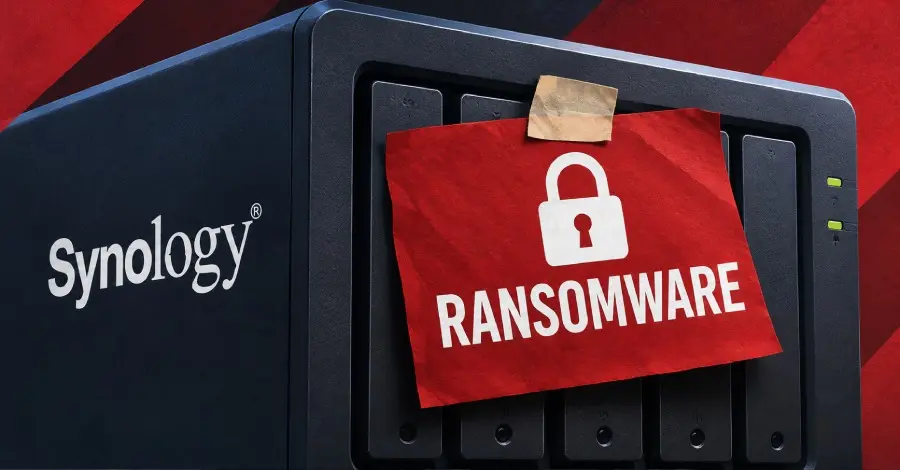
Network Attached Storage (NAS) manufacturer Synology has issued an urgent advisory, calling on customers worldwide to update the DiskStation Manager (DSM) software powering its devices following a wave of targeted ransomware attacks. The Taiwanese technology vendor reported that it has observed threat actors actively exploiting security vulnerabilities patched as far back as December 2024, specifically targeting servers and storage units running outdated iterations of the operating system.
These ongoing malicious campaigns are designed to infiltrate vulnerable systems, encrypt stored files, and subsequently extort victims for financial ransom. While Synology refrained from detailing the precise technical vectors of every active exploitation in its formal statement, the company explicitly pointed users toward a crucial security advisory originally published in late 2024. That historical advisory outlined multiple underlying vulnerabilities that have since been remediated in subsequent software patches, underscoring the severe risks associated with running unpatched network infrastructure.
The advisory and subsequent warnings arrive amid mounting user reports across public forums like Reddit, where multiple Synology owners have stepped forward to share their personal experiences after falling victim to cyber assaults. Affected individuals described discovering that their storage arrays had been compromised by the C3RB3R ransomware strain, a malicious payload characterized by its tendency to lock down user data and append the ".L0CK3D" extension to all compromised file names. For many home users and small businesses relying on these network-attached drives for centralized data storage and backups, the attacks have resulted in significant operational disruptions and intense anxiety over data loss.
This recent surge in targeted campaigns highlights a long-standing security challenge facing network-attached storage devices across the broader technology ecosystem. NAS hardware, valued for its accessibility, high storage capacity, and continuous connection to the internet, has frequently drawn the attention of cybercriminal syndicates seeking lucrative targets. Because these devices often store critical personal archives, media libraries, or vital corporate backups, they represent high-value targets for threat actors looking to maximize leverage through data encryption and extortion schemes.

The history of NAS-focused ransomware campaigns dates back several years. In July 2019, devices manufactured by another prominent Taiwan-based storage giant, QNAP Systems, were heavily targeted by a ransomware variant initially dubbed QNAPCrypt, more widely recognized by security researchers as eCh0raix. That early campaign demonstrated how automated scripts could scan the public-facing internet for vulnerable storage appliances, compromise them via weak credentials or unpatched software flaws, and deploy encryption routines directly onto the local file systems.
The threat landscape expanded further in August 2021, when Synology issued urgent warnings regarding aggressive brute-force attacks driven by a malware family known as StealthWorker. At the time, researchers and the company’s internal security teams discovered that these attacks leveraged large networks of already compromised machines to systematically guess common administrative credentials across public-facing services. When successful, the botnet gained unauthorized administrative access to the underlying system, allowing threat actors to deploy various malicious payloads, including ransomware. Synology noted during that period that infected devices frequently pivoted to launch secondary attacks against other Linux-based infrastructure operating within the same networks.
Around that exact same timeframe, threat intelligence specialists at Palo Alto Networks Unit 42 published comprehensive findings detailing an active eCh0raix variant that was simultaneously targeting network-attached storage appliances manufactured by both QNAP and Synology. That specific campaign demonstrated the versatility of modern ransomware operators, who frequently combine software vulnerability exploitation—such as manipulating known flaws like CVE-2021-28799—with traditional brute-force tactics targeting default or easily guessable administrative accounts to achieve system compromise.
In light of the recent activity involving outdated DSM versions and the C3RB3R strain, Synology has reiterated its longstanding security recommendations, strongly encouraging all system administrators and everyday users running vulnerable software iterations to apply the necessary updates without delay. The vendor also emphasized the importance of adopting proactive security measures, such as enabling automatic system updates within the DiskStation Manager interface to ensure that security patches are applied immediately upon release, thereby closing potential windows of opportunity for external threat actors scanning the global IP space for unpatched infrastructure.