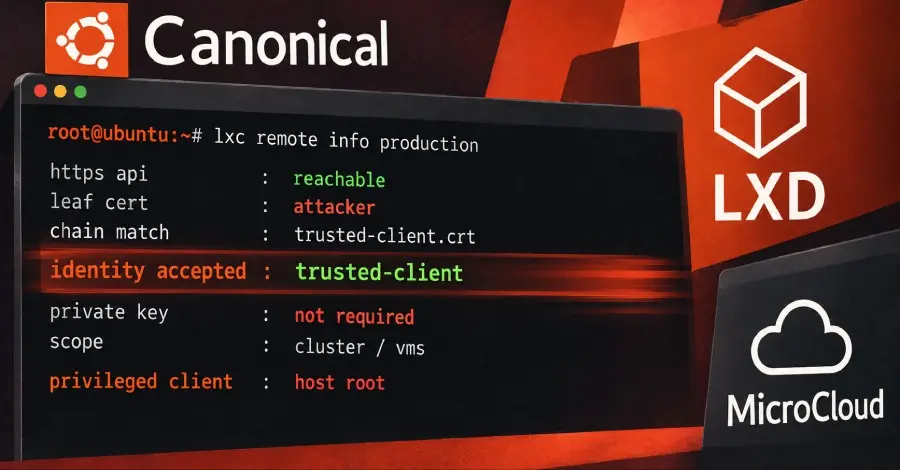
A critical security vulnerability affecting Canonical’s LXD and MicroCloud platforms has been discovered, potentially allowing remote attackers to impersonate trusted clients and gain administrative access without holding valid private keys. Tracked as CVE-2026-112816 and carrying a maximum severity CVSS score of 10.0, the flaw exposes cluster environments and underlying host machines to severe compromise if exploited. Canonical has swiftly responded to the disclosure by releasing patched versions across all supported product lines, urging administrators to apply updates immediately.
The security issue stems from how LXD and MicroCloud handle authentication through mutual TLS (mTLS), a protocol where both the client and server present digital certificates to verify their identities during a connection handshake. In a standard mTLS configuration, a server evaluates incoming connections against its trust store—a localized repository of approved client identities. However, the core vulnerability lies in a flaw within the server-side certificate validation logic.
When establishing a secure connection, the server improperly verified the presented certificate chain. While a valid TLS connection fundamentally guarantees that a client possesses the private key corresponding exclusively to the first certificate in the chain, known as the leaf certificate, the server failed to restrict its trust validation to this mandatory root of proof. Instead, the implementation evaluated every certificate attached by the client against the internal trust store. Because public certificates are not inherently secret, an unauthorized entity could intercept a trusted client’s public certificate and append it to the certificate chain behind their own.

Misled by this flawed validation logic, the server incorrectly assumed that the connecting party owned the appended trusted certificate, thereby granting the attacker full authentication privileges. Once inside the system, the malicious actor effectively inherits the exact permissions of the impersonated client, gaining comprehensive access to the cluster and any associated virtual machines. Furthermore, if the hijacked account possesses high-level administrative privileges, the compromise can rapidly escalate, granting the attacker root-level control over the entire host machine.
The attack vector requires two primary prerequisites: network accessibility to the HTTPS application programming interface and a copy of a public certificate belonging to a client already trusted by the server. Under default configurations, standalone LXD servers are not inherently vulnerable to remote exploitation because the network API remains disabled, listening exclusively on a localized unix socket unless an administrator explicitly enables the feature by adjusting the core.https_address configuration setting.
However, MicroCloud deployments present a more nuanced risk profile. MicroCloud integrates multiple machines running LXD into a unified, cohesive cluster. According to advisory details provided by Canonical, an attacker capable of observing and capturing a cluster member’s public certificate during the initial node-joining process could leverage that intercepted data to authenticate successfully as a legitimate member of the cluster.
The scope of the vulnerability extends across multiple long-term support and standard releases of LXD, including versions 4.0.14, 5.0.10, 5.21.8, and 6.9, alongside their corresponding prior iterations. The open-source Incus project, which originally emerged as a community-driven fork of LXD, independently identified the flaw and reported it, prompting Canonical to verify its presence in its own codebase. The Incus development team addressed the identical vulnerability within version 7.6.0 of their software. Meanwhile, upstream archive packages for Ubuntu LXD were determined to be unaffected or not shipped, leaving snap installations as the primary targets requiring remediation.

To mitigate the risk of exploitation, Canonical has made updated snap packages publicly available. For LXD, fixed versions include release 6.10.1 for the 6/stable channel, 5.21.9 for the 5.21/stable channel, 5.0.11 for the 5.0/stable channel, and 4.0.15 for the 4.0/stable channel. For MicroCloud users, patches are available via version 3.4.1 in the 3/stable channel and version 2.1.5 in the 2/stable channel. Administrators managing these environments can initiate the update process by executing standard snap refresh commands for the respective packages.
As of the initial advisory release, threat intelligence assessments from the U.S. Cybersecurity and Infrastructure Security Agency, documented on October 30, indicated that there was no active evidence of the vulnerability being exploited in the wild. The identifier does not currently appear on CISA’s Known Exploited Vulnerabilities catalog, and no functional exploit code has been publicly released.
Because Canonical’s initial advisory did not outline a direct temporary workaround configuration for LXD aside from applying the official patches, security professionals emphasize the importance of network segmentation. Restricting network access to the exposed HTTPS API limits the attack surface and reduces overall risk until environments can be fully updated. Similarly, representatives for the Incus project noted that configuration workarounds do not exist for the underlying cryptographic logic error, making strict network boundary controls and immediate software updates the only viable defense mechanisms for affected infrastructure administrators.