Updated Oct 16, 2026, 1:56 a.m. EDT
Published Oct 16, 2026, 1:53 a.m. EDT
The principle of holding digital assets for the long term has long been touted as a cornerstone for building wealth within the volatile cryptocurrency market. However, a closer look at historical cycles reveals that this strategy has not delivered equal results across all major coins.
Consider XRP, the payments-focused cryptocurrency native to the XRP Ledger and historically positioned as one of the world’s largest digital assets by market capitalization. While the broader cryptocurrency ecosystem has expanded dramatically over the past decade, XRP remains a notable exception to the rule of long-term appreciation, still trading well below its cycle high set nearly nine years ago.
The broader market’s transformation dates back to the historic 2017 crypto craze, a period when digital assets definitively broke into the mainstream. That frenzied retail and institutional run pulled in millions of new participants, eventually carrying over into the first weeks of January 2018. During that explosive market peak, XRP reached an all-time high of $3.55.
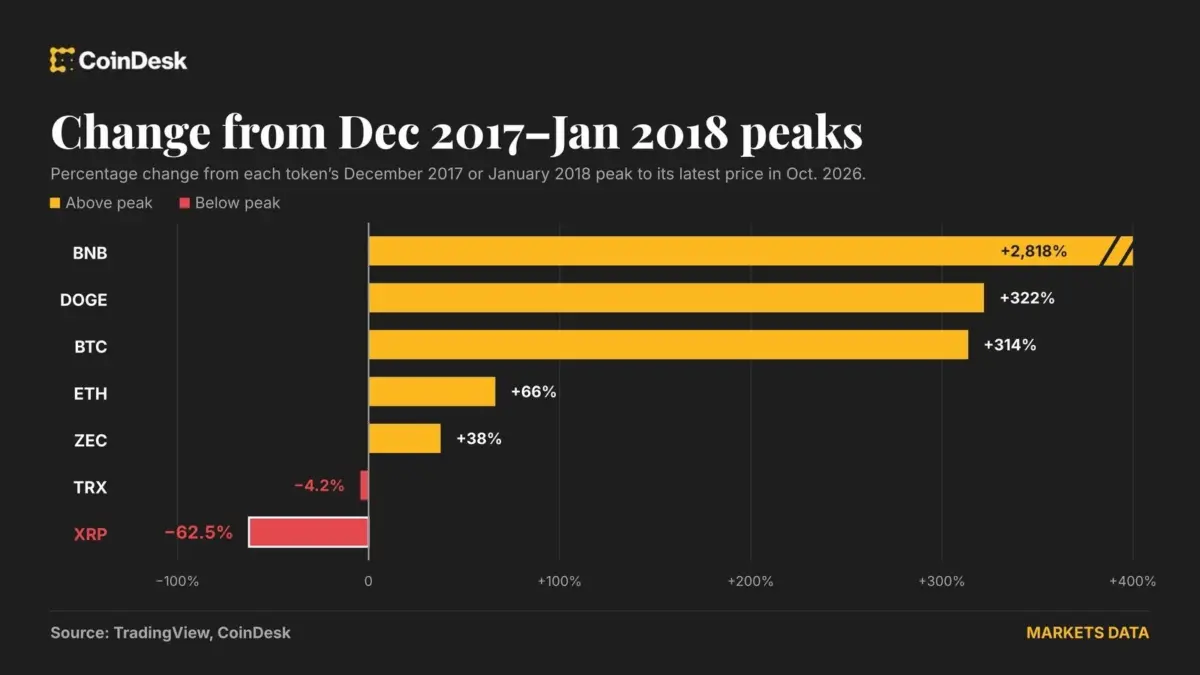
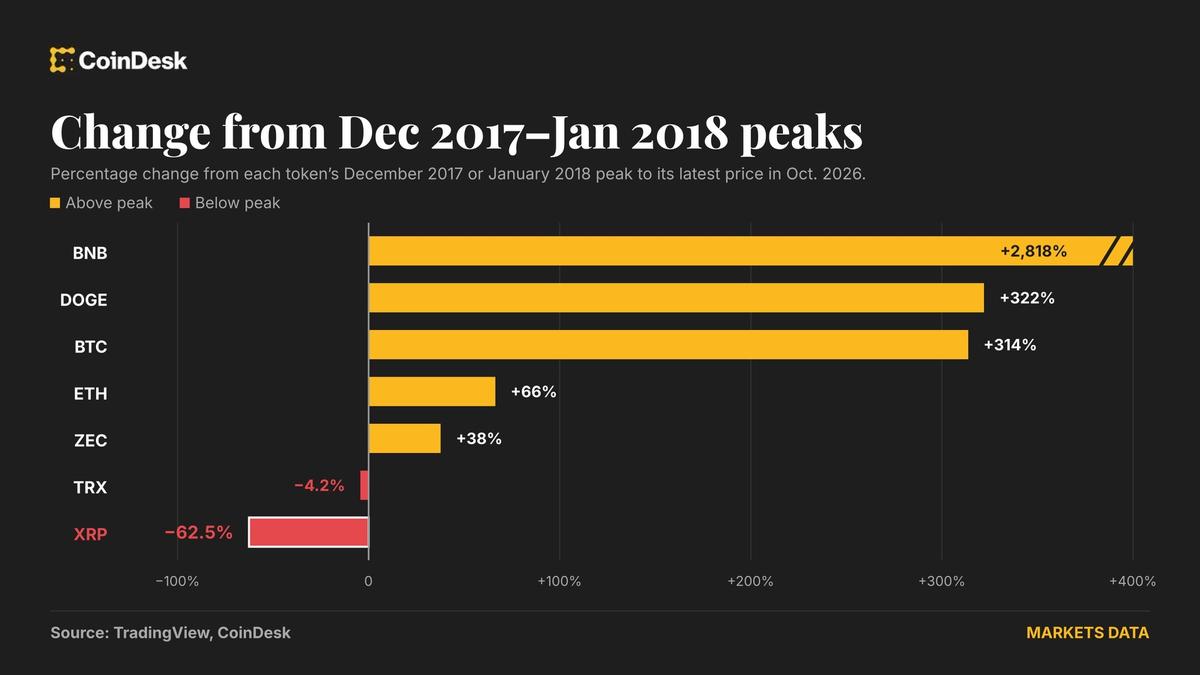
Today, XRP changes hands at approximately $1.33, leaving it down roughly 62.5% from its early 2018 peak. This means that an investor who purchased XRP at the absolute top of that cycle remains underwater nearly nine years later. While XRP did manage to briefly eclipse its old record by climbing to $3.66 in July 2025, that milestone was short-lived before prices corrected sharply downward.
In stark contrast, other legacy cryptocurrencies have far outpaced their 2017-era benchmarks. Bitcoin, the world’s premier digital asset, trades significantly higher, marking a massive gain of over 300% from its December 2017 peak of $19,804. Meme-inspired token Dogecoin is up more than 300% from its January 2018 high, while Binance Coin (BNB) has delivered staggering returns, soaring roughly 2,800% above its corresponding historical mark. Even smart contract pioneer Ethereum and privacy-focused zcash show positive gains from that era, sitting up 66% and 38% respectively. Other newer network tokens, such as Solana, which launched later in 2020, have established entirely new market paradigms, while bitcoin, ether, and other major tokens have experienced typical pullbacks from their 2025 peaks yet remain far elevated above their 2017 baselines.
Too Many Coins
Market analysts examining XRP’s sluggish long-term price recovery point first to the mechanics of token supply. The sheer expansion of circulating tokens over the years has diluted individual unit values, even as the asset’s total network valuation remained relatively stable.
"Circulating supply grew 63%, from 38.7 billion in 2017 to 63.1 billion, while XRP’s total market value fell only about 3%," explains Nicolai Sondergaard, senior research analyst at analytics firm Nansen. "More XRP in circulation means each token represents a smaller share of roughly the same total value."
Circulating supply represents the active number of coins available on the open market. As this figure increases through scheduled releases and ecosystem distributions, each individual coin accounts for a proportionally smaller slice of the network’s aggregate market capitalization.
Oliver Carding, head of marketing at institutional digital asset management firm Tesseract Group—which manages over $500 million in assets—suggests that XRP presents a more stable picture when viewed through the lens of total network value rather than raw spot price.
"On value, XRP recovered," Carding notes. "About 63% more XRP is in circulation than at that peak, so the same circulating market capitalization would mean a price roughly 39% lower."
Weaker Demand
Beyond supply dynamics, structural demand for XRP has faced distinct headwinds, particularly when compared to the massive institutional capital inflows captured by competing ecosystems. The introduction of U.S.-listed exchange-traded funds (ETFs) has fundamentally altered the digital asset landscape, providing traditional financial institutions with direct regulatory-compliant exposure vehicles. However, while bitcoin and ether investment products have successfully attracted billions of dollars in institutional wealth, XRP-focused funds have lagged significantly behind.
"ETF uptake has also been muted relative to BTC and ETH," observes Paul Howard, senior director at digital asset market-making firm Wincent.
Market data compiled by source SoSoValue indicates that XRP investment funds have accumulated a total of just $1.80 billion in investor capital since launching nearly a year ago. By comparison, spot bitcoin ETFs frequently pull in more than $1 billion in net inflows during a single trading day, illustrating a vast disparity in institutional appetite. Furthermore, on-chain and trading metrics compiled by Nansen highlight a broader cooling of market engagement, showing XRP spot trading volume down 53.5%, perpetual futures volume down 44%, and active network addresses contracting by 10.7%.
Ripple’s Focus
Analysts also attribute XRP’s relative underperformance to the strategic priorities of Ripple, the enterprise blockchain company closely associated with the digital asset. While the broader crypto industry gravitated toward high-growth sectors such as decentralized finance (DeFi), artificial intelligence tokens, and speculative memecoins—narratives that successfully drew substantial retail capital and deep integration with traditional financial networks—Ripple maintained a narrower focus.
"Ripple, meanwhile, has been working hard to build payment infrastructure, RLUSD [stablecoin], and trade financing products around the usage of the ledger and coin, and this has taken focus from just core XRP," Howard explains.
Furthermore, the rapid evolution of decentralized finance created entirely new avenues for capital deployment that directly benefited competing layer-1 assets.
"The role of DeFi for investment into ETH, SOL, and HYPE has also been a new narrative which XRP has not focused on," Howard adds.
The SEC Case
Another defining factor that weighed heavily on XRP’s market trajectory over the past several years was its protracted legal battle with United States financial regulators. In December 2020, the U.S. Securities and Exchange Commission filed a landmark lawsuit against Ripple and two of its executive leaders, alleging that the firm had raised approximately $1.3 billion through unregistered securities offerings of XRP.
The high-stakes litigation cast a heavy shadow over the token’s market liquidity and accessibility. Major cryptocurrency exchanges, led by Coinbase, promptly suspended XRP trading following the enforcement action, severely curtailing retail market participation during the explosive 2021 bull market.
A federal court delivered a mixed ruling in 2023, determining that programmatic sales of XRP on public exchanges did not constitute securities offerings, whereas direct institutional sales did. Subsequent legal developments saw Ripple ordered to pay a $125 million civil penalty in 2024. The multi-year legal saga finally reached its definitive conclusion in August 2025, when both litigants formally dropped their respective appeals.
Reflecting on the timeline, Carding notes that the regulatory overhang helps account for the token’s failure to challenge its previous records during earlier market expansions.
"The SEC case helps explain why XRP did not revisit its 2018 high in 2021, when Coinbase suspended trading, but the appeals were dropped in August 2025 with XRP above $3," Carding says. "Since then, XRP is down about 59%, against 32% for bitcoin and 44% for ether, and its circulating market capitalisation is down about 56%."
Not the Only Laggard
Despite its unique set of challenges, XRP is far from being the only digital asset from the historic 2017 top tier that continues to struggle with reclaiming its previous all-time highs on a nominal price basis.
"On price, six of the other nine assets in the January 2018 top ten are further below their levels of that week," Carding points out.
For market participants and analysts closely monitoring XRP’s future performance relative to the rest of the cryptocurrency economy, industry observers advise watching specific structural metrics rather than focusing solely on retail sentiment.
"What I would watch is XRP against bitcoin, alongside net monthly distribution after re-escrow and changes in fund holdings," Carding suggests. "Relative weakness that persists as distribution slows would point to weaker demand."
In practical terms, this analytical approach involves tracking whether XRP continues to underperform bitcoin even as the rate at which new tokens enter the active supply slows down through Ripple’s programmatic escrow releases. If supply growth decelerates while XRP’s market performance still lags behind bitcoin, it would serve as a clear indicator that organic investor demand for the asset remains subdued.