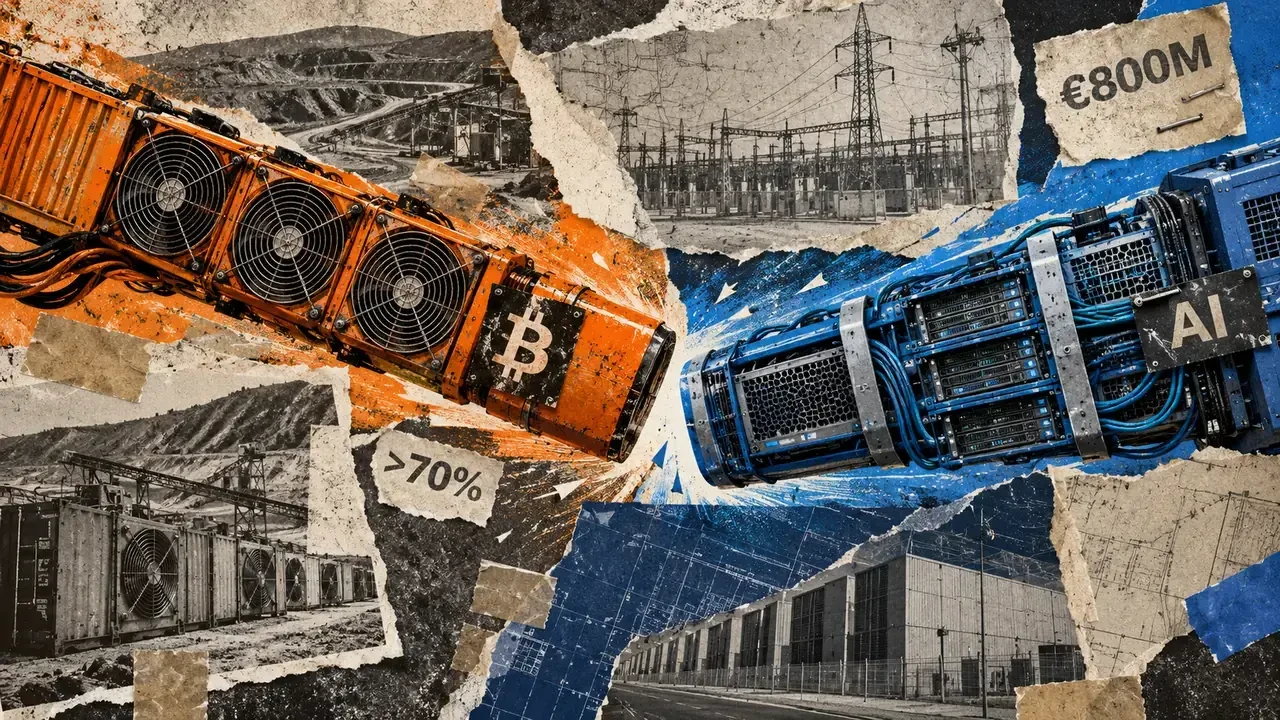
AMSTERDAM — SWI Group has successfully raised €800 million in a major capital increase aimed at expanding its artificial intelligence infrastructure, marking a significant step forward in its strategic plan to repurpose the FTX-backed Bitcoin miner Genesis Digital Assets.
On Oct. 12, the Amsterdam-listed digital infrastructure company announced the completion of its latest financing round, which was heavily backed by prominent institutional investors. The capital raise successfully valued the group at €6.1 billion, pushing the company’s total equity raised since March well past the €1.1 billion milestone.
The newly secured financing will be directly channeled into comprehensive data-center development, power infrastructure upgrades, and advanced computing deployments across key strategic markets in both Europe and the United States. SWI has been aggressively converting its extensive digital infrastructure portfolio away from traditional cryptocurrency mining and toward high-performance computing (HPC) and artificial intelligence workloads.
A cornerstone of this ongoing expansion is Genesis Digital Assets (GDA), a former flagship venture investment of bankrupt cryptocurrency exchange FTX’s trading affiliate, Alameda Research. SWI successfully acquired a controlling stake in the mining firm earlier this year, positioning the distressed asset as a primary vehicle for its broader technological pivot.
The high-stakes fundraising effort arrives at a time when traditional Bitcoin miners are increasingly redirecting substantial capital toward AI infrastructure. This migration has been heavily fueled by projections of markedly superior profitability, alongside surging market valuations for companies that manage to secure valuable access to scarce electrical grid capacity and established data-center footprints.
Former FTX Investment Becomes Foundation for AI Expansion
Genesis Digital Assets previously stood as one of the single largest venture-capital investments made by Alameda Research before the catastrophic collapse of the FTX empire in November 2022. During the height of the cryptocurrency market boom between 2021 and 2022, the prominent trading firm poured approximately $1.15 billion into Genesis, at a time when the Bitcoin miner commanded a hefty private market valuation of roughly $5.5 billion.
Following the spectacular collapse of FTX, the multi-billion-dollar investment became embroiled in complex, protracted bankruptcy litigation. The FTX recovery trust initiated legal action seeking to reclaim funds that it alleged Alameda had improperly and fraudulently transferred to the mining entity. However, the contentious legal battle was finally brought to a close when the FTX trust formally dismissed the $1.15 billion lawsuit.
Capitalizing on the subsequent market turmoil and restructuring opportunities, SWI systematically consolidated its control over Genesis. By August, the company completed the acquisition of a dominant stake exceeding 70% through a combination of strategic share purchases and comprehensive corporate restructuring.
Moving forward under its new operational vision, the company plans to rename the miner SWI Digital. It intends to leverage the firm’s established United States-based mining infrastructure as a foundational springboard for high-performance computing and enterprise-grade AI services.
The existing power-connected sites of Genesis remain entirely central to this overarching strategy, providing SWI with immediate access to robust physical infrastructure that can be systematically redeveloped to handle far more demanding and lucrative computing workloads.
SWI has previously disclosed that its combined European and American digital infrastructure portfolio boasts a massive footprint exceeding 4 gigawatts of total power capacity. Furthermore, the firm has demonstrated its unwavering commitment to the sector by allocating more than 80% of its total capital expenditure toward digital infrastructure development.
In addition to retrofitting physical data centers, the group harbors ambitions to develop its own proprietary AI cloud platform. This strategic move is designed to extend SWI’s core business model far beyond mere data-center ownership, transforming it into a full-scale provider of specialized computing services tailored for modern enterprises and software developers.
Max-Hervé George, Chief Executive Officer of SWI, noted that the latest infusion of capital would crucially enable the company to scale its operations in tandem with the explosive global demand for advanced computing capacity.
The newly authorized shares will be issued across several distinct series. However, SWI has opted not to publicly identify the specific institutional participants involved in the round, nor has it broken down the exact financial allocation designated specifically for the Genesis Digital Assets integration.
Bitcoin Miners’ AI Pivot Delivers Stronger Returns
SWI’s aggressive capital allocation and infrastructure pivot come on the heels of a sharp divergence in the financial trajectories of traditional Bitcoin mining and emerging AI infrastructure operations.
According to comprehensive research published in CoinShares’ second-quarter mining report, modern AI computing infrastructure can potentially generate an estimated $1.5 million in annualized profit per megawatt of capacity. This stands in stark contrast to the estimated $500,000 in annualized profit typically generated by conventional Bitcoin mining operations under prevailing market conditions.
This threefold profitability differential has catalyzed a substantial market revaluation of former mining enterprises that successfully execute a pivot toward artificial intelligence and high-performance computing.
The CoinShares report highlighted that 10 out of the 12 publicly traded mining companies tracked by the firm experienced dramatic share price gains ranging between 70% and 195% throughout the second quarter alone.
Companies that successfully transitioned their core business models to focus heavily on AI infrastructure—including prominent industry players such as Hut 8, Cipher Mining, TeraWulf, and Core Scientific—traded at an average valuation of 19.4 times forward sales. This is considerably higher than the 6.6 times forward sales multiple commanded by their more traditional, mining-focused competitors.
This pronounced valuation gap reflects surging investor demand for corporate entities that possess pre-existing grid electricity connections and physical facilities capable of supporting power-hungry AI workloads without years of regulatory and construction delays.
Nevertheless, successfully converting these heavy industrial assets into state-of-the-art AI facilities remains an exceptionally capital-intensive endeavor.
CoinShares estimates that developing fully functional, AI-grade computing facilities from existing mining infrastructure can cost anywhere between $8 million and $15 million per megawatt. This represents a massive leap compared to the relatively modest $700,000 to $1 million per megawatt required to establish standard cryptocurrency mining infrastructure.
Moreover, the research report underscored a significant structural imbalance within the sector, revealing that more than $100 billion in publicly disclosed AI computing contracts across the tracked companies have thus far supported only about $1.1 billion in actualized annualized revenue. Currently, roughly 550 megawatts of operational capacity are actively generating billings, sitting against a backdrop of more than 4 gigawatts of total contracted capacity.
This stark disparity between contracted pipeline and realized revenue has placed a premium on flawless project execution, as public market investors assign lofty valuations to companies attempting the complex transition away from Bitcoin mining.
While SWI’s newly secured €800 million capital increase provides the firm with a robust financial cushion for its ongoing expansion, the company has yet to disclose specific details regarding which Genesis facilities will be prioritized for conversion, the precise capital expenditure required for the retrofitting process, or a definitive timeline for when these upgraded assets will begin generating consistent AI computing revenue.