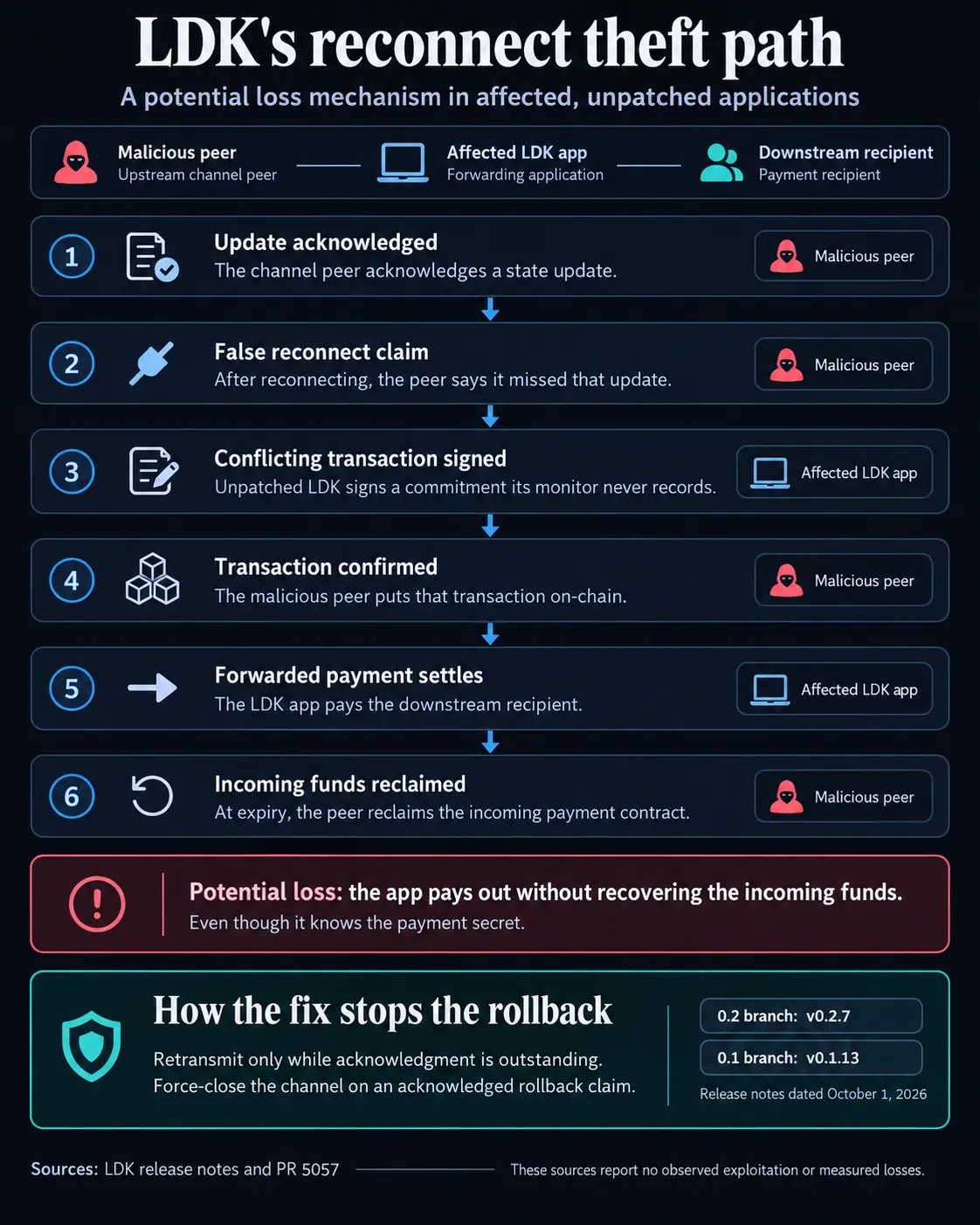
The vulnerability was publicly disclosed alongside the release of versions v0.2.7 and v0.1.13 on October 1. These security updates address the LDK reconnect flaw across the 0.2 and 0.1 branches, respectively. The existence and nature of these fixes were subsequently highlighted by Bitcoin Optech in its weekly newsletter published on October 9, drawing broader attention to the issue within the broader Bitcoin development community.
How the LDK Reconnect Flaw Threatens Bitcoin Funds
The mechanics of the exploit hinge on a complex interaction between channel state updates, network disconnections, and peer-to-peer trust assumptions inherent in the Lightning Network. According to the technical details outlined in pull request 5057, the attack vector begins when a channel peer acknowledges a state update during normal operations. Following this acknowledgment, the peer intentionally or accidentally disconnects, and upon reconnecting, falsely claims that it never received or acknowledged the update in question.
Prior to the deployment of the patch, this deceptive claim could inadvertently cause LDK to sign a conflicting commitment transaction. In the Lightning Network, a commitment transaction represents the mutually agreed-upon state of a payment channel at any given time and can be broadcast to settle the channel directly on the Bitcoin blockchain if disputes arise. However, in the vulnerable versions of LDK, the newly signed, conflicting transaction was not properly recorded by the library’s channel monitor—the vital internal component responsible for tracking and protecting the channel’s on-chain claims.
This operational gap created a dangerous window for potential fund theft, effectively turning a standard forwarded payment into a net loss for the forwarding node. In a worst-case scenario, a malicious sender could confirm the conflicting transaction on the blockchain while simultaneously allowing the forwarded payment to successfully settle with the next recipient down the line. Later, the malicious actor could reclaim the incoming payment contract once it expired, even though the forwarding node possessed the cryptographic secret normally required to claim those funds.
Consequently, the forwarding application would have paid out downstream funds without ever recovering the corresponding incoming funds from the malicious peer. To neutralize this threat, the newly implemented fix strictly restricts retransmissions, allowing them only while a peer’s original acknowledgment remains genuinely outstanding. Furthermore, the updated software now enforces a strict channel force-closure if a peer attempts to claim that a previously acknowledged update was somehow missed.
Additional Fixes for LSPS2 Just-in-Time Payment Risks
In addition to resolving the critical reconnect vulnerability, the v0.2.7 release addresses an entirely separate theft vector associated with LSPS2 just-in-time payment flows. In these specialized arrangements, a liquidity service provider automatically opens a new payment channel as part of the process of handling an incoming payment for a user.
The flaw in the unpatched LSPS2 implementation involved the potential for an intercepted payment to misrepresent its true monetary amount. This discrepancy could trick the liquidity service into opening a channel and forwarding a larger amount of Bitcoin than what was actually supplied by the incoming payment. To cover the shortfall, the service would inadvertently end up subsidizing the transaction out of its own pocket, exposing operators to financial exploitation. Pull request 5042 introduces a rigorous amount check to ensure that such discrepancies are caught and neutralized before channels are opened.

Industry observers have noted that this specific exposure is isolated to the LSPS2 service flow. Notably, the release notes for version v0.1.13 highlight the shared reconnect fix but do not include the LSPS2-specific patch, reflecting the modular nature of the library and the differing architectures of the software branches.
These newly patched defects are entirely distinct from other recent vulnerabilities, such as the splice-fee diversion and saved-state loading bugs that were previously addressed in LDK version v0.2.6. Furthermore, developers have emphasized that Core Lightning, a separate and distinct implementation of the Lightning Network protocol, operates independently of these LDK-specific issues.
Implementation Requirements for Application Developers
Because of the architectural design of the Lightning Development Kit, the SDK is compiled and executed directly inside individual client applications rather than running as a standalone server daemon. This structural reality means that simply releasing a library patch is not enough to secure the ecosystem; developers of wallets and payment platforms must actively incorporate the updated library code into their own deployed software builds.
For teams integrating LSPS2 functionalities, the commit documentation for pull request 5042 includes important operational warnings. Specifically, payment contracts that were queued or handled by any prior, unpatched version of the software retain unvalidated amounts. Development teams are therefore required to carefully account for these pending contracts in addition to updating the underlying library package to ensure comprehensive security across their user base.