Alex Mashinsky, the disgraced founder of the now-bankrupt cryptocurrency lender Celsius Network, has formally agreed to a permanent ban from participating in the securities, commodities, and cryptocurrency industries. The lifetime prohibition is the centerpiece of a comprehensive civil settlement with the state of New York, announced on Oct. 9, which officially resolves a high-profile civil lawsuit originally filed by the New York Attorney General’s office in January 2023.
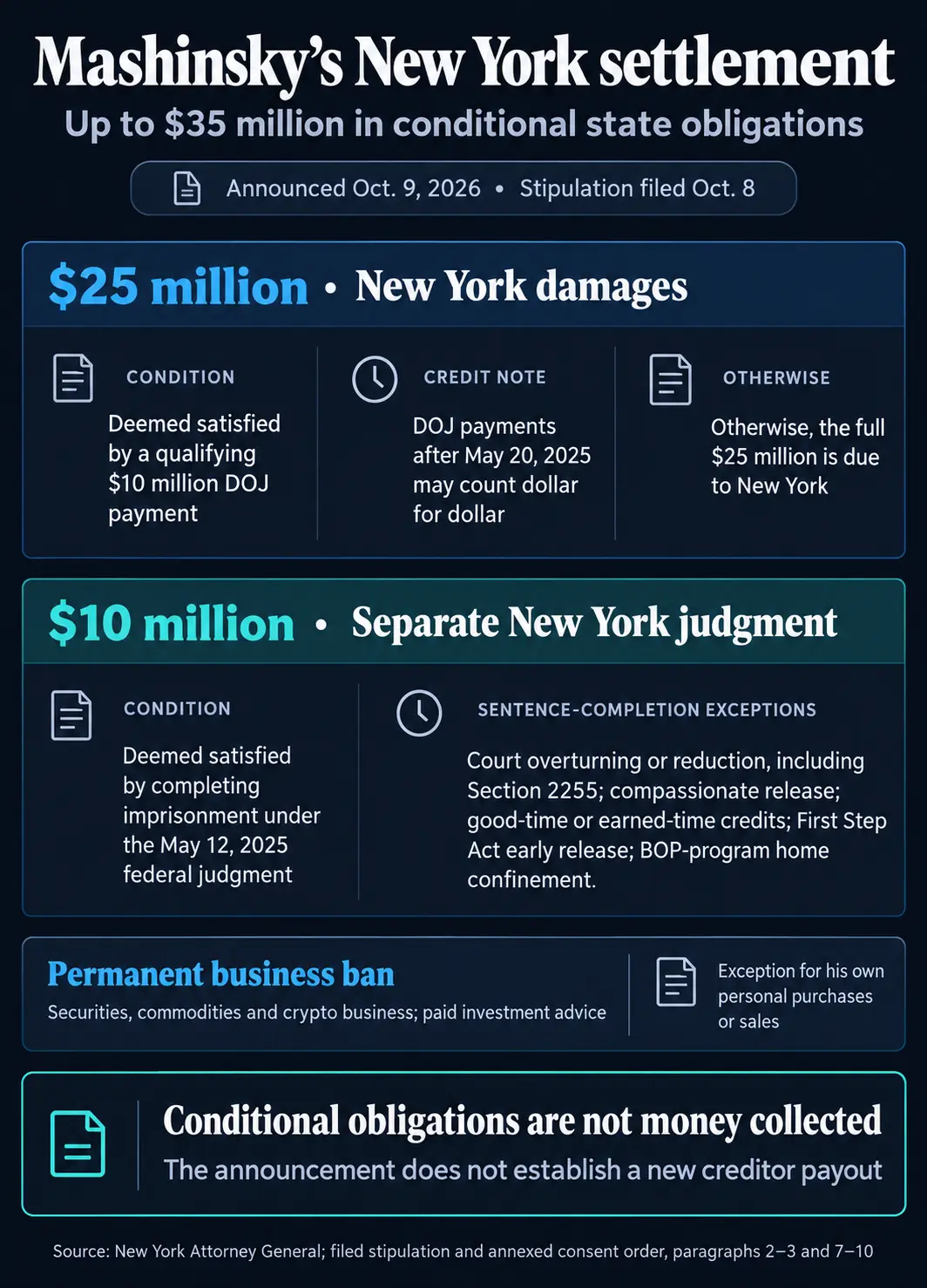
Alongside the lifetime professional ban, the agreement establishes conditional state payment obligations totaling up to $35 million. Despite the substantial financial figures cited in the paperwork, the settlement does not generate any new or direct payouts for the thousands of everyday creditors who suffered financial devastation when Celsius collapsed.
The state-level resolution adds an extra layer of legal and financial penalties onto Mashinsky, who is already serving a 12-year federal prison sentence following his conviction for orchestrating a massive fraud scheme that misled investors and precipitated the platform’s catastrophic downfall.
What the $35 Million Figure Entails
The financial structure of the New York settlement is heavily dependent on conditional terms, complex offsets, and the outcome of Mashinsky’s existing federal criminal penalties. Rather than demanding an immediate upfront lump-sum payment of $35 million in cash, the consent order breaks the financial liabilities down into distinct, highly specific obligations tied directly to his federal case and prison sentence.
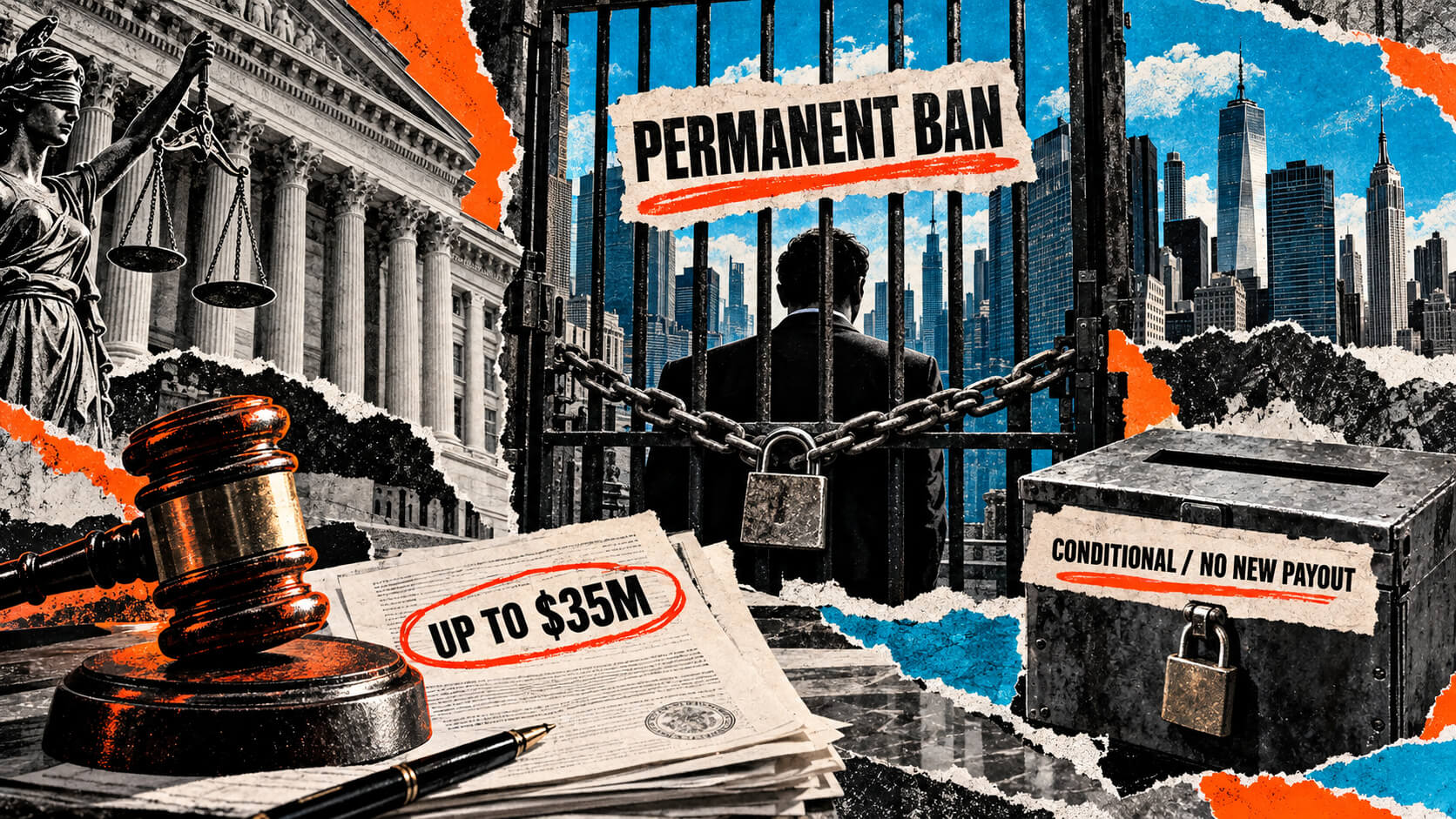
The first major component of the agreement involves a $25 million damages assessment payable to the state of New York. However, under the precise legal terms outlined in paragraph 2 of the annexed consent order, this massive obligation is deemed fully satisfied if Mashinsky completes a qualifying $10 million payment to the United States Department of Justice, as stipulated under paragraph 11 of his federal forfeiture order.
To achieve this satisfaction, any DOJ payments made by Mashinsky after May 20, 2025, are eligible to count on a strict dollar-for-dollar basis toward that crucial $10 million threshold. Should he fail to make the specified payments to federal authorities, the New York Attorney General retains the legal right to pursue him for the entire $25 million damages figure.
The second major financial obligation established by the settlement is a separate $10 million monetary judgment payable directly to the state of New York. According to paragraph 3 of the consent order, this specific judgment is deemed satisfied upon the complete fulfillment of Mashinsky’s imprisonment term under the federal judgment entered on May 12, 2025.
Crucially, this sentence-completion condition is subject to several express exceptions. The clauses cover scenarios where Mashinsky’s sentence might be legally overturned, vacated, or reduced by a court of law, including through a formal Section 2255 legal challenge. Additionally, the text explicitly lists mechanisms for early or alternative release, such as compassionate release, standard good-time credits, earned-time credits, early release initiatives under the federal First Step Act, or home confinement programs administered through the Bureau of Prisons.
A Permanent Business Ban With Personal Trading Exceptions
Beyond the complex financial liabilities, the New York settlement imposes an absolute and permanent industry ban designed to bar Mashinsky from ever holding a position of financial trust again. The agreed-upon regulatory restrictions cover a broad array of financial sectors, including all securities and commodities businesses, with an explicit focus on the digital asset and cryptocurrency markets.

The lifetime ban prevents Mashinsky from acting in professional capacities such as a broker, investment adviser, corporate manager, company officer, or external consultant. Furthermore, it strictly prohibits him from providing any form of investment advice if that guidance is distributed in exchange for compensation or any other economic benefit.
Despite the sweeping nature of these professional prohibitions, the legal text preserves a narrow, highly specific exception. The agreement does not strip Mashinsky of his fundamental personal rights as an individual investor; he is still legally permitted to execute personal purchases or sales of cryptocurrency for his own portfolio.
As part of the stipulated agreement, Mashinsky formally admitted to key elements of the state’s accusations. Specifically, he acknowledged that he repeatedly misled investors regarding the true regulatory compliance and official approval status of Celsius, as well as concealing his own massive insider sales of the platform’s native token, CEL.
The broader legal saga surrounding Mashinsky reached a significant milestone on May 8, 2025, when a federal court officially handed down a 12-year prison sentence following his fraud conviction. Court documents from the proceedings also recorded a staggering federal forfeiture order set at $48.4 million.
Providing context on the ongoing fallout from the Celsius bankruptcy, representatives for the New York Attorney General noted that the bankrupt estate had successfully distributed more than $3.4 billion to affected creditors as of August 2026. While qualifying payments made by Mashinsky to the Department of Justice will satisfy specific conditions outlined in the new state settlement, regulatory authorities confirmed that these milestones do not trigger any additional distributions or recovery funds for the platform’s long-suffering creditors.