
Recent upward price momentum in Bitcoin (BTC) does not yet reflect an adequate influx of fresh capital entering the broader cryptocurrency market, according to the latest analytical insights from prominent onchain research platform Glassnode.
In the latest edition of its flagship newsletter, The Week Onchain, Glassnode examined the mechanics behind Bitcoin’s recent price movements and concluded that existing market participants are largely responsible for the asset’s trajectory. Rather than being propelled by a massive wave of new buyers, corporations, or external liquidity providers, the recent appreciation is primarily being fueled by coins changing hands at higher valuations among investors who were already heavily exposed to the market.
This dynamic highlights a potential structural hurdle for the world’s leading cryptocurrency as it continues to knock against crucial psychological and technical resistance barriers. Market analysts note that while macro factors, geopolitical tensions, and shifting macroeconomic conditions play a role in short-term volatility, the internal health of the asset depends heavily on whether external capital inflows can eventually accelerate to match the ambitions of current holders.
Bitcoin Capital Inflows Fall Short of Realized Cap Growth
To understand the health of a market cycle, onchain analysts frequently track the realized cap—a metric that values each individual Bitcoin not at its current spot market price, but at the exact price point at which it last moved on the blockchain. This offers a more accurate reflection of the total capital actually stored within the Bitcoin network.

According to Glassnode’s findings, "new money" inflows into Bitcoin over the 30-day period leading up to Oct. 5 totaled approximately $4.9 billion. This metric accounts for purchases made by corporate treasuries, overall stablecoin growth across major blockchain ecosystems, and net inflows directed into United States-based spot Bitcoin exchange-traded funds (ETFs).
However, during that exact same 30-day timeframe, Bitcoin’s realized cap expanded by a staggering $12.8 billion—more than double the volume of new capital entering the ecosystem.
"New money therefore covers less than two fifths of that rise. The rest is coins changing hands at higher prices among money already in the market," Glassnode researchers commented in the newsletter.
Further contextual data reveals that this specific divergence is not entirely new; recent rallies in the BTC/USD trading pair have exhibited a similar structural signature since the landmark launch of the U.S. spot Bitcoin ETFs in January 2024. Despite this historical parallel, current market conditions present a distinct environment. Inflows remain relatively modest when juxtaposed against short-term realized-cap gains.
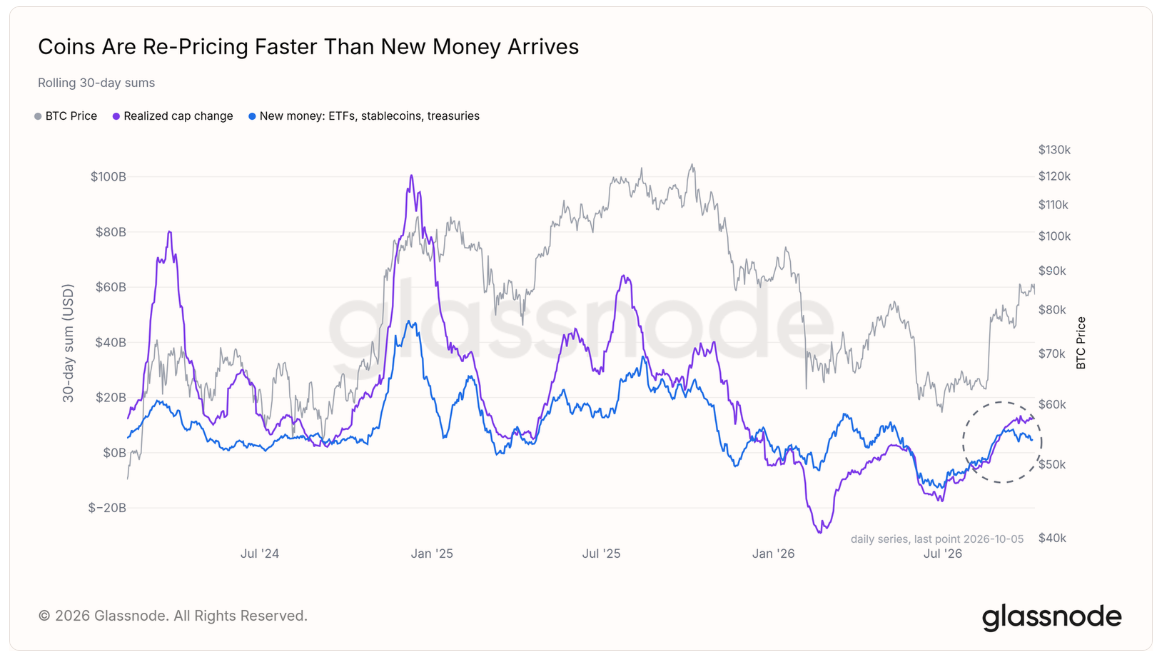
"The rallies of 2024 and 2025 showed a similar mix, but on far larger inflows," Glassnode added. Until those external capital inflows pick up the pace, the sustainability of any upward price move depends heavily on existing market participants continuing to pay higher prices for available supply.
Newer Investor Profit-Taking Surges as Bitcoin Tests $85,000
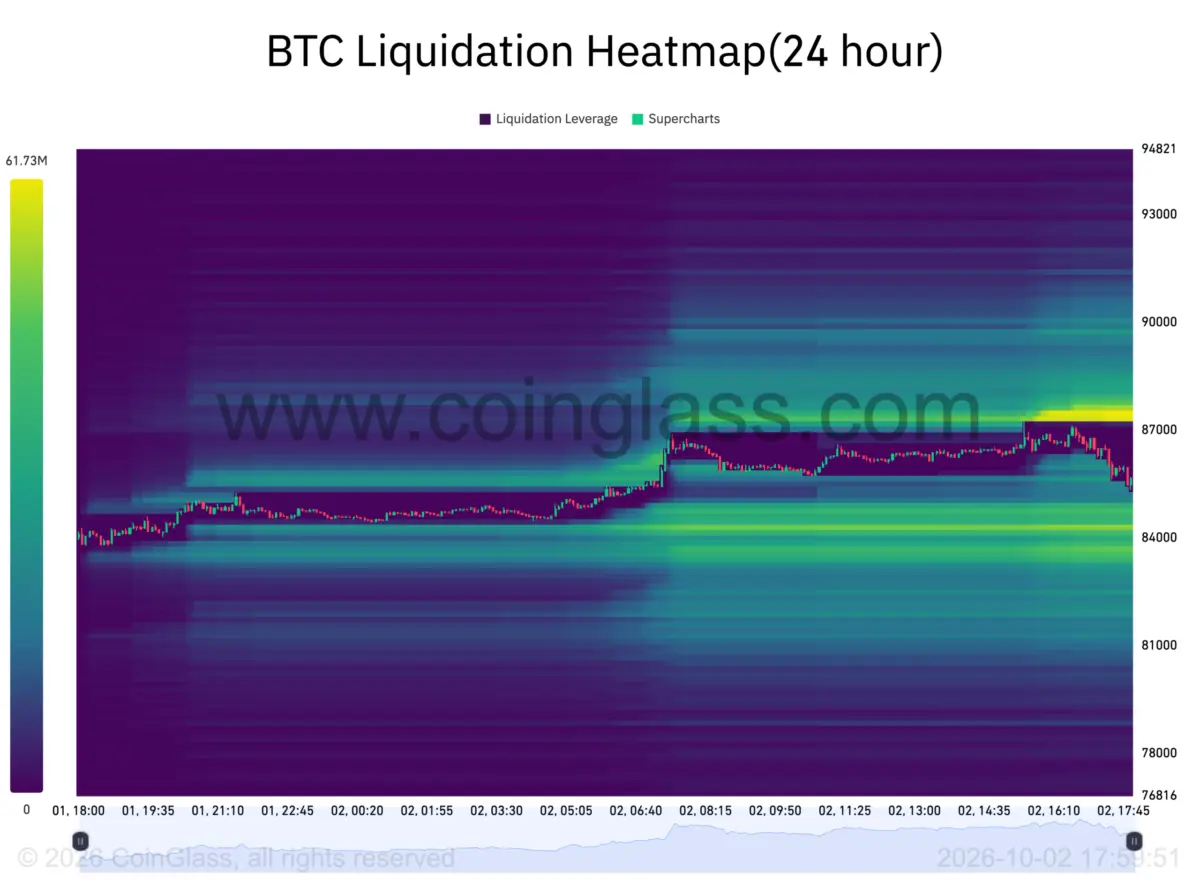
The absence of robust new capital inflows comes at a delicate time for Bitcoin price action. Over the weeks following Sept. 21, Bitcoin made four distinct attempts to break out decisively beyond the $87,000 threshold. Each of these breakout attempts ultimately stalled out as buyers encountered thick and resilient overhead ask liquidity sitting on major exchange order books. Consequently, the BTC/USD pair hovered near the $83,000 mark, registering a modest 1% decline month-to-date.
This price suppression has occurred alongside broader macroeconomic pressures, including a recent drop to an October low of $82,700 as global bond markets experienced renewed sell-offs driven in part by escalating geopolitical nerves surrounding Iran and the Middle East.
Adding to the complex market dynamics, Glassnode highlighted a sharp spike in profit-taking behavior among newer investors over the weekend. This activity coincided with Bitcoin securing its first weekly close above the $85,000 level since January.
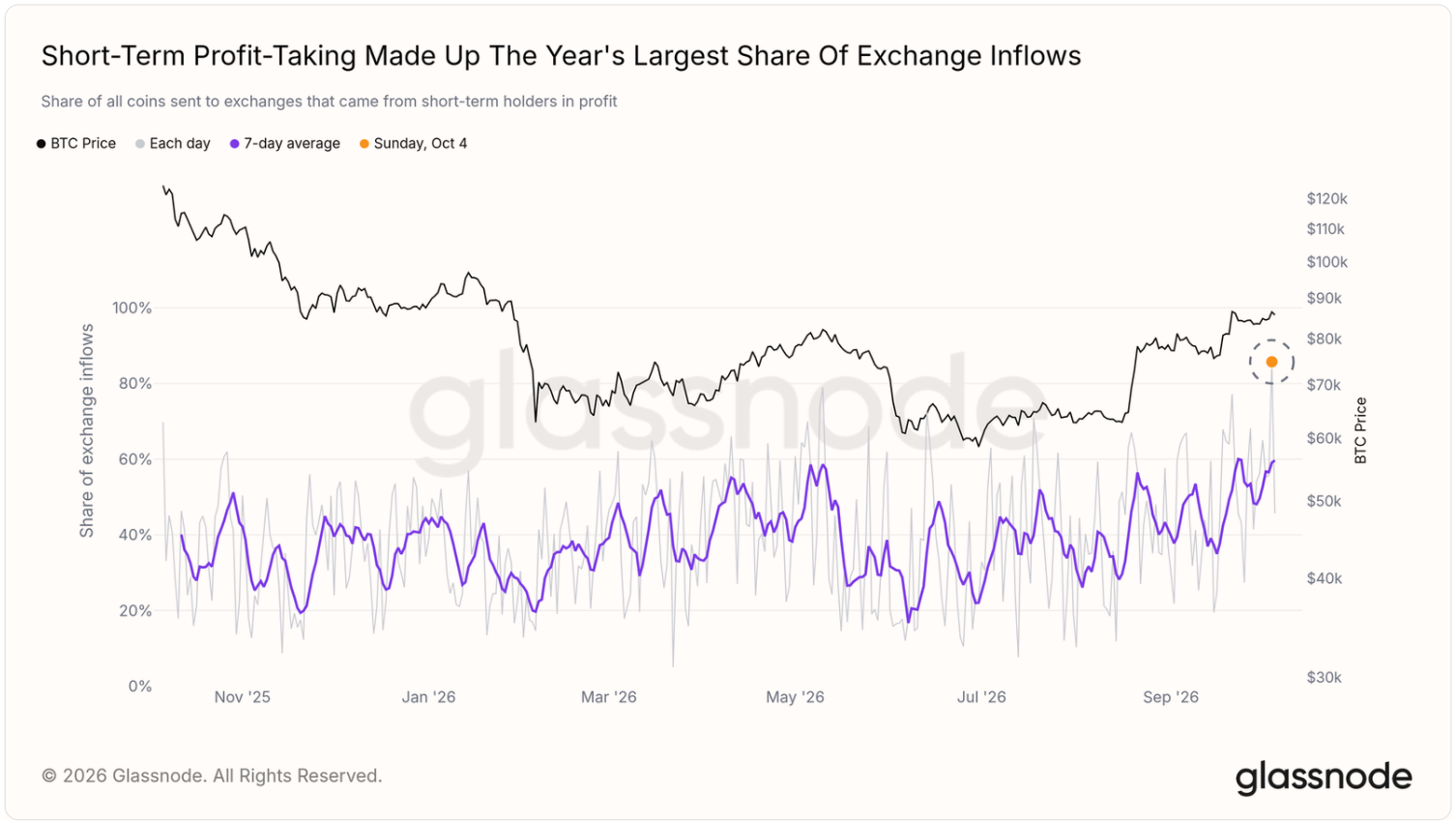
"Of all the coins sent to exchanges that day, about 86% came from short-term holders, those holding for less than 155 days, moving coins at a profit. That is the highest share of any day in the past year; on a typical day it is under two fifths," the research platform noted.
Short-term holders (STHs) are historically characterized by their heightened sensitivity to immediate price volatility and market sentiment shifts. Despite their propensity to lock in gains when prices appreciate rapidly, this cohort remains collectively in a net profit position. Data compiled from crypto analytics provider CryptoQuant indicates that the aggregate cost basis—frequently referred to as the realized price—for short-term holders stood at approximately $78,250 as of Oct. 7.
As the market navigates these conflicting forces of stubborn overhead resistance, enthusiastic profit-taking by newer participants, and a relative lag in fresh external capital, traders and analysts alike continue to monitor onchain metrics closely to determine whether Bitcoin can build the structural foundation necessary for a sustained push toward higher all-time highs.