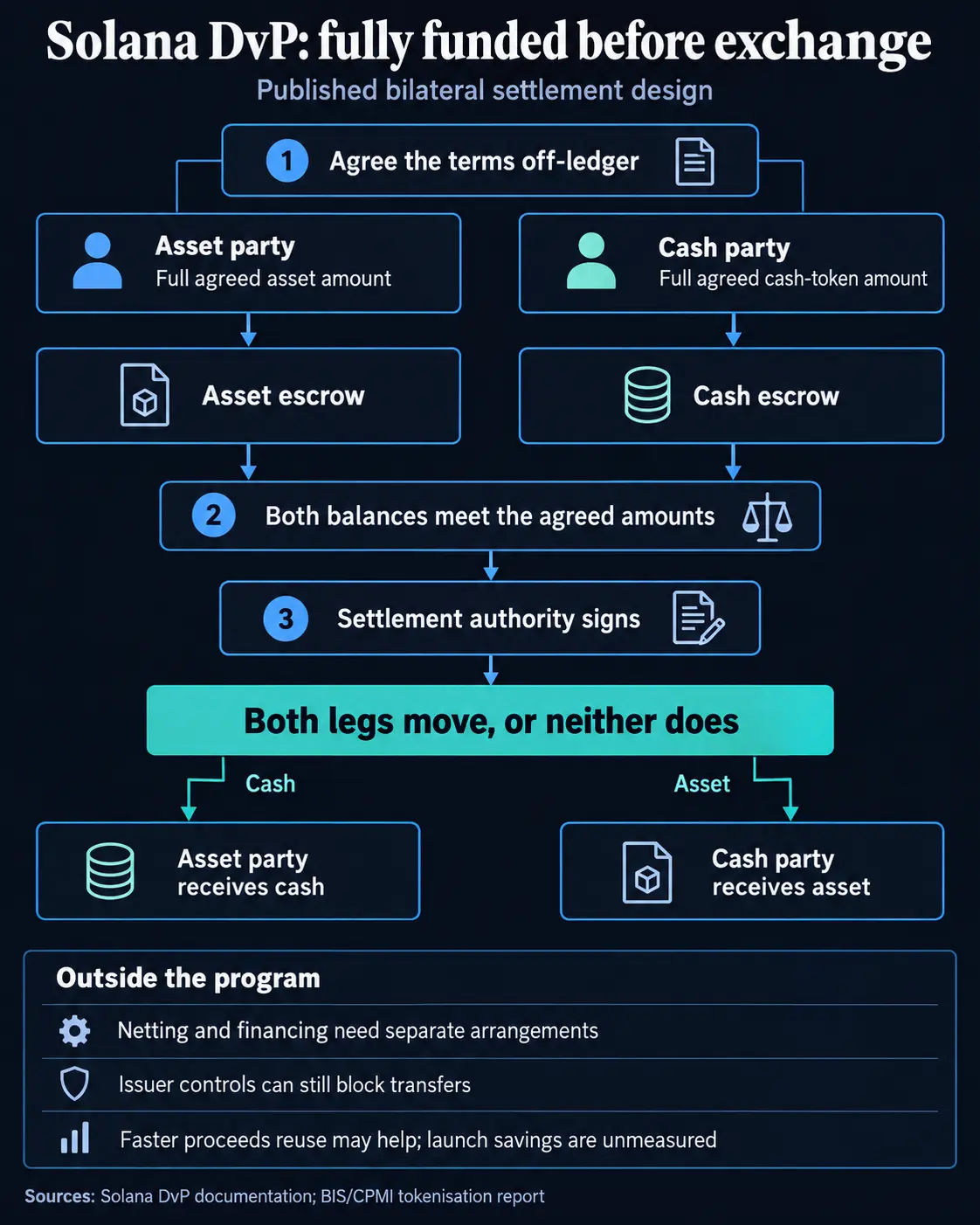
The Solana Foundation has officially launched Solana DvP, a new open-source standard for delivery-versus-payment settlement tailored for financial institutions. According to the published design of the institutional settlement program, the framework requires the full cash and asset legs of a trade to be fully available and deposited before an exchange can be executed.
Announced on Oct. 6, the atomic settlement program is engineered to prevent a buyer from paying without concurrently receiving the designated asset. However, the program itself supplies neither the cash nor the external financing required to reach that initial funded state. Under the published mechanics, the system places each side’s tokens into separate escrow accounts and then moves both agreed amounts together in a single transaction. The design also explicitly excludes netting—the standard financial process of offsetting obligations across multiple trades before paying a remaining balance.
While institutional participants may benefit from a significantly shorter wait time to access their proceeds, they are still tasked with sourcing the full capital amount for every individual trade they submit to the network. Furthermore, the initial announcement provided no measured capital-saving results or total-cost comparisons to quantify these potential efficiencies against traditional settlement rails.
Full Funding and Faster Reuse
Under the published program limits, a single trade record covers a straightforward exchange between two distinct parties. Both legs of the transaction must consist of designated token accounts native to Solana, and partial fills are strictly prohibited. Consequently, traditional bank-account payments executed across external payment rails fall entirely outside the scope of this atomic exchange.
The underlying settlement code, referenced at the documented source commit, performs strict validation checks to ensure that each escrow balance contains at least the precise amount agreed upon for that specific leg before transferring either asset. If either side is underfunded, the entire settlement transaction fails. In such cases, any excess tokens are safely returned to the named party rather than being used to increase what the counterparty receives.
Economic responsibility for the trades remains entirely with the participants and their respective financiers. A buyer must independently arrange the necessary cash token, while a seller must secure the required asset token. Although a lender could theoretically finance either position through a separate financial arrangement, that relationship remains completely outside the scope of the DvP program.
Funding is executed via ordinary, checked token transfers, meaning specialized custody or treasury systems can supply the tokens without requiring a complex or proprietary funding call. Both balances must meet the agreed-upon amounts at the exact moment of settlement, and a designated settlement authority must cryptographically sign off to exchange them.
This settlement authority—acting as a third address named directly in the trade record—must sign the settlement instruction to execute the swap, and the final destinations are permanently fixed when the record is originally created. If a required transfer cannot be completed for any reason, the settlement transaction automatically reverses, while any earlier funding transfers remain separate transactions.
Gross funding questions ask precisely how much capital must be available for a single trade, whereas funding duration examines how long those assets remain unavailable for alternative uses. Solana DvP’s bilateral design requires full funding amounts at the exact moment of settlement, but it does not mandate that institutions keep those balances idle permanently.
A participant that receives usable cash or assets faster may be able to deploy them into subsequent trades sooner. This capability could theoretically reduce how long an institution needs external financing or lower the amount of liquidity it must hold against a sequence of ongoing obligations. Ultimately, the tangible benefit heavily depends on when funding is required and when the resulting proceeds actually become spendable.
Offsetting obligations typically reduces the volume of capital that needs to move during a settlement cycle. Because Solana DvP does not perform this calculation across multiple trades, institutions that require netting or credit facilities must arrange those functions elsewhere before deciding how much capital to transfer into their respective escrows.
This operational tradeoff has been highlighted by traditional financial watchdogs. The Bank for International Settlements (BIS) and the Committee on Payments and Market Infrastructures addressed the dynamic in their October 2024 report on asset tokenization, noting that immediate gross settlement can frequently demand significantly more liquidity than traditional netting arrangements. At the same time, the report identified the countervailing benefit: quicker access to money and assets can reduce the opportunity cost of liquidity tied up during prolonged settlement windows.

Similar distinctions have emerged across various segments of the digital asset landscape. A CryptoSlate analysis of tokenized deposits previously examined the division between moving cash faster versus reducing the total capital required. Meanwhile, broader banking integrations on Solana continue to explore hybrid models where token transfers and token burning sit alongside daily traditional netting of bank-account movements, effectively combining tokenized speed with separate offsetting processes.
What the Atomic Exchange Protects
The primary protection offered by Solana DvP is the elimination of principal delivery risk within the token exchange itself. This ensures that neither side hands over its agreed leg without the other leg moving simultaneously. However, the broader financial relationship between the counterparties still depends heavily on the specific instruments being exchanged.
A cash token inherently carries the credit and redemption risks of its issuer, while a regulated asset token may retain built-in transfer controls. Mechanisms such as freeze functions, pause capabilities, and permanent-delegate powers remain fully relevant while tokens are sitting inside the program’s escrows.
The program’s unwind instructions allow either party to reclaim its own leg while leaving the trade open, or to reject the trade entirely and trigger a refund for both legs. The designated settlement authority can also cancel a trade, and a separate recovery instruction handles deposits that might arrive after a trade has already closed, subject to the underlying token’s specific transfer rules.
Crucially, these recovery powers do not override an issuer that chooses to freeze an escrow account or block transfers. A fully funded trade can still fail to complete, and refunds can heavily depend on issuer cooperation, alongside the availability of the authorized settlement signer.
Under the trade-creation terms, refunds and reclaims are routed back to the named party’s original token account, even if an institutional custodian originally supplied the initial deposit. While agreed settlement destinations can successfully receive proceeds, the refund route may differ significantly from the original funding route.
Industry documentation instructs network operators to recognize a settlement as complete only when a transaction reaches Solana’s finalized commitment stage. Whether that technical finality also constitutes a legally final settlement under commercial law depends entirely on the private agreements established between the participating parties and the applicable regulatory regimes.
Deployment, Audits, and Institutional Use
The Solana Foundation’s documentation currently points to an upgradeable program deployed on mainnet-beta and devnet. The mainnet deployment includes a designated upgrade authority—an address possessing the technical power to alter the deployed program code. Consequently, participating institutions must rely on the governance and settlement rules established by this authority.
Client documentation references specific public source revisions, while independent security reviews have evaluated the codebase. Security auditing firm Cantina conducted an evaluation of an earlier repository and specific fixes, resulting in four medium-risk findings that were marked as fixed, alongside three low-risk and six informational findings that were formally acknowledged by developers.
The Foundation maintains that the program is ready for real funds while continuing to invite design partners and early institutional participants ahead of a broader production release. Notably, major financial institutions like JPMorgan have maintained limited involvement; the bank provided input regarding standard securities settlement practices, but the official announcements expressly disclaimed any role by the bank in the program’s design, development, operation, approval, endorsement, or guarantee.
For institutional adopters, the most valuable future evidence will connect actual settlement utilization metrics with the exact amount and duration of required funding, ongoing financing costs, and whether proceeds genuinely become spendable faster. While Solana DvP delivers a defined and reliable atomic exchange mechanism, transforming that technical capability into a measurable capital-saving service will ultimately depend on the broader cash, assets, and financing structures surrounding it.