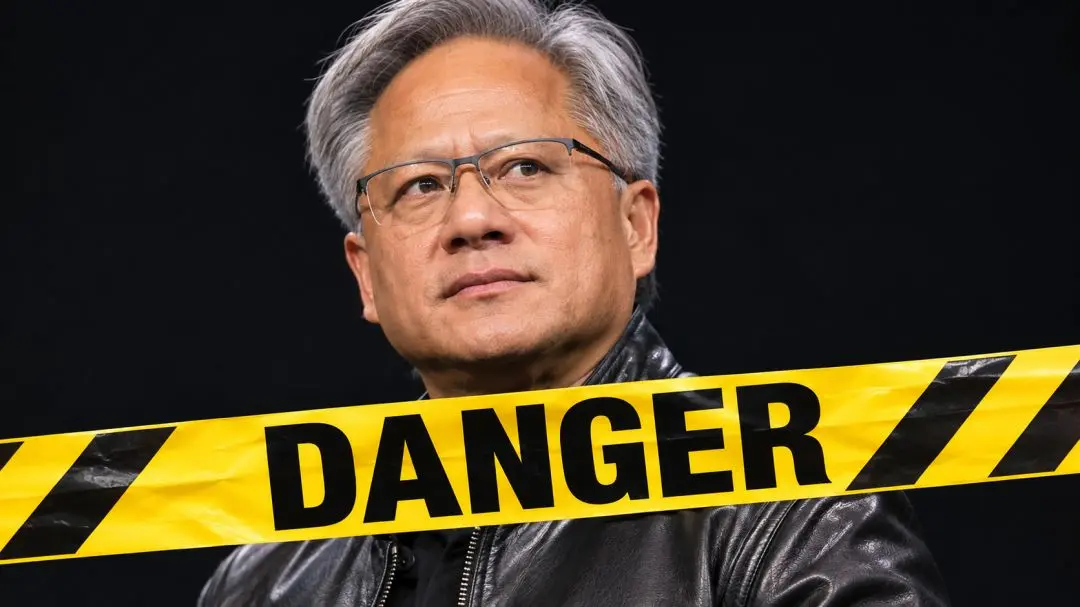
Investors cheered Jensen Huang’s return as Nvidia’s chief executive officer on Monday, celebrating a dramatic corporate homecoming that sent waves of relief across global markets. However, renowned business academic Jeffrey Sonnenfeld of Yale University believes shareholders are celebrating a grave mistake. He sees a technology powerhouse that has become largely responsible for putting sophisticated, high-end computing technology directly into the hands of the nation’s adversaries, all at a moment when geopolitical risks and security stakes could not possibly be higher. Far from acting as a champion of American industrial might, Sonnenfeld argues that Nvidia’s operational missteps and leadership choices make the company a detriment to U.S. global industrial strength.
As evidence to support this stark assessment, Sonnenfeld points to mounting research and investigative reports suggesting that Nvidia’s most advanced artificial intelligence chips—including the powerful B300 hardware—have successfully reached China despite strict U.S. export controls. He also connects this reality to the sinking shares of prominent AI startup Anthropic. That market downturn, he suggests, stems from a growing realization among industry observers that China’s seemingly miraculous open-source AI models are, in a fundamental sense, unauthorized copies of top U.S. research labs’ hard work. This illicit transfer persists even as Nvidia has repeatedly insisted that hardware smuggling into restricted markets remains a non-factor.
Indeed, Huang’s reinstatement was greeted with immense enthusiasm overseas, particularly in Asia, as documented by reports from The Washington Post. "The king is back!" declared one prominent headline published by China’s state-affiliated Star Market Daily, underscoring the deep ties and commercial significance the region holds for the Silicon Valley chipmaker.
Political Pressure and the Fight for Control
The dramatic corporate reversal itself followed heavy, coordinated pressure from Washington. Nvidia’s chairman had effectively ruled out Huang’s return to the top post just a week prior to the announcement. Then, in a whirlwind of private weekend telephone calls spearheaded by Vice President JD Vance, top administration officials leaned heavily on the corporate board to welcome Huang back into the fold. The pressure culminated when President Donald Trump called the board directly to vouch for the executive. "I made the deal," Trump told CNBC during a broadcast on Monday, highlighting the unprecedented level of direct political intervention in a major American corporation’s governance.
Sonnenfeld argues that the directors who capitulated to this pressure, choosing to return Huang to both his executive seat and the board of directors while an active investigation probes whether foreign intelligence efforts targeted him, now face a historic level of individual legal liability.
The legal deluge against the company and its leadership has already begun to materialize in earnest. As reported weeks ago, a potential class-action lawsuit was filed against Nvidia almost immediately following the initial leadership turmoil. Days later, a shareholder derivative suit followed. Filed formally on Nvidia’s behalf against the directors themselves, this secondary suit alleges that the corporate board deliberately ignored glaring red flags concerning Huang’s relationship with suspected Chinese intelligence operative Alice Huang.
The mechanics of these legal challenges highlight distinct paths for accountability. The class-action lawsuit is squarely aimed at forcing Nvidia and Huang to compensate retail and institutional investors for substantial financial losses. Meanwhile, the derivative suit puts the personal behavior and oversight failures of the directors on trial, ensuring that any financial recovery is funneled directly back into Nvidia’s corporate coffers. The legal pressure intensified further when three additional lawsuits were filed on November 18, coinciding with the day of Nvidia’s most recent quarterly earnings call. All five legal actions have been filed in Northern California, where Nvidia maintains its corporate headquarters.
A Growing Web of Investigations and Inquiries
The legal and regulatory burdens facing Huang and Nvidia extend far beyond shareholder litigation. The company is currently juggling a sprawling array of government probes and oversight actions. These include a Department of Justice antitrust investigation, a reported Securities and Exchange Commission probe into Nvidia’s corporate accounting practices, a possible Federal Bureau of Investigation review, an investigative subpoena issued by the California Attorney General, and an export-control case that resulted in corporate partner Megaspeed landing on the United States trade blacklist. Furthermore, the company faces mounting congressional inquiries, highlighted by a scheduled Senate Banking Committee hearing where Huang has formally agreed to testify.
When questioned about whether the board’s heavy reliance on government assurances is legally defensible or amounts to a clear abdication of its fiduciary duties, Sonnenfeld is blunt in his critique. He asserts that the directors fundamentally failed to rely on objective, independent experts. According to Sonnenfeld, this failure is a primary reason why the board is destined to lose these legal battles and why the individual directors face unprecedented personal liability. He notes that the board maintains an inadequate directors and officers liability policy and faltered in its basic corporate diligence, pointing to their hiring of the Wachtell legal firm, which he claims barely initiated a substantive investigation before the board abruptly reversed course.
Sonnenfeld describes the board’s decision to reinstate Huang directly to the board of directors as an act characterized not just by incompetence and collaboration, but by outright cowardice. He notes that while intense political pressure can sometimes be understood when a company’s business model relies heavily on federal contracts—such as SpaceX, where a massive percentage of revenue comes from the government—Nvidia relies on the U.S. government for less than one percent of its business. Consequently, he argues, the board lacked the defensive leverage typically provided by government dependence. While political intervention might temporarily shield executives from certain federal investigations, Sonnenfeld emphasizes that it cannot stop private shareholder litigation, which is projected to expand significantly and carry exorbitant costs.
This corporate controversy has notably transcended traditional partisan divides. Fourteen prominent Republican senators, alongside influential conservative figures such as Pete Ricketts, Josh Hawley, Tom Cotton, and John Cornyn, have publicly voiced their opposition to these developments. Sonnenfeld suggests that this widespread bipartisan pushback helps explain why Nvidia’s stock price has experienced sharp turbulence.
Regarding the potential for classified intelligence findings to absolve Huang of wrongdoing, Sonnenfeld remains deeply skeptical. He points out that the board has not reviewed these findings, and the broader results from upcoming probes by the Senate Intelligence Committee, the Senate Special Committee on Investigations, the Senate Banking Committee, and their respective House counterparts remain entirely unwritten. Even if the board were to review such materials, Sonnenfeld contends that it would not alter the fundamental legal and governance failures already committed.
Export Controls and the Global Tech Landscape
As federal authorities evaluate regulatory frameworks, questions persist regarding whether the Department of Commerce will continue to tighten chip export controls to restrict China’s computing access or reverse recent policy adjustments. Sonnenfeld points to the recent sanctioning of Megaspeed as a necessary step that should have been taken much earlier. He reiterates his view that Nvidia’s hardware distribution has inadvertently harmed U.S. global industrial competitiveness, noting documented instances where advanced chips reached institutional entities tied to foreign military apparatuses, eventually surfacing in systems that pose direct security challenges.
Furthermore, Sonnenfeld addresses the narrative surrounding China’s rapid advancements in artificial intelligence. While open-source models developed by overseas entities have often been praised as independent technological miracles, Sonnenfeld argues that investigations reveal a different reality. He claims that these systems rely heavily on distilling work from top American labs, facilitated by the acquisition of high-end Nvidia hardware despite existing trade restrictions.
Nvidia has consistently denied reports that its most advanced processors have been successfully smuggled into restricted markets. However, Sonnenfeld highlights ongoing international tracking efforts, pointing to reports from foreign intelligence and security researchers identifying high-end hardware inside Chinese networks. He observes that while tech industry leaders have largely remained silent regarding Huang’s contentious return, the corporate leadership at major enterprises across finance, retail, and manufacturing has offered no public celebration of the move, contrasting sharply with the vocal demonstrations seen among certain factions of the tech sector.
When evaluating the operational necessity of Huang’s return, Sonnenfeld contends that the executive was never personally responsible for the fundamental engineering breakthroughs driving the company. He credits co-founder Chris Malachowsky and his specialized hardware teams with designing the underlying graphics processing units, and engineer Ian Buck with developing the essential CUDA software architecture that harnesses these chips. These foundational engineering talents, Sonnenfeld notes, remained at the company regardless of executive leadership changes.
The controversy surrounding Huang’s initial ouster—triggered by an admitted extramarital affair with a subordinate—has also sparked fierce debates regarding corporate governance and human resources policies. While some commentators have attempted to minimize the incident as an overreach of corporate compliance protocols, Sonnenfeld argues that a chief executive officer who fails to uphold the organization’s established code of conduct renders those rules entirely unenforceable for the rest of the workforce. He stresses that workplace relationships involving subordinates inherently compromise objective decision-making regarding resource allocation, staffing, and product strategy, creating an environment susceptible to either favoritism or retribution where team members’ professional trajectories are unfairly tied to dynamics completely outside their control.