
The United Kingdom’s financial watchdog has officially published its landmark crypto regulatory framework, marking the final stage of an extensive roadmap designed to integrate digital assets firmly into the country’s mainstream financial regulatory perimeter.
Announced via a press release shared with Cointelegraph, the comprehensive rules introduce sweeping changes for the digital asset sector. Significant new elements include mandatory licensing requirements for cryptocurrency firms, strict capital stress-testing protocols, enhanced rules to combat market manipulation and insider trading, and simplified capital requirement standards specifically tailored for stablecoin issuers.
David Geale, executive director of payments and digital finance at the Financial Conduct Authority (FCA), emphasized that the new framework bridges the gap between traditional banking regulation and digital innovation. He noted that crypto companies operating within the UK will now be held to standards comparable to those governing other established financial service providers.
According to Geale, the regulator has successfully engineered a framework that eliminates the need for companies to choose between regulatory certainty and operational flexibility. He stated that the new regime provides both, offering a stable and competitive environment for businesses to build and grow sustainably within the UK market.
Under the updated guidelines, a broad spectrum of cryptocurrency enterprises—including digital asset trading platforms, institutional custodians, stablecoin issuers, staking service providers, and various other intermediaries—will be legally required to obtain formal FCA authorization to continue operating in the United Kingdom.
The rollout follows the conclusion of a public consultation window that wrapped up on June 3, during which the regulator gathered feedback from industry stakeholders regarding the overarching guidelines for the nation’s forthcoming digital asset regime.

Industry experts have welcomed the shift, viewing it as a mature evolution for the market. Edwin Mata, a corporate attorney and the chief executive officer of tokenization platform Brickken, observed that the draft represents a pivotal transition. He noted that the UK market is successfully moving away from an enforcement-led environment and stepping into a comprehensive financial services regime, illustrating the FCA’s clear intent to make crypto companies operate akin to traditional regulated financial institutions.
Despite the broad praise for bringing regulatory clarity, market participants have also raised critical questions regarding the economic impact and long-term viability of the compliance costs. Katie Harries, Coinbase’s head of policy in Europe, commended the final rules for preserving access to global liquidity and praised the innovative design of the licensing structure. However, she pointed out a couple of pressing issues that still require careful consideration.
Harries noted that while the FCA has made welcome adjustments to its prudential framework, it remains an open question whether these modifications have gone far enough to ensure that the cost of doing business in the UK does not become materially higher compared to competing international jurisdictions. Furthermore, she highlighted that the UK’s future regulatory approach to decentralized finance remains her second major concern, warning that earlier proposals carried the risk of resembling a de facto ban on centralized platforms providing retail and institutional access to decentralized finance applications.
AML-Authorized Crypto Firms Need New Licenses in the UK
A critical operational detail of the new framework is that crypto firms currently holding authorization exclusively under existing money laundering regulations will not have their licenses automatically converted. Instead, these entities will be mandated to undergo the comprehensive process of securing a brand-new authorization under the upgraded regime.
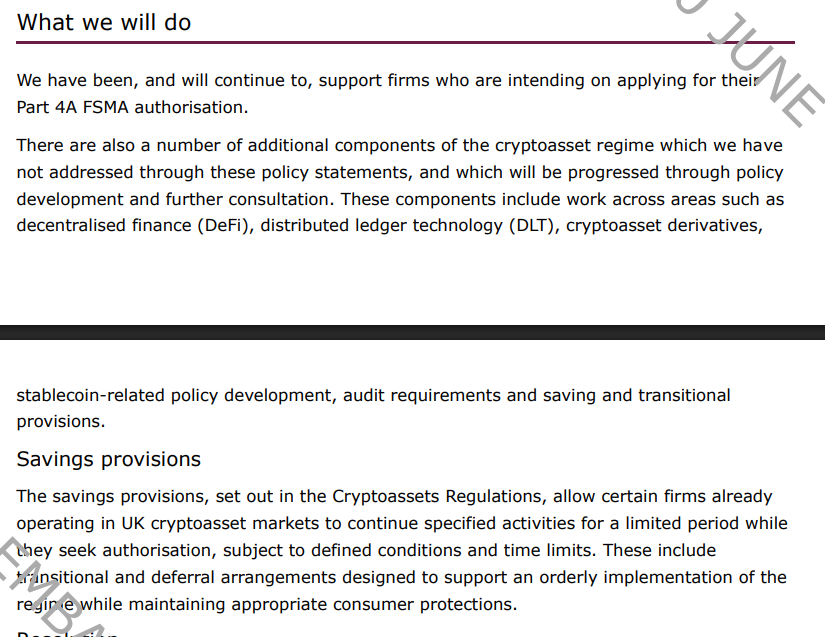
To accommodate the transition and prevent sudden market disruptions, the FCA has implemented transitional savings provisions. These provisions will allow certain companies already actively operating in the UK to continue specified business activities for a limited period while they actively pursue formal authorization under the newly established framework.
To assist firms through the complex compliance process, the FCA announced that pre-application support meetings for interested companies will officially commence next month. Furthermore, the regulator plans to outline its detailed policy statements during a dedicated webinar scheduled for July 17. This will be followed by the publication of an additional policy statement in September, which will clarify precisely how the regulatory perimeter applies to various specific cryptoasset activities.
FCA Simplifies Stablecoin Capital Standards, Promises Tailored DeFi Guidance
In refining its approach to stablecoins, the FCA has largely preserved the core framework introduced in earlier drafts while implementing thoughtful, minor adjustments. Notably, the regulator has simplified the backing asset composition requirements. Issuers will no longer be forced to calculate estimated redemption forecasts. Additionally, the rules now incorporate explicit requirements for statutory trusts over reserves while removing the previously mandated unallocated backing fund accounts.
Under the finalized guidelines, stablecoin issuers will be required to offer specific, guaranteed withdrawal rights to their users. The framework also permits a 5 percent excess to be held within the backing asset pool and allows for limited intragroup custody arrangements, provided that strict operational safeguards are firmly in place.
The FCA emphasized that these adjustments establish a solid baseline regime for stablecoin issuance within the country. The regulator also noted that it will consult further with the Bank of England later in the year to determine how these regulatory standards will specifically apply to stablecoin issuers that are formally recognized as systemic by Her Majesty’s Treasury.
Looking ahead at the broader technological landscape, the FCA confirmed plans to host a separate public consultation later this year focused specifically on decentralized finance guidance and operational resilience standards for firms utilizing distributed ledger technology. The regulator also intends to consult on updates to its Financial Crime Guide to ensure it adequately covers cryptoasset firms.
Matthew Long, director of payments and digital assets at the FCA, reiterated the regulator’s ongoing commitment to understanding and addressing the nuances of decentralized architectures. He stated that the agency will continue working closely on decentralized finance, pursuing a careful case-by-case approach. Long explained that true decentralized finance, characterized by scenarios where there is no identifiable person or corporate entity undertaking the activity, will naturally fall outside the traditional scope of the regulatory framework.
As the countdown begins toward the opening of the licensing window from September until February 2027, followed by the official go-live date of October 25, 2027, the UK digital asset industry stands on the brink of a thoroughly regulated era.