
Intents Clash Over Stolen Funds Following Massive Bitget Hack
The crypto industry is locked in a fierce debate over decentralization, moral responsibility, and financial integrity following a massive security breach that saw $387.5 million in stolen funds quickly moved across multiple blockchain networks. The incident, which stemmed from a hack targeting prominent cryptocurrency exchange Bitget, has forced a reckoning among decentralized finance protocols regarding how they handle illicit flows and whether absolute permissionlessness can coexist with ecosystem safety.
Following the exploit on Sept. 24, the stolen assets began traversing various cross-chain bridges and protocols. Bitget Chief Executive Gracy Chen publicly appealed to decentralized cross-chain swap platform THORChain, urging leadership to refuse service to attacker-linked addresses and noting that the broader digital asset industry was watching how the protocol would respond.
However, THORChain refused the request, igniting a broader industry debate between advocates who believe protocols have a moral obligation to block stolen funds and purists who hold the cypherpunk ideals of permissionless, censorship-resistant technology as absolute.
Having previously watched validators and users navigate a situation where hackers funneled $1.2 billion through the protocol during past incidents, THORChain’s stance on the matter remains firm. Protocol contributor Boone Wheeler explained the foundational philosophy in an interview, stating that a truly permissionless protocol is inherently blind to the provenance of the assets moving through it. According to Wheeler, if THORChain possessed the technical capability to block specific stolen funds, it would by definition cease to be a permissionless infrastructure.

Where does permissionlessness end?
Critics of THORChain’s absolute neutrality argue that the protocol has not always adhered strictly to unyielding decentralization. Observers point to an incident in May when validators voted to halt the chain after an automated system triggered following a security vulnerability exploit that drained over $10 million from one of the platform’s vaults.
The contrast in industry approaches became even sharper when examining the response from NEAR Intents, a cross-chain transaction competitor to THORChain. NEAR took the opposite route by actively intervening to block hack-linked funds. Its automated security layer, known as SHIELD, identified more than $50 million in attempted transaction flows tied to the Bitget incident. The system successfully stopped $503,000 during execution, though it noted that approximately $166,000 ultimately passed through. Additionally, NEAR Intents waived its share of Bitget’s recovery bounty as part of its cooperative stance.
Alex Shevchenko, general manager at NEAR, explained the duality of their network architecture, emphasizing that while NEAR Protocol is entirely permissionless—allowing anyone to build, transact, and validate without approval—that does not mean individual applications built on top of it are forced to process every incoming request.
Despite this defense, NEAR Intents has faced heavy criticism from decentralization advocates who argue that intervention proves the protocol lacks true permissionlessness and decentralization. Such actions, critics warn, could expose the project to pressure demanding broader and more frequent controls. However, legal experts like crypto lawyer Yuriy Brisov suggest that because SHIELD operates as an automated system rather than a manual compliance desk, it may still fall within legal protections traditionally afforded to decentralized protocols. Brisov noted that the absence of a manual compliance team managing operations day-to-day represents a smart structural solution for DeFi companies navigating regulatory expectations.
Permissionless does not necessarily mean neutral
Bitget CEO Gracy Chen acknowledged that while different protocols operate under varied architectures, governance models, and technical capabilities, a distinct line exists between permissionless infrastructure and actively facilitating the movement of known stolen funds. Praising the cooperative response from NEAR Intents, Chen confirmed that Bitget intends to pursue appropriate legal and recovery processes for those assets.
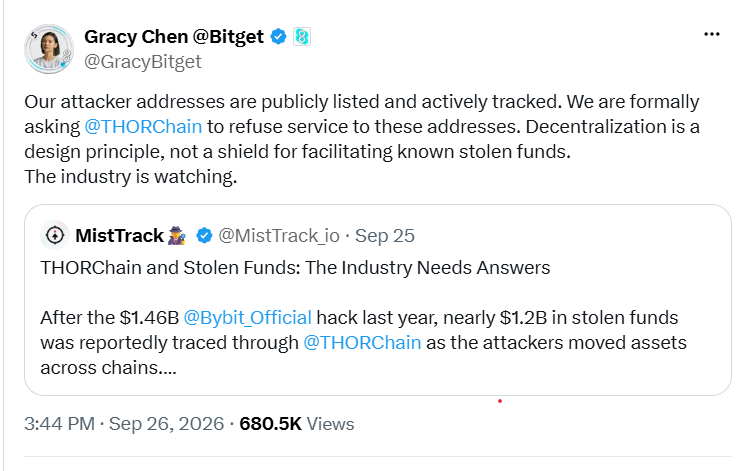
Bitget’s leadership is actively engaging the broader market to understand what is technically and governance-wise possible when illicit assets are identified, hoping the industry can collaborate on workable approaches. Chen emphasized that maintaining permissionless infrastructure does not inherently preclude the establishment of mechanisms designed to detect and respond to known illicit flows.
Complicating THORChain’s absolute defense of neutrality is the reality that the protocol has demonstrated an ability to intervene during emergencies. Post-mortem reports detailing the May exploit revealed that the network automatically halts activity when solvency checks detect an insolvency event, allowing node operators to deploy broader emergency controls to pause trading, signing, and other network operations.
Wheeler countered that a firm consensus exists among THORChain’s node operators regarding the preservation of permissionless operations, maintaining that network halts are deployed exclusively during active technical issues or protocol-level emergencies. Furthermore, Wheeler reiterated that THORChain possesses no built-in functionality to screen individual addresses or transactions, a deliberate design choice intended to ensure the system remains truly permissionless by design.
NEAR Intents provides a contrasting model
While THORChain positions itself firmly within the uncompromising, developer-centric side of the decentralized spectrum, the NEAR ecosystem occupies a middle ground, balancing open participation with active ecosystem defense.
Shevchenko noted that NEAR Intents was built with integrated financial integrity measures, with the SHIELD component engineered to automatically apply targeted risk controls to supported cross-chain flows. During the Bitget incident, SHIELD leveraged public onchain data, internal anti-money laundering databases, and intelligence feeds provided by third-party analytics partners. According to Shevchenko, screening for stolen funds and restricting money laundering safeguards the integrity of the wider blockchain economy, preventing major hacks from draining capital and activity from the ecosystem.
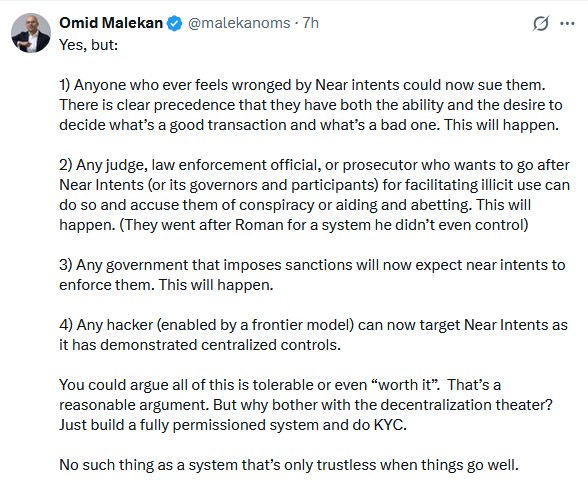
The effectiveness of this automated infrastructure was further demonstrated when the AI-based SHIELD system successfully identified suspicious behavior behind a separate multi-million-dollar Omni deposit and withdrawal interaction exploit, prompting an immediate halt to related activity.
Chen reiterated that when stolen assets can be reliably identified, ecosystem participants should cooperate whenever technically and legally feasible. Such cooperation could range from transaction tracing and information sharing to declining specific interactions, freezing assets where underlying infrastructure permits, or supporting recovery efforts through formal law enforcement and legal channels.
The cost of drawing the line
The ideological divide over protocol intervention highlights deeply rooted philosophical differences within the cryptocurrency community. Joël Valenzuela, a libertarian, cypherpunk, and head of business and development for Dash, argues that permissionless protocols must remain entirely neutral, regardless of the circumstances.
Valenzuela asserted that permissionless protocols should never draw arbitrary lines when identifying stolen funds, because the mere capacity to do so transforms them into permissioned systems. While acknowledging the frustration of watching stolen funds move freely across networks, he warned that introducing intervention capabilities opens a dangerous Pandora’s box that could eventually lead to widespread censorship of innocent users. Instead, Valenzuela argued that centralized exchanges must bear the responsibility of hardening their security protocols, pointing to decentralized exchanges as the ultimate trajectory for the industry.
Conversely, Max Shannon, senior research associate at Bitwise Europe, suggests that protocols in their formative development stages, such as THORChain and NEAR, must still earn market trust, making the refusal to launder hack proceeds a pragmatic and sound defensive stance. Shannon predicts that THORChain’s strict adherence to non-intervention will likely result in increased money laundering activity shifting away from platforms like NEAR Intents and toward THORChain.
Shannon observed that the demand for credible neutrality at all costs remains a foundational cypherpunk ideal championed by a vocal minority of crypto builders and users. As the industry matures, the friction between absolute permissionlessness and practical ecosystem defense continues to shape the evolution of cross-chain liquidity and decentralized infrastructure.