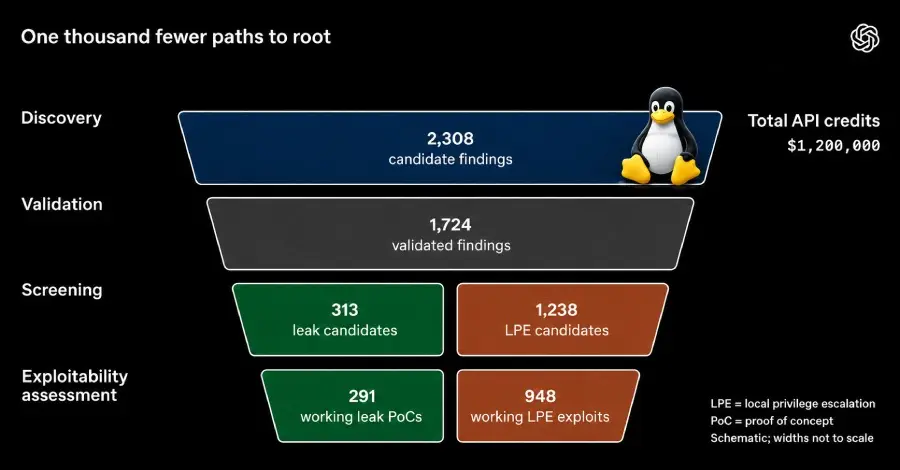
In a significant milestone highlighting the rapidly evolving intersection of artificial intelligence and cybersecurity, OpenAI detailed a sophisticated automated pipeline on Wednesday that utilized an upcoming cyber-focused AI model to identify, validate, and patch 948 local privilege escalation vulnerabilities within the Linux kernel. The large-scale operation, which cost approximately $1.2 million in API credits, marks a major step forward in how frontier artificial intelligence models can be deployed to both stress-test foundational software architecture and harden defenses against sophisticated threat actors.
According to technical documentation released by the artificial intelligence company, their prototype successfully analyzed 2,308 candidate Linux kernel findings during a mid-October 2026 run. Within a condensed 30-hour window, the autonomous agentic pipeline dynamically reproduced 1,724 vulnerabilities, generated proof-of-concept exploits for 291 information leak vulnerabilities, and ultimately produced 948 working local privilege escalation exploits capable of granting an unprivileged local user complete root access on a commonly deployed Linux distribution.
The research builds directly upon previous disclosures made by OpenAI earlier this year in June 2026, when the company revealed that its GPT-5.5-Cyber model had independently discovered an initial batch of 24 local privilege escalation exploits. The latest initiative scales that capability into a fully realized, five-stage agentic pipeline capable of handling massive volumes of complex operating system code at unprecedented speeds.
Outlining the financial and operational scale of the project, OpenAI noted that the total cost for the extensive run reached $1,213,430, translating to roughly $1,279 per generated local privilege escalation exploit. More notably, the company stated that to the best of its knowledge, the automated agents operating within the pipeline successfully discovered and implemented at least 10 novel Linux exploitation techniques that had not previously been documented or utilized in standard security research.

This development serves as yet another stark indicator of how frontier artificial intelligence is fundamentally reshaping the contours of cybersecurity. Industry analysts observe that while advanced AI systems are dramatically accelerating vulnerability discovery and exploitation capabilities, they are simultaneously providing defenders with the tools needed to reliably address latent software defects before malicious actors can weaponize them. By integrating additional structural instructions and multi-step iterative patching processes, organizations can potentially make the exploitation of software financially and technically prohibitive for bad actors.
However, the broader cybersecurity landscape is facing acute pressure as these capabilities proliferate across the digital ecosystem. In a comprehensive report published last month, security firm VulnCheck categorized AI-assisted vulnerability discovery as a rapidly escalating risk category. According to their assessments, automated and AI-driven tools are effectively turbocharging novice hackers, significantly lowering the technical barrier to entry and enabling individuals with little to no formal cybersecurity expertise to detect complex software vulnerabilities.
This democratization of advanced hacking capabilities means that access to cutting-edge AI models is no longer confined to defensive organizations and well-resourced security researchers. Malicious entities are increasingly leveraging the exact same technological capabilities to discover, refine, and weaponize zero-day vulnerabilities, thereby expanding their viable targets and operational reach with minimal effort.
Empirical data from the Google Threat Intelligence Group illustrates the dramatic scale of this shift. Insights compiled by GTIG show that the total number of publicly disclosed vulnerabilities per month has more than doubled over the course of the year, surging from 5,045 disclosures in January 2026 to 10,740 disclosures by August 2026. Furthermore, the volume of vulnerabilities officially classified as high-risk has experienced a staggering 167% growth over the same period, climbing from 131 disclosures at the start of the year to 350 disclosures in August.

Government and intelligence agencies have also echoed these concerns regarding the accelerating pace of the threat landscape. In an assessment published earlier in the week, the United Kingdom’s National Cyber Security Centre warned that the widespread availability of AI-powered cyber tools has almost certainly driven a significant surge in the discovery of zero-day vulnerabilities across global software supply chains.
The NCSC emphasized that while defensive AI tools have successfully shortened the transition window from a zero-day flaw to an N-day vulnerability and accelerated the release of security patches, many systems remain dangerously exposed. Without proper, widespread configuration and adoption of advanced defensive technologies, organizations continue to face severe risks from attackers utilizing AI-driven cyber tools to map and exploit system weaknesses.
Furthermore, the British intelligence agency pointed out that modern threat actors have increasingly displayed diminished caution regarding the loss of specific access vectors or operational footholds. Because the automated cost to replace or rediscover lost capabilities has become minimal through AI assistance, adversaries are finding it easier to use advanced cyber capabilities for a broader spectrum of activities, ultimately lowering the operational risk involved in breaching target networks.
Addressing these systemic challenges requires a fundamental evolution in how enterprises manage their internal security operations. The NCSC noted that organizations must rapidly overhaul and accelerate their internal patching and testing processes to keep pace with the unprecedented velocity of vulnerability discovery enabled by modern artificial intelligence. Traditional patch management timelines, which often span weeks or months, are no longer viable in an environment where AI models can process and exploit source code in a matter of hours.

Echoing this sentiment, OpenAI stressed that the exponential rate of vulnerability discovery demonstrated by frontier models must be urgently matched by automated, high-fidelity patch generation capabilities. Securing modern software infrastructure and effectively shrinking the exploitation window will depend heavily on the integration of automated remediation tools that can keep pace with automated threats.
Through human expert-guided iteration, OpenAI researchers believe that AI-generated patches can achieve functional correctness, align seamlessly with existing software coding styles, and remain robust against complex attack variants. Nevertheless, the company offered a sobering assessment of the current threat reality for enterprise administrators and system architects. For the immediate future, possessing access to a low-privileged account on an operating system that lacks the latest available security patches must be treated by defenders as functionally equivalent to granting root-level access to a well-resourced and determined threat actor.