In the modern digital landscape, every enterprise relies on a complex web of credentials to function securely. These keys, tokens, and passwords act as the fundamental bridges connecting humans, automated systems, and artificial intelligence workloads to critical data, services, and infrastructure. Securing this foundational credential layer requires a comprehensive, multi-phase approach encompassing detection, remediation, and prevention. While uncovering exposed secrets is the logical starting point for any security program, the subsequent phase—remediation—frequently becomes a major bottleneck that stalls organizations and leaves systems vulnerable for extended periods.
Addressing this industry-wide hurdle forms the focus of ongoing discussions surrounding enterprise security maturity. Building upon previous insights into how rapidly the modern credential layer is expanding across various digital surfaces, security experts emphasize that merely identifying an exposed secret falls short of mitigating risk. To take decisive action, security teams require robust context around every single finding. Without deep visibility into what a secret accesses, which systems depend on it, and the potential fallout of revoking it, organizations routinely experience decision paralysis.
This hesitation prevents immediate secret rotation, frequently allowing compromised credentials to remain active for years. According to recent research from GitGuardian’s State of Secrets Sprawl report, a staggering 64% of valid secrets discovered in corporate codebases back in 2022 were still fully functional in January 2026, four years later. While security professionals would ideally benefit from a universal, one-size-fits-all solution to address every leak, the reality is that each exposed secret ties directly to a unique integration, requiring streamlined processes to help organizations of all sizes handle vulnerabilities effectively.
Why Credential Remediation Challenges So Many Teams
When a security team uncovers an exposed credential, the personnel making the discovery rarely possess the precise authority or institutional knowledge required to resolve the issue independently without triggering unintended side effects. A security engineer might quickly verify that a discovered token is valid and dangerous, but they typically lack immediate visibility into which upstream or downstream services will fail the moment that credential gets revoked. Because causing a production outage is often perceived within an enterprise as a far greater operational risk than the abstract threat of a stolen and abused secret, responders are forced into time-consuming internal investigations.
Simultaneously, the software developers who understand where and why a specific key was implemented—and who hold the expertise to rotate it safely—are usually immersed in shipping new product features and addressing pressing business demands. Receiving an automated email alert containing merely a file path and a generic secret type forces these busy developers to halt their primary workflows and launch independent investigations. Consequently, these crucial security requests frequently sink into crowded development backlogs.
Compounding this friction, larger organizations struggle immensely to identify the exact person holding the answer to critical operational questions. Application security teams monitor the source code where keys are utilized, identity and access management groups govern the identities issued those keys, and platform engineering teams manage the centralized vaults housing them. In organizations in the early stages of their secrets security maturity journey, these departments operate in silos, each possessing only a partial understanding of the broader credential ecosystem.
Furthermore, endpoint security teams monitor activity at the individual workstation level, tracking credentials stored locally as software supply chain attacks increasingly target plaintext credential stores. An exposed secret discovered on a developer’s laptop could easily serve as the triggering event for an urgent rotation following an infostealer compromise. Historically, however, endpoint teams maintain little to no operational connection with application security or platform engineering groups. A single credential can intersect with all these distinct departments, yet each isolated group observes only its own narrow slice of the credential layer. When multiplied across hundreds or thousands of potential leaks, the true scale of the remediation challenge becomes glaringly apparent.
The Dangers of Acting Without Investigation
The operational risk of revoking a critical credential without fully understanding the resulting fallout remains exceptionally high for any business, especially when weighed against the probability of future credential abuse. Naturally, this calculation shifts dramatically during an active security breach, when an active adversary is engaged in data exfiltration or lateral movement and every second counts. Such genuine emergencies rarely languish in backlogs. Mature organizations recognize that proactively addressing leaks before an emergency materializes represents a superior strategy, yet average remediation times still stretch across multiple weeks for most enterprises.
The duration of a remediation cycle depends almost entirely on how quickly and accurately incident responders can gather and communicate vital context. Before asking broader structural questions about where else an exposed key appears or which systems depend on it, responders must establish foundational facts: Does the credential still work? What specific resources can it access? Who owns it?
Consider two distinct cloud credentials discovered in an audit. The first grants strictly read-only access to a single, isolated storage bucket, while the second functions as a root-level master key with administrative control over core production environments. While their distinct privileges and dependent workloads dictate different levels of operational urgency, both instances demand an identical depth of insight and investigation to triage the remediation pathway effectively. Security leaders must decide whether the appropriate response involves a routine rotation scheduled for the next sprint or immediate revocation.
The ultimate objective is to eliminate leaked keys rapidly while ensuring zero interruption to production environments or automated pipeline builds. Safely rotating secrets demands dedicated resources and a coordinated operational plan. When organizations rely exclusively on piecemeal, manual remediation procedures, human error becomes inevitable. A security team that inadvertently causes a production outage once will inevitably face steep organizational resistance the next time they request a credential rotation.
Prioritizing by Impact and Context
When triage begins, validity traditionally serves as the primary and most straightforward signal for responders. However, relying on validity alone provides an incomplete picture. Research highlights that a validity-only triage approach misses nearly half of all critical secrets—such as custom API tokens and SSH keys—simply because those specific credential types cannot be verified automatically through standard tooling.
While validity remains important, factors such as broad access to sensitive data or core operational systems significantly elevate urgency. If an exposure occurs publicly on the internet, the risk level escalates further. Effective risk scoring models must account for these driving factors and adapt dynamically as new contextual information arrives. Scoring a credential once at the moment of initial discovery resembles trusting an initial CVSS score in a vulnerability disclosure; it serves as a helpful baseline but requires continuous updates based on real-time organizational reality. Centralizing as much contextual data as possible is essential to accelerating response times as security teams navigate complex operational boundaries.
Routing Workflows and Ensuring Accountability
Remediation requests must be structured to empower developers and platform engineers to take immediate action without forcing them to duplicate investigations already conducted by security personnel. Any request to replace a production-system key should explicitly detail its validity status, known exposure locations, mapped dependencies, and connection to core business operations. The more comprehensive the information provided to the individual handling the ticket, the faster they can execute the fix.
In an ideal operational environment, every remediation request routes directly to a designated owner. Within the messy reality of enterprise ecosystems, however, security teams frequently need to involve the specific developer who introduced the leak, leveraging commit attribution and source metadata to bridge the gap. Establishing clear communication channels is vital, as developers often require further instructions or technical guidance during the rotation process.
Security tickets should never simply be abandoned or thrown over organizational silos. Centralized collection and sharing of follow-up updates and remediation progress ensure that every department maintains visibility into the rotation lifecycle at any given moment. This continuous accountability provides verifiable proof of corporate resilience when external auditors examine security posture. Furthermore, engineers require clean communication channels to signal when active work begins and when tickets are ready for closure. Integrating remediation workflows into existing project management tools keeps security tasks aligned with daily engineering operations while seamlessly connecting with security operations tooling.
Executing Safe Rotations and Verifying Fixes
Executing a safe secret rotation requires following a precise, sequential order to preserve system availability, a core pillar of the traditional information security triad. For mature organizations with mature infrastructure, this process can be as straightforward as rotating a secret directly within a centralized vault, given that production applications already consume credentials dynamically from the secrets manager. In such cases, any plaintext copies become harmless once the original offending secret is officially revoked.
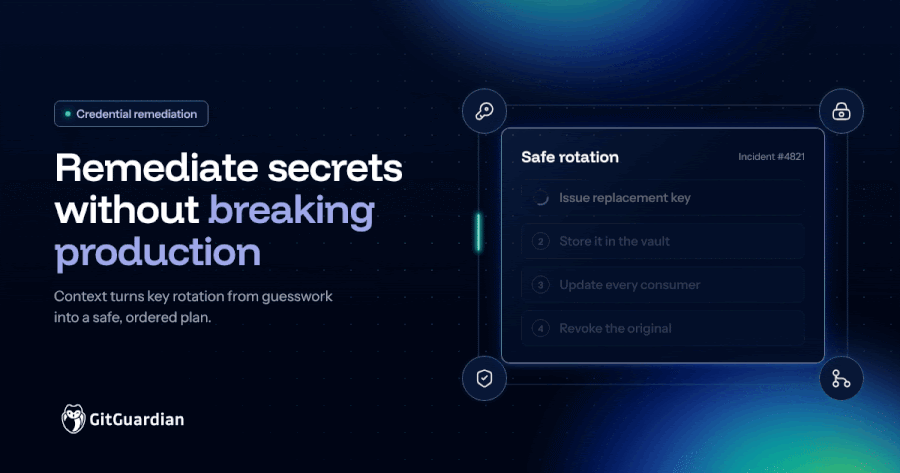
In scenarios where vaulted copies are not yet in use, the process typically begins by issuing a replacement credential and storing it securely within a vault. Responders then replace every occurrence of the legacy plaintext secret with a dynamic vault call across all known consumers. The updated code or configuration is subsequently pushed live and monitored closely for anomalies, with rollback procedures prepared in case of failure. Only after confirming that all downstream systems consume the new vaulted credential without disruption should the team revoke the original secret. Disrupting this sequence transforms a routine security fix into an operational incident.
Closing an incident ticket should only occur once there is verifiable confirmation that the old credential no longer authenticates. Organizations must maintain a thorough audit trail documenting the vulnerability, the remediation actions taken, and proof of resolution. Incidents closed while credentials remain active require dedicated internal review queues, as siloed teams frequently rotate keys in one system while leaving them valid elsewhere due to fragmented tooling. Ultimately, comprehensive incident records provide essential documentation for security leaders and compliance auditors alike, detailing exposures discovered, response ownership, and overall remediation velocity.
From Remediation to Prevention
Remediation allows organizations to reduce risk one credential at a time while simultaneously illuminating underlying systemic patterns that cause recurring exposures. By analyzing whether specific codebases, users, or development practices repeatedly generate plaintext secrets on unmanaged workstations, enterprises can tackle the root causes of security backlogs. Transitioning from reactive remediation to proactive prevention—spanning developer workstations and AI-driven coding workflows—represents the critical next frontier in securing the modern enterprise credential layer.