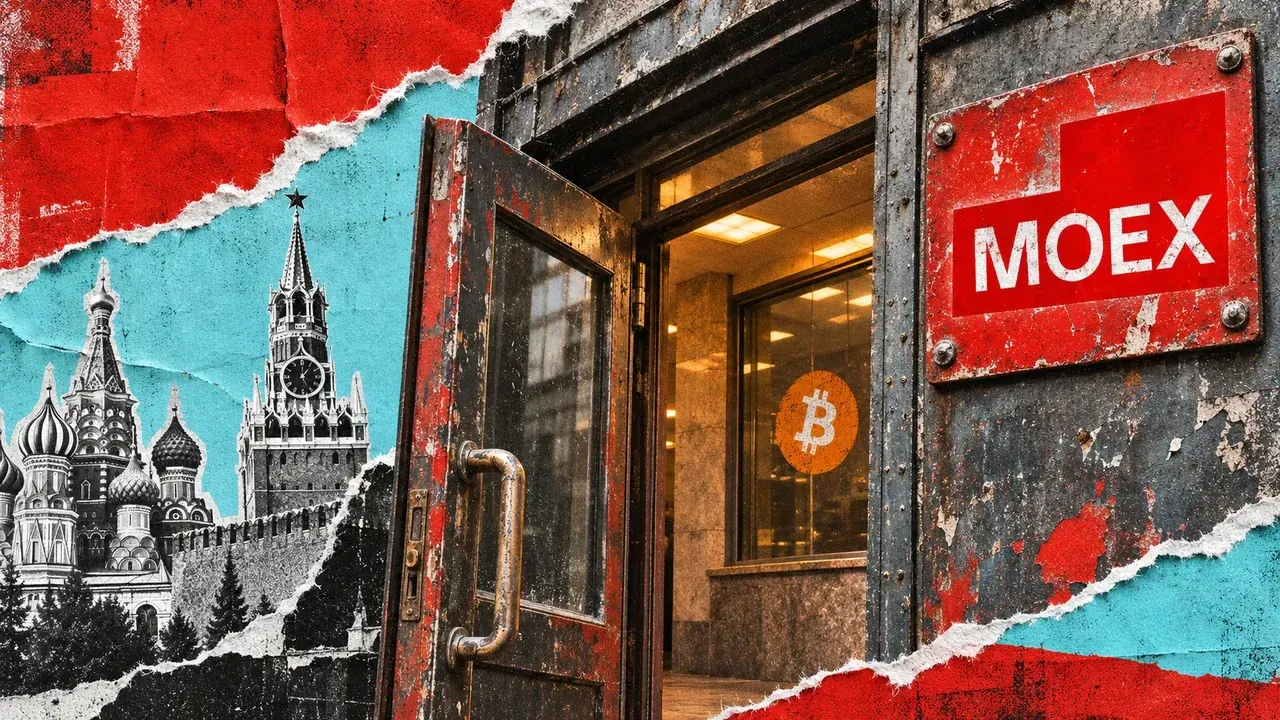
Russian financial markets are bracing for a historic shift as the nation’s exchanges prepare to launch official cryptocurrency trading, pending final approval of operational rules by the Central Bank of Russia. Beginning November 22, exchanges across the country are legally permitted to facilitate the trading of digital assets, provided they meet strict regulatory criteria and secure formal endorsement from the central monetary authority.
The most prominent step in this rollout is slated for December 1, when the Moscow Exchange (MOEX) plans to initiate a pilot program utilizing a US-sanctioned clearinghouse. While this milestone represents a major integration of digital assets into Russia’s traditional financial infrastructure, retail access will be heavily constrained. Ordinary investors will face strict annual purchase caps, and the new framework maintains an absolute ban on using cryptocurrency for everyday domestic retail payments.
The regulatory architecture underpinning this transition took formal shape when the central bank’s retail purchase rules went into effect on November 17. Under these guidelines, everyday investors are restricted to trading a tightly curated trio of digital assets: Bitcoin, Ethereum, and the United States dollar-linked stablecoin USDT. A separate ordinance governing exchange operations took effect simultaneously, establishing that trading venues could open their order books as early as November 22, contingent upon the central bank greenlighting their specific trading rules.
For the Moscow Exchange, the target date of December 1 marks the beginning of pilot transactions as participating financial firms finalize their network connections. This new marketplace is designed to allow everyday investors to purchase crypto assets through familiar, traditional financial intermediaries—such as brokers and asset managers—while simultaneously reinforcing the strict prohibition against using digital currencies for domestic purchases of goods and services.
The 300,000-Ruble Limit Applies to Each Intermediary
To mitigate systemic risk and control retail exposure, the central bank has imposed a strict annual expenditure cap on ordinary market participants. The allowance covers purchases made through a single intermediary during any given calendar year.
The mechanics of this limit are straightforward yet restrictive. If an investor purchases 100,000 rubles’ worth of Bitcoin and another 100,000 rubles’ worth of Ethereum—totaling roughly $1,200—through the same broker, they have consumed two-thirds of their annual allowance. Crucially, this calculation is based entirely on the initial amount of rubles spent rather than the subsequent market value of the holdings a week or a month later.
These authorized purchases can flow through various traditional channels, including asset managers and registered crypto exchange offices. The cap applies equally to direct market orders and over-the-counter deals arranged outside an exchange’s primary order book.
In contrast, qualified or sophisticated investors are permitted to purchase a broader array of coins without encountering the same 300,000-ruble purchase cap. However, even these high-net-worth or experienced individuals must pass a mandatory proficiency test and formally review the associated risks before executing trades, mirroring the compliance requirements mandated for ordinary retail investors.
The central bank selected Bitcoin, Ethereum, and USDT for the retail-approved list largely due to their high liquidity, massive trading volumes, and extensive price history. Each of these assets boasts at least five years of verifiable trading data on major international exchanges, giving regulators a reliable baseline for oversight.
Under the new regulatory mandates, exchanges bear significant compliance burdens. They must formally register all participating companies, meticulously track individual orders and completed transactions, calculate accurate market prices, and report comprehensive activity logs directly to the central bank.
Furthermore, Russia’s updated crypto legislation provides for specialized digital depositories designed to record asset ownership rights securely. These depositories form a critical pillar of the broader exchange and custody framework required to support the market once active trading gets underway.
Despite these advanced technical frameworks, owning Bitcoin through the official domestic system still does not grant citizens the right to spend it at a local Russian shop. Domestic merchants remain strictly barred from accepting cryptocurrency as payment for goods and services.
At the same time, a separate provision has been carved out for cross-border settlements, allowing exporters and importers to utilize digital assets to navigate international trade hurdles. Under this arrangement, a broker can assist a customer in exchanging rubles for Bitcoin, and an exporter can receive Bitcoin as payment for an international shipment. Yet, a restaurant in downtown Moscow is still legally required to charge its patrons in traditional fiat currency.
Moscow Exchange Must Handle the Assets
The Moscow Exchange is no stranger to digital asset exposure, having already established a robust market for investors seeking indirect participation in cryptocurrency price movements. By mid-September, MOEX reported more than 600 billion rubles in crypto-futures turnover since its initial contracts were introduced during the summer of 2025.
However, those existing instruments are cash-settled contracts that pay out gains or losses in rubles based on underlying price fluctuations, without ever delivering the actual digital assets to the investor. Consequently, the massive turnover figures generated by futures trading offer little insight into how much physical Bitcoin everyday investors will actually want to buy and hold through the upcoming spot market system.
According to the exchange’s technical specifications, the new platform will feature same-day and next-day settlement cycles. Meanwhile, the National Clearing Centre’s published market plan outlines five core trading pairs: Bitcoin, Ethereum, and USDT paired against the Russian ruble, alongside Bitcoin and USDT paired against USDX, a specialized settlement currency utilized internally by the clearinghouse.
Notably, the exchange has no immediate plans to introduce direct Bitcoin-to-USDT trading pairs during the initial launch phase, though management may consider cross-crypto pairs at a later stage, possibly by 2027.
Market participants will have the flexibility to place anonymous orders or negotiate direct deals with known counterparties. The clearinghouse expects to process settlements rapidly, aiming for a frequency of roughly every 30 to 60 minutes.
Short selling will be strictly prohibited during the initial launch phase, although individual brokers may choose to offer margin trading services under applicable regulatory frameworks. Industry analysts note that a single large, pre-arranged block trade could artificially inflate a day’s total turnover without necessarily establishing the deep, steady stream of everyday buyers and sellers required to form a liquid, efficient market.
The clearinghouse’s documentation also details how cryptocurrencies will physically move once a trade is successfully matched and executed. Settlement will take place through dedicated accounts maintained at a separate digital depository operating outside the immediate Moscow Exchange group. This means that a corresponding blockchain transaction will not necessarily be triggered for every single trade executed on the order book.
When one market participant buys Bitcoin from another, the depository can simply update its internal ledger to reflect the transfer of ownership rights while the underlying coins remain securely held in institutional custody. This streamlined approach allows the exchange to process high volumes of trades without constantly broadcasting transactions between public blockchain wallets every time an order matches.
This architecture places immense importance on the identity of the designated depository and the precise rules governing how assets enter and leave its custody. While MOEX has outlined the proposed account structure, publicly available documents reviewed thus far do not explicitly identify a separate independent depository, nor do they confirm whether retail customers will eventually be permitted to withdraw their crypto holdings directly to personal, self-hosted wallets.
Initially, the market is intended exclusively for existing qualified trading and clearing participants, with individual brokers shouldering the responsibility of vetting which customers are authorized to access these services. MOEX has confirmed it will utilize the National Clearing Centre to clear all transactions, leaning heavily on infrastructure that traditional stock-market participants already know and trust.
This operational blueprint introduces a complex geopolitical wrinkle. The United States Treasury officially sanctioned both the Moscow Exchange and the National Clearing Centre in June 2024. This designation creates notable compliance hurdles for the planned USDT market, which the exchange intends to introduce cautiously through a pilot program featuring tightly restricted trading volumes.
Technical specifications indicate that the USDT traded on the platform will be issued on the Ethereum blockchain, meaning the underlying tokens remain under the control of an entity outside of Russia. Tether, the issuer of USDT, maintains a strict corporate policy of freezing wallets associated with individuals or entities placed on US sanctions lists. While this policy alone does not automatically dictate the fate of specific wallets utilized by MOEX or its clearing and custody partners, it introduces lingering uncertainty.
Although settling individual trades through internal depository accounts reduces the frequency of moving tokens across a public blockchain, the underlying USDT must still be physically stored somewhere within the network. To date, the exchange has not publicly identified the specific wallets that will hold these tokens, explained who will supply them, or described how Tether’s stringent sanctions enforcement mechanisms would intersect with domestic custody arrangements.
No asset freezes connected to the proposed pilot have been verified, and available regulatory documents do not establish whether Tether has formally reviewed or approved the arrangement.
As the December launch approaches, the initial trades processed on the Moscow Exchange may largely consist of existing client transactions being migrated onto official exchange books. Whether a genuinely usable and liquid domestic market takes shape will depend entirely on sustained trading activity and the ability of participants to buy and sell near quoted market prices. For the USDT market in particular, the exchange and its institutional partners must ultimately prove they can securely hold underlying tokens and complete settlements through the proposed depository framework while navigating an unresolved international sanctions landscape.