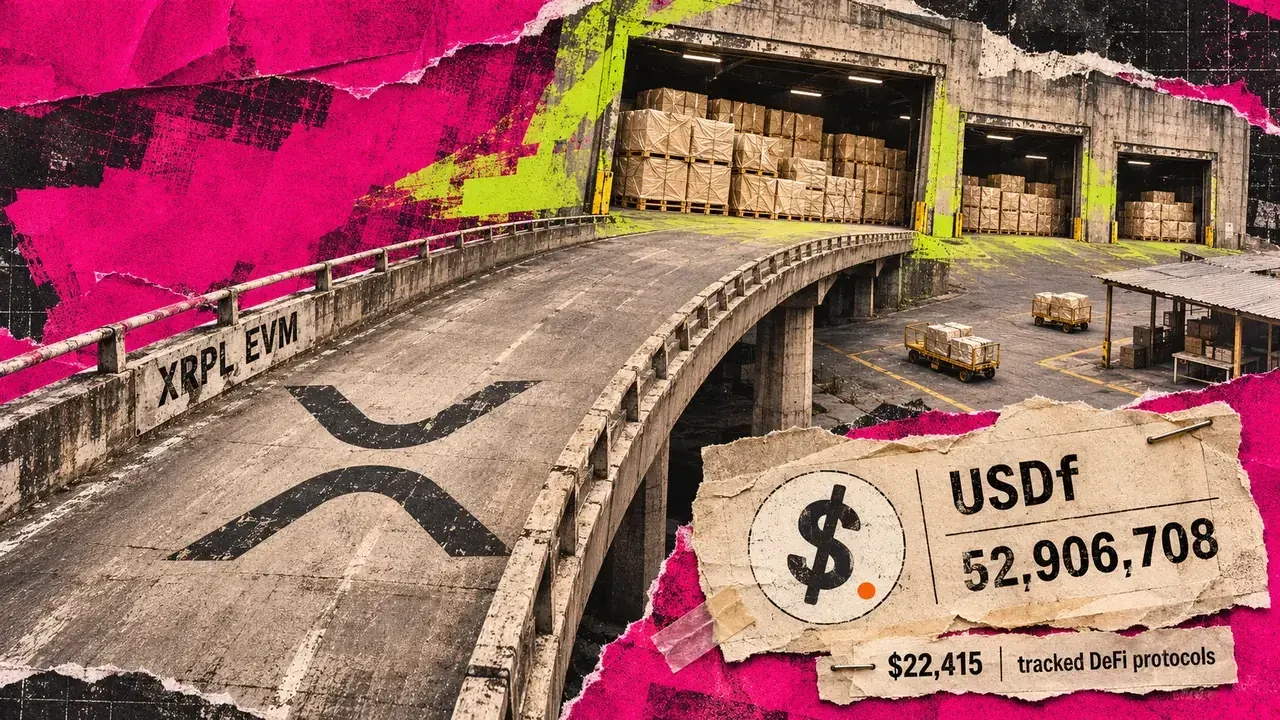
A fresh explorer snapshot taken on November 17 reveals that virtually the entire supply of the dollar-pegged USDf token on the XRP Ledger (XRPL) EVM—an XRP-powered smart contract sidechain—is concentrated across just three digital addresses.
According to data pulled from the blockchain’s official explorer, the smart contract currently houses 52.9 million tokens. This figure closely aligns with metrics provided by analytics platform DefiLlama, which values the chain’s tracked bridged stablecoin inventory at approximately $52.7 million. However, despite the presence of tens of millions of dollars in stablecoin liquidity, measured application activity and network fee expenditure remain remarkably low. DefiLlama’s tracking indicates a total value locked (TVL) of merely $22,415 across monitored decentralized finance (DeFi) protocols, while chain fees over a recent 24-hour window scraped the bottom at just $0.09.
The XRPL EVM operates as a distinct blockchain separate from the native XRP Ledger. Official documentation describes it as a sovereign layer-1 network designed to execute Ethereum-compatible smart contracts while utilizing XRP to cover transaction fees. This structural design grants XRP a direct, functional role in powering the operation of the chain. At the same time, market analysts note that bridging a dollar-pegged asset to the sidechain does not automatically translate to an equivalent dollar amount spent on acquiring native XRP tokens.
Where the USDf Inventory Sits
An inspection of the USDf contract metadata on November 17 documented an aggregate supply of 52,906,708 tokens. A breakdown of the holder list exposed a heavily skewed distribution, with nearly all tokens resting in three primary wallets. The largest single address commands roughly 40 million USDf, representing approximately 75.6% of the total supply. A second address holds about 7 million tokens, accounting for 13.25%, while a third address maintains 5.9 million tokens, making up 11.15%.
A fourth address, publicly labeled as SquidMulticall, appears on the ledger holding a nominal balance of a single smallest unit, translating to 0.000000000000000001 USDf.
Crucially, the three dominant addresses currently lack public names, labels, or institutional tags within the network response. Because of this anonymity, industry observers emphasize that these holdings cannot safely be interpreted as belonging to three distinct independent investors, retail customers, or separate beneficial owners. High concentration metrics of this nature establish neither verified individual ownership nor active economic deployment.
Historical context regarding the migration of these funds points back to a broader cross-chain transfer initiative. Falcon Finance previously highlighted the bridge route in a weekly recap published on July 14, 2025. At the time, the project reported that USDf was integrated among a batch of assets included in a $100 million liquidity bridge routed to the XRPL EVM via the Axelar protocol.
Data aggregated by DefiLlama on November 17 corroborates the circulating volume, recording 52,906,708 circulating dollar-pegged units valued at approximately $52,674,373.43. This aggregate valuation implies a slight discount, trading at roughly $0.9956 per unit. Furthermore, the platform’s dedicated chain dashboard confirms that USDf single-handedly accounts for the entirety of the tracked stablecoin market capitalization on the XRPL EVM.
The modest $22,415 DeFi figure represents an entirely separate category of financial measurement. Under standard DefiLlama data definitions, chain TVL strictly aggregates assets deposited directly into monitored protocols, whereas bridge TVL is systematically excluded from overarching chain totals. Consequently, financial analysts caution that the vast gap between the total token inventory sitting on the chain and the tracked DeFi TVL should not be misconstrued as missing capital, nor does it definitively prove that every token residing outside monitored protocols remains entirely idle.
Digital assets frequently sit within smart contracts or auxiliary wallets without protocol-level metrics capturing deep trading liquidity, broad retail participation, or sustained borrowing and lending loops. Furthermore, absolute dollar-denominated TVL fluctuates alongside underlying token prices, meaning raw token balances and granular application activity must be analyzed in tandem to paint an accurate picture of network health.
What the Activity Means for XRP
While the foundational architecture of the XRPL EVM integrates XRP for transaction settlement, overall user engagement metrics on the chain remain subdued. The same DefiLlama dashboard reported zero decentralized exchange volume over a 24-hour observation window, and a meager $5.37 across a broader seven-day period. Network fee generation reflected this quiet environment, registering just $0.09 over 24 hours.
Transaction throughput figures from the official chain explorer series further illustrate a quiet network. On November 16, the platform processed 1,365 transactions, following totals of 1,004 transactions on November 15 and 1,020 transactions on November 14.
While executing transactions and paying network fees necessitates the consumption of XRP, market analysts point out that the sheer stock of USDf sitting on the sidechain does not automatically establish fresh retail or institutional XRP purchases, indicate the magnitude of user-held XRP reserves, or guarantee persistent, organic demand to replenish spent gas tokens.
Market observers note that a more robust case for functioning, healthy liquidity would require a wider distribution of balances across a larger cohort of wallets, deeper usable trading books across decentralized exchanges, and consistent, repeated application-level transactions. Similarly, while continuous XRP fee expenditure demonstrates baseline gas usage by active participants, concrete evidence of fresh secondary market acquisitions would remain necessary to verify any underlying, net-new buying demand for the native asset.