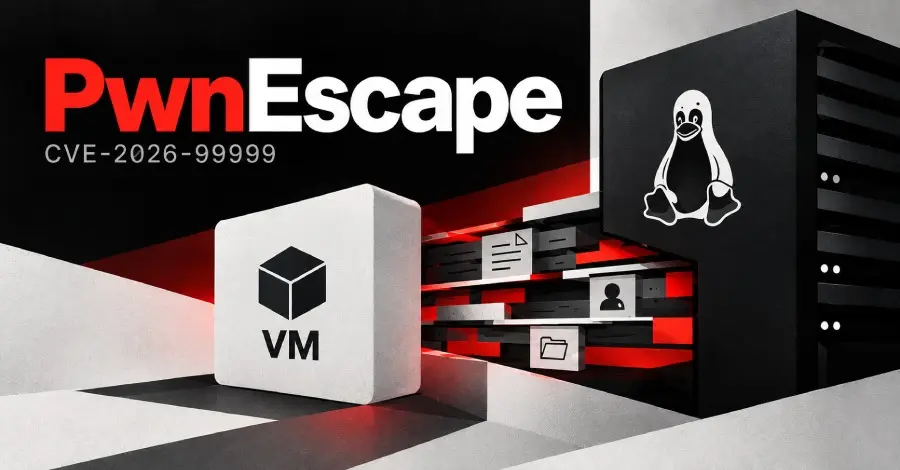
A newly disclosed and highly critical vulnerability residing deep within the Linux kernel has sent ripples through the cloud computing industry. The flaw allows low-privileged code running inside a virtual machine to read sensitive memory on the underlying host computer. Discovered and demonstrated against live cloud production infrastructure, the security gap has exposed systemic risks inherent in the shared foundational layers relied upon by modern cloud providers to isolate customer workloads.
Tracked officially as CVE-2026-99999 and colloquially dubbed "PwnEscape" by its discoverers, the vulnerability is not native to any single vendor’s deployment configuration or proprietary software stack. Instead, it targets the core networking code of the Linux kernel itself. Because this code constitutes the shared layer that cloud providers utilize to establish secure boundaries between disparate customer environments, the flaw effectively undermines the foundational isolation guarantees upon which multi-tenant cloud architectures are built.
The vulnerability was initially unearthed as part of a high-stakes security challenge hosted by cloud platform Vercel. Following responsible disclosure protocols, the security researchers reported the finding privately before any public details were released. At the time of disclosure, security telemetry and incident monitoring systems showed no indication that the flaw had been weaponized or exploited in the wild by malicious actors.
What the Researcher Showed
The vulnerability was discovered by Paulos Yibelo, a security researcher affiliated with the firm pwn.ai. According to a detailed technical write-up published by the firm, Yibelo demonstrated that specially crafted network packets transmitted from within a guest virtual machine could trigger a cascading series of dangerous outcomes on the host system. Specifically, the packets were capable of reading host memory, crashing the host machine entirely, and ultimately executing arbitrary code. Crucially, all three distinct attack vectors stem from a single, root-level flaw within the kernel’s packet processing logic.
During live demonstrations conducted against Vercel’s production sandboxes, Yibelo showed that each network packet dispatched from the guest virtual machine could carry back approximately 32 bytes of raw host memory. Because the guest could continuously transmit packets at will, an attacker was theoretically capable of siphoning memory segments over an extended duration.
While memory leakage and sandbox validation were successfully performed on live production infrastructure, more aggressive manifestations of the exploit—namely, host crashes and arbitrary code execution—were strictly confined to isolated lab environments meticulously configured to mirror Vercel’s specific architecture. In those controlled lab tests, just two specially crafted network packets were sufficient to crash a host machine, immediately knocking offline every individual sandbox instance running on that shared physical hardware.
Leveraging the exact same kernel flaw, the researcher successfully escalated privileges to achieve administrative control of a host machine, effectively breaking out of the virtual machine boundary. Yibelo explicitly emphasized that this complete breakout was strictly a laboratory achievement and did not represent a claim of root command execution within any vendor’s active production environment.

Detailing the methodology behind the discovery, Yibelo explained that the research was accelerated by an internal automated framework known as Omega-Pwn. This system integrated specialized security research tooling with architectural elements derived from SingularityNET’s OmegaClaw platform, allowing researchers to maintain complex hypotheses, track code execution paths, log failed attempts, and preserve experimental results across long-running investigative sessions. The primary reasoning engine steering the analytical work was an advanced large language model, GPT-5.6 Sol. The human researchers directed the overall investigation, continually challenged the model’s analytical findings, and rigorously validated promising leads against actual kernel behavior on systems under their direct administrative control.
Representatives from Vercel confirmed that while the memory leakage was successfully demonstrated against their live production sandboxes, no telemetry or exploitation report from the challenge indicated that any participant successfully accessed or exfiltrated customer files, sensitive cryptographic secrets, or underlying application data.
How Severe It Is, and Who Can Set It Off
Kernel maintainers and security evaluators have assigned CVE-2026-99999 a severity score of 9.3 out of 10, categorizing it as a critical-severity vulnerability. While the entry has been formally received by the U.S. National Vulnerability Database, formal federal scoring and review processes remain ongoing.
An analysis of the vulnerability metadata reveals that the primary attack vector is local. In practical terms, this means that an exploiting entity must already possess the capability to execute code locally inside a guest environment, mirroring the position held by the security researcher during the demonstration. It is not a remote code execution vulnerability that an external attacker could trigger indiscriminately by hurling malicious packets across the open public internet.
Furthermore, the vulnerability does not currently appear on the Cybersecurity and Infrastructure Security Agency catalog of known exploited vulnerabilities, reinforcing the assessment that real-world exploitation has not yet been observed.
Why It Reaches Beyond Vercel
The discovery unfolded within the architecture of Vercel Sandbox, which isolates each customer’s running code inside dedicated Firecracker microVMs. These lightweight virtual machines maintain their own independent instances of the Linux kernel and execute directly on bare-metal Amazon EC2 host hardware. Within this model, the microVM serves as the primary enforcement barrier separating individual customers from the underlying host, as well as separating one customer’s environment from another.
Because the vulnerability resides within the Linux kernel networking code executed by the host rather than within the microVM boundary layer itself, its implications extend far beyond a single cloud provider. pwn.ai noted that Vercel’s sandbox infrastructure was already hardened significantly beyond standard industry benchmarks, with no configuration errors or architectural oversights discovered during the assessment.
Given that nearly all major cloud computing providers rely on the Linux kernel to isolate multi-tenant workloads at the hypervisor or container layer, a critical flaw in this shared infrastructure presents an industry-wide risk rather than an isolated vendor defect.

The Fix and the Fixed Versions
The definitive remedy for the vulnerability arrives in the form of a targeted patch to the Linux kernel. Authored by Michael S. Tsirkin of Red Hat and officially merged into the mainline kernel repository as commit 6785011f8b16, the fix introduces a rigorous validation check. This modification ensures that a network packet’s checksum data cannot improperly reference memory within the IPv4 header before the kernel processes the packet, with the validation logic applied across five distinct choke points within the networking subsystem.
The patch author explicitly characterized the modification as a defense-in-depth measure, noting that more comprehensive validation regarding how incoming packets initially enter the kernel subsystem remains an area for ongoing development.
Kernel maintainers swiftly backported the security fix to active stable branches across the Linux ecosystem. Affected stable branches and their respective initial patched versions include version 5.10.272, version 5.15.223, version 6.1.190, version 6.6.159, version 6.12.113, version 6.18.57, and version 7.2.11.
Because commercial Linux distributions frequently curate and maintain their own kernel packages, they often backport critical security patches directly into older version releases without incrementing the public version number. Consequently, administrators are advised to review specific vendor security advisories and verify the active presence of the backported patch rather than relying solely on surface-level version strings reported by system utilities.
Cloud operators and system administrators are strongly urged to update their host kernels to one of the officially patched versions or apply the corresponding vendor-supplied security packages, followed by a system reboot. Simply updating the guest operating system or container kernel does not mitigate the vulnerability, as the flaw compromises the host kernel itself. In environments where immediate patching is operationally impossible, security teams must rely on defense-in-depth hardening measures. Vercel emphasized that maintaining strict host kernel update cadences, disabling nested virtualization, and running microVMs under tightly restricted process jailers—such as those enforced by Firecracker to limit system call privileges—can severely restrict the potential impact of an attempted breakout, even if the underlying kernel flaw has not yet been patched.
Found in a $1 Million Challenge
The vulnerability was uncovered during a highly publicized, two-week security challenge conducted by Vercel in August, which offered up to $1 million in aggregate rewards to ethical hackers capable of successfully compromising its sandbox environments. While no individual researcher claimed the maximum grand prize, top per-report payouts reached $50,000. In total, Vercel disbursed $242,000 across 1,285 submitted reports, with PwnEscape standing out as the single critical finding of the event.
Security researchers at pwn.ai highlighted the speed of modern vulnerability discovery, noting that their team identified the deep-seated kernel flaw in just three days by combining automated AI source-code analysis with human-directed research strategies. The total compute and API token expenditure required to run the automated discovery pipeline remained under $700. This achievement marks yet another milestone in the rapidly evolving trend of security researchers leveraging artificial intelligence models to uncover and chain complex, deeply buried software vulnerabilities.