
Unverified smart contracts have been directly linked to at least $36.7 million in cumulative losses across four major decentralized finance exploits over the past six months, according to a comprehensive new report from blockchain intelligence firm Chainalysis. The findings highlight a shifting and increasingly sophisticated threat vector in the Web3 ecosystem, as malicious actors systematically pivot their attention toward protocols whose underlying source code is not publicly accessible on blockchain explorers.
For years, many developers in the decentralized finance space operated under the assumption that keeping smart contract code private or unverified provided an intrinsic layer of security. However, the latest findings from Chainalysis challenge this longstanding industry assumption, demonstrating that protocols relying on hidden code are increasingly depending on obscurity as a primary security measure—an approach that analysts warn is rapidly losing its effectiveness in the face of modern technological advancements.
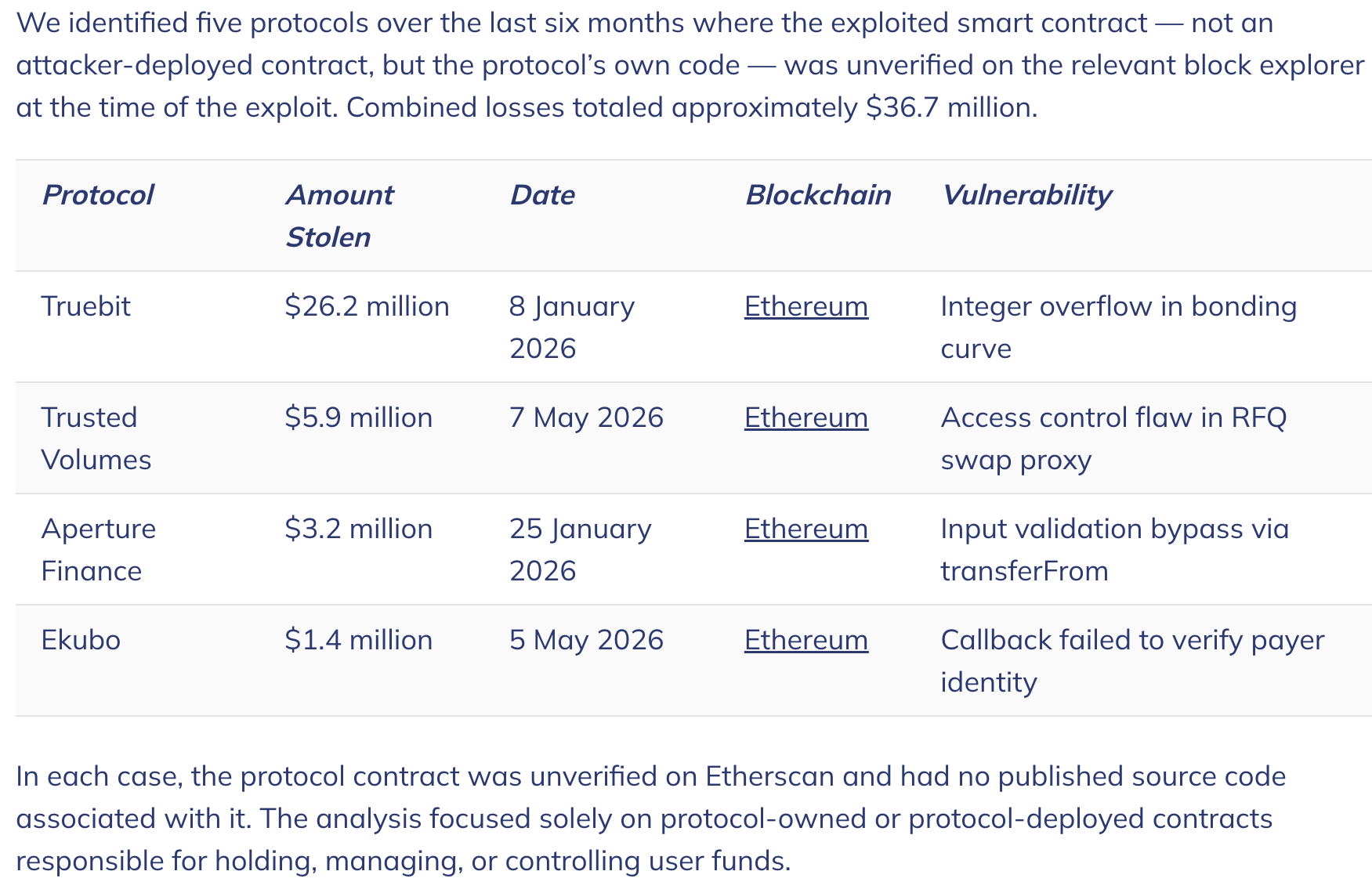
The largest single incident documented in the report involved Truebit, a protocol that suffered a staggering $26.2 million loss after an attacker successfully exploited an underlying integer overflow vulnerability. Crucially, the vulnerable contract had remained unverified on the Ethereum blockchain explorer since it was originally deployed in 2021. The three other distinct incidents highlighted in the Chainalysis report involved Trusted Volumes, Aperture Finance, and Ekubo, each falling victim to similar architectural vulnerabilities tied to unverified deployment states.
In every single one of these cases, the exploited smart contract had not undergone the standard industry practice of source code verification on a public blockchain explorer. Because the source code was withheld from public view, independent security researchers, white-hat hackers, and automated auditing tools were severely limited in their ability to scrutinize the logic governing the protocols. Furthermore, this lack of public verification frequently excluded these vital contracts from participating in comprehensive bug bounty programs, even though they maintained absolute custody and control over significant amounts of user funds.

The underlying catalyst behind this concerning trend lies in rapid technological advancements, specifically the evolution of sophisticated decompilation tools and artificial intelligence. Historically, reverse-engineering smart contract bytecode to uncover hidden logic flaws or mathematical errors required immense manual labor. According to Chainalysis, what once demanded a skilled reverse engineer spending intensive days manually analyzing a single contract can now be partially automated across massive volumes of unverified contracts simultaneously.
Malicious actors are increasingly harnessing these advanced decompilation capabilities alongside artificial intelligence models to systematically probe unverified codebases, identify hidden attack vectors, and execute complex exploits before protocol developers or community members are even aware of the threat. In a parallel development underlining the growing intersection of AI and cybersecurity threats, technology company Anthropic recently revealed that 560 out of the 832 accounts it banned for policy violations over a one-year period had utilized artificial intelligence specifically to assist in preparing cyberattacks, including writing malicious software and identifying target vulnerabilities.
To combat this rising wave of sophisticated attacks, Chainalysis has strongly recommended that all decentralized finance protocols embrace full source code verification as a baseline security requirement. Additionally, the firm urged projects to expand their bug bounty coverage to include broader community auditing and to integrate real-time monitoring tools designed to detect anomalous transactions before funds can be permanently drained from a protocol.
DeFi Security Concerns Persist After Record April Losses
The sobering insights shared by Chainalysis arrive against the backdrop of a broader, highly volatile security climate across the entire cryptocurrency and decentralized finance landscape. The ecosystem has faced mounting pressure following a catastrophic surge in illicit fund outflows earlier in the year. According to aggregated data from DeFiLlama, hackers and malicious exploiters managed to steal a staggering $629.7 million in the month of April alone, marking the highest monthly total recorded since February 2025.
The vast majority of the devastation witnessed in April was concentrated in just two massive security breaches. KelpDAO suffered a catastrophic loss of $293 million, while Drift Protocol was simultaneously hit by a $280 million exploit. Together, these two high-profile incidents accounted for more than 80 percent of all digital assets stolen during that single month, triggering widespread panic and forcing developers across the industry to re-evaluate their systemic risk exposure.
Although overall financial losses fell sharply in the subsequent month—with blockchain security firm CertiK reporting roughly $68.3 million stolen from cryptocurrency exploits in May—the complex fallout from April’s record-breaking attacks continued to reverberate through the market. In June, blockchain intelligence platform Arkham released findings revealing that the attacker responsible for the massive KelpDAO exploit had successfully laundered nearly all of the roughly $220 million in unfrozen stolen funds, highlighting the immense difficulties law enforcement and security teams face when attempting to recover assets once they enter mixing services or cross-chain bridges.
The shockwaves from the KelpDAO breach also prompted widespread institutional and protocol-level introspection. Numerous decentralized finance projects rushed to thoroughly review their internal security infrastructure and oracle dependencies. Among them, Solv Protocol publicly announced its strategic intention to migrate its operations to Chainlink’s robust crosschain infrastructure following comprehensive internal security audits prompted by the industry-wide wake-up call.
As developers, auditors, and intelligence firms grapple with the dual threats of automated code exploitation and massive cross-chain liquidations, the decentralized finance sector faces a critical inflection point. The traditional reliance on security through obscurity is proving unsustainable, forcing the industry to adopt rigorous transparency, proactive monitoring, and advanced defensive measures to protect user capital in an increasingly automated threat landscape.