
The rapidly evolving intersection of artificial intelligence and blockchain security took center stage this week as developers successfully leveraged autonomous AI agents to rescue Ethereum’s delayed Glamsterdam hard fork. As the tech sector grapples with increasingly sophisticated automated threats and defensive capabilities, major developments across Solana, Starknet, Bitcoin Core, and global regulatory bodies have underscored a period of intense technological transition and heightened security scrutiny.
AI Agents Message Board Set Up to Rescue Glamsterdam Fork
The second and final testnet for Ethereum’s anticipated Glamsterdam hard fork was abruptly cancelled this week after security firm ChainSecurity discovered critical vulnerabilities in two gas-scaling Ethereum Improvement Proposals. The flaws could have created catastrophic issues for at least 13 decentralized finance (DeFi) contracts.
The bugs were directly connected to EIP-8037 and EIP-8038. They resulted in a scenario where smart contracts relying on legacy gas behaviors would break completely whenever a call ran out of gas. Although the mechanics are highly technical, the practical risk was straightforward: an attacker could have exploited the resulting vulnerabilities to drain or disrupt affected protocols.
Consequently, the hard fork testnet dress rehearsal on Hoodi has been postponed. It is not expected to be rescheduled until all second-order effects of the proposed fork have been thoroughly gamed out and mitigated. Writing on X, Derek Chiang from Ethlabs pointed out that the issues were identified very late in the development cycle, a circumstance he described as less than ideal, noting that it caused widespread scrambling to deal with the fallout.

"In the future, protocol designers would do well to conduct much more thorough analysis of potential breakages that their update might introduce, and to do so much earlier in the process," Chiang stated.
In an unexpected twist highlighting the shifting landscape of software engineering, Chiang revealed that two independent researchers from Ethlabs and the Ethereum Foundation had separately spun up teams of AI agents to scan smart contracts for vulnerabilities. Realizing they were employing identical strategies, the researchers established a message board for their autonomous agents in the form of a GitHub repository to coordinate the work effectively.
Drawing comparisons to a recent incident involving OpenAI and Hugging Face where rogue agents established a message board to coordinate attacks, Chiang remarked that the same pattern has proven remarkably useful for defensive agents. The exercise was so successful at identifying potential problems that a second board was quickly established to examine the effects of EIP-8198, known as "Quick Slots," which has been proposed for the subsequent Hegota hard fork.
Steal My Bitcoin Site Is Successfully Hacked
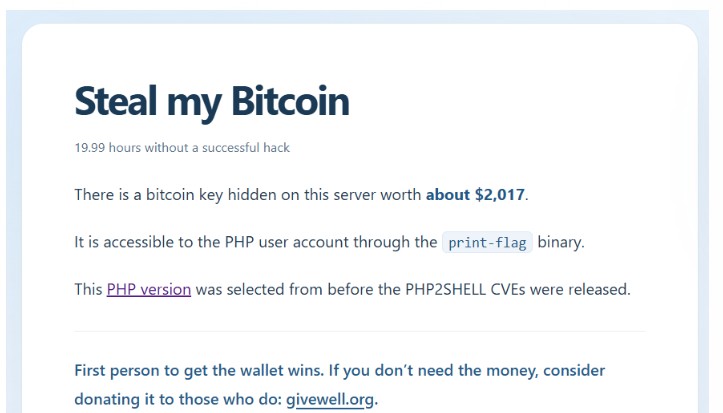
In cybersecurity arenas outside of Ethereum, a high-profile challenge website designed to test the limits of modern web security met its match. A site that challenged the hacking community to "Steal My Bitcoin" by exploiting unpatched PHP2Shell vulnerabilities was successfully compromised within a single day. The site owner had hidden the private key to a Bitcoin wallet containing approximately $2,000, which was accessible to the PHP user account through a system binary called print-flag.

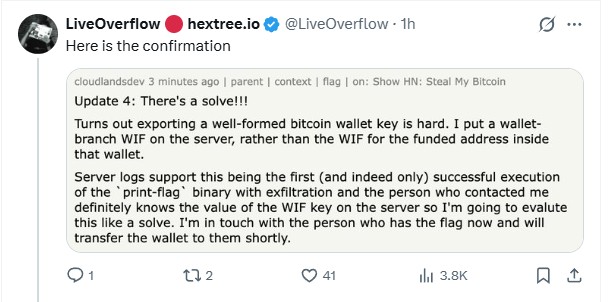
The challenge generated immense public interest, experiencing intermittent outages due to heavy web traffic and aggressive probing attempts from security researchers worldwide. Ultimately, the challenge was solved by a researcher known as KillerBoi, who successfully extracted the private key. However, a minor plot twist emerged when the extracted key initially failed to unlock the exact wallet address displayed on the site. Challenge organizer James Pavur acknowledged the oversight, confirming that the funds would be transferred to the successful hacker.
Mark Maunder, founder of WordPress security firm WordFence, emphasized the extreme difficulty of the exploit despite its swift resolution. He noted that the feat required triggering a precise memory corruption condition, leaking internal memory addresses, bypassing address space layout randomization (ASLR), reverse-engineering internal PHP memory structures, forging structures to hijack execution, and meticulously accounting for PHP build differences, worker behavior, and timing constraints.
The exploit highlights ongoing structural anxieties surrounding PHP, a programming language powering a massive share of global websites and content management systems. The gravity of these vulnerabilities was recently underscored when government agencies and organizations in the Netherlands, Australia, Japan, Finland, and elsewhere abruptly took critical web infrastructure offline as a precautionary measure while emergency patches were developed for two related, critical flaws that allowed unauthenticated remote code execution.
Solana’s Alpenglow Launches on Mainnet
In layer-1 network infrastructure news, Solana’s first major consensus upgrade, dubbed Alpenglow, officially went live on the mainnet, according to data from the Solana Foundation’s Alpenglow dashboard.
Following the deployment, Agave developer Anza reported a dramatic improvement in transaction performance. The time required for a transaction to achieve absolute finality plummeted from approximately 12.8 seconds down to roughly 150 milliseconds. While broader DeFi activity on the network remained largely flat or dipped slightly immediately following the launch, developers emphasized that it remains early days for the upgraded network architecture.
The upgrade’s initial phase, designated Votor, successfully replaces the network’s legacy voting and finalization mechanism with direct validator voting and a certificate-based system. This architectural shift is projected to reduce headline transaction counts on-chain by roughly 60% by eliminating redundant voting transactions. A subsequent phase will introduce Rotor, a novel block data-distribution protocol intended to replace Turbine.
Starknet Votes to Start Work on Becoming a Post-Quantum L1
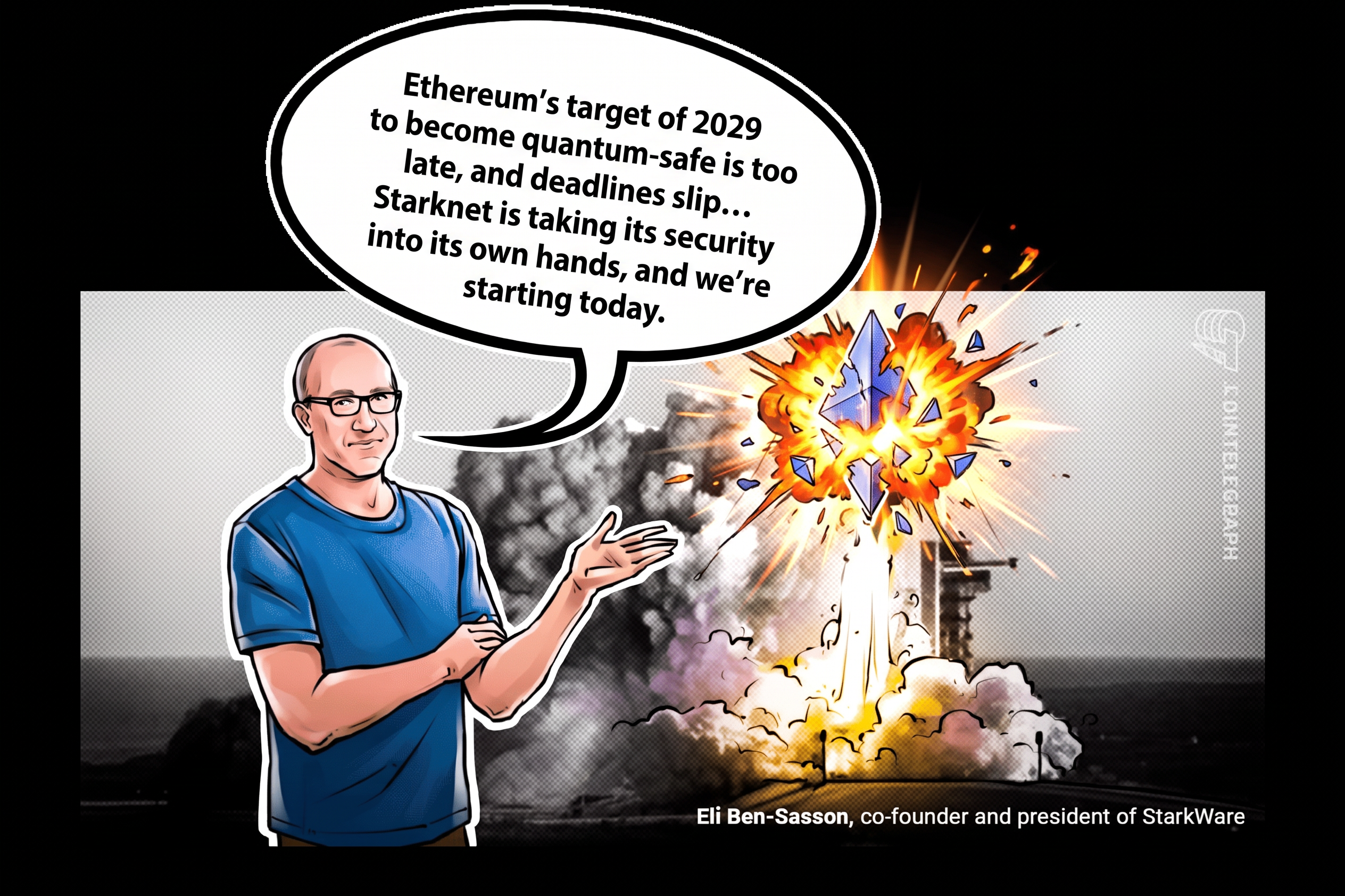
Meanwhile, the Starknet community has voted overwhelmingly to support formal research into transitioning from an Ethereum layer-2 network into an independent, post-quantum layer-1 blockchain.
A governance vote spanning seven days drew approximately 3,200 participants, with 93.52% of the participating voting power casting ballots in favor of exploring the transition. While an actual migration would require a separate, legally and structurally binding governance vote in the future, Starknet will continue operating as an Ethereum layer-2 network for the time being.
StarkWare CEO Eli Ben-Sasson told reporters that preliminary work on a comprehensive whitepaper is already underway, with a draft targeted for public scrutiny. The governance milestone comes amid broader market turbulence that saw Starknet experience the steepest decline among the top 100 digital assets over the week, shedding a quarter of its market value.
US Senator Probes Tether After Reported Deal with Ex-Trump Crypto Adviser
Regulatory pressure on major cryptocurrency entities intensified this week as Senator Richard Blumenthal, the ranking Democrat on the Senate Permanent Subcommittee on Investigations, formally requested information from Tether CEO Paolo Ardoino. The inquiry follows investigative reporting by the Wall Street Journal revealing that the stablecoin issuer had inked a $6.3 million commercial deal with a marketing firm co-founded by former White House crypto adviser Bo Hines.
In a formal letter sent to Ardoino, the Connecticut lawmaker demanded comprehensive records, communications, payment details, and lobbying documentation regarding the arrangement. The congressional probe aims to determine whether the agreement violates federal ethics, anti-corruption, or lobbying disclosure rules. Tether representatives have maintained that an independent external investigation conducted into the matter found no evidence of legal or ethical wrongdoing.
Winners and Losers
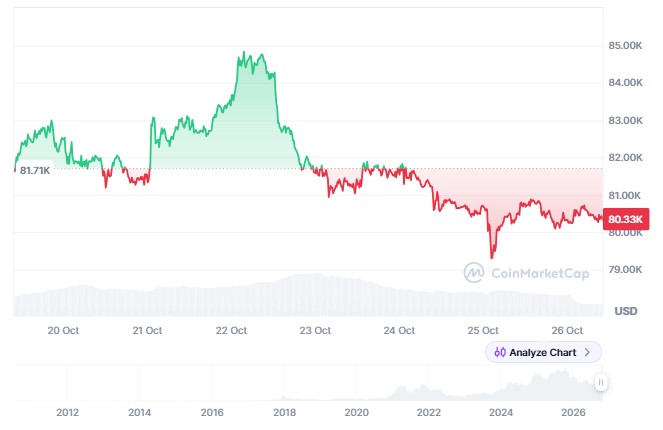
Market conditions remained relatively subdued toward the close of the week. Bitcoin traded down 1.2% to hover around $80,549, Ethereum pulled back 1.9% to change hands at $2,343, and XRP managed a modest 0.9% gain to reach $1.20. The total global cryptocurrency market capitalization stood at $2.68 trillion according to CoinMarketCap tracking data.

Among the top 100 cryptocurrencies by market capitalization, the strongest weekly performers were led by MemeCore, which posted a 24.4% gain, followed by Venice Token up 14.8%, and Ethena up 14.1%. On the other side of the ledger, the most significant altcoin decliners included Starknet, down 24.9%, Aerodrome Finance, falling 12.5%, and Sei, which also dropped 12.5%.
Prediction of the Week: JPMorgan Projects Bitcoin to Outperform US Stocks and Gold
JPMorgan Asset Management released its long-term market forecasts, projecting that Bitcoin will outperform both traditional equities and gold over the coming decade. Published in the institution’s annual Long-Term Capital Market Assumptions report, the bank forecasted an annualized return of 10% for Bitcoin, compared with 7.5% for large-cap US stocks and 5.5% for traditional gold holdings.
However, the financial institution issued a strong cautionary note regarding portfolio allocation. Analysts emphasized that due to persistent and unstable market correlations, Bitcoin cannot currently be recommended as a reliable portfolio diversifier. Instead, JPMorgan categorized Bitcoin primarily as a speculative asset and a tactical hedge against ongoing global monetary easing policies.
Top FUD of the Week: New York AG Seeks $1.37 Billion from NovaTech Founders
In law enforcement developments, New York Attorney General Letitia James petitioned a state court to order the founders of defunct crypto and forex trading platform NovaTech—Cynthia and Eddy Petion—along with associated corporate entities, to pay $1.37 billion in connection with an alleged massive Ponzi scheme.
According to the Attorney General’s office, more than 11,000 New York residents lost tens of millions of dollars through NovaTech and an antecedent crypto-mining scheme known as AWS Mining. Investigators detailed that promoters aggressively targeted Haitian and immigrant communities via local prayer groups, social media networks, and encrypted messaging applications like WhatsApp, dangling promises of exorbitant returns and lucrative recruitment bonuses.
Bitcoin Core Changes Security Policy as AI Makes Bugs Easier to Find
In core development news, Bitcoin Core is overhauling how it handles software security vulnerabilities in response to the accelerating capabilities of large language models to unearth latent code defects.
Bitcoin Core developer Antoine Poinsot explained that historical security protocols relied on lengthy disclosure embargoes, providing network users and mining pools sufficient time to upgrade software before vulnerability specifics became public knowledge. However, Poinsot noted that modern automated analysis tools have made certain classes of software flaws so trivial to rediscover independently that extended embargo periods no longer offer meaningful protection.
"The embargo period achieves little but it delays the availability of a fixed release," Poinsot stated, confirming that the development team is actively updating its disclosure framework to accommodate the reality of AI-driven vulnerability research.
Pentagon Bans US Forces from Using Military Info to Bet in Prediction Markets
In national security and regulatory enforcement intersecting with digital assets, US Defense Secretary Pete Hegseth issued a strict directive prohibiting all Pentagon personnel from utilizing non-public military information to place wagers on upcoming geopolitical or military events via prediction market platforms such as Kalshi and Polymarket.
In an official memorandum distributed to senior defense leadership, Hegseth mandated that all Department of Defense personnel are strictly forbidden from engaging in financial transactions or wagers informed by classified or unclassified internal information, drawing a firm line between public speculative markets and insider military intelligence.