
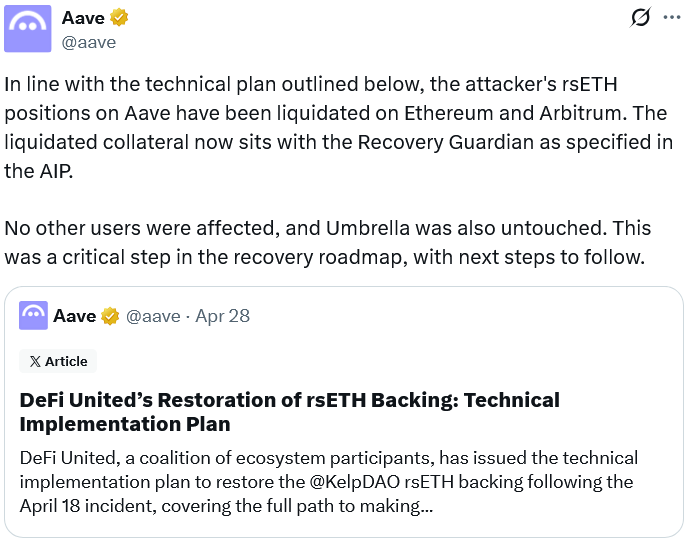
Aave Labs has successfully liquidated the remaining rsETH positions tied to the Kelp DAO attacker across both the Ethereum and Arbitrum networks, bringing the decentralized finance (DeFi) ecosystem one crucial step closer to fully restoring the backing of the restaked token and compensating affected users.
The successful liquidation marks a critical milestone in the broader "DeFi United" recovery plan, according to an official announcement shared by Aave on X on Wednesday. The protocol confirmed that the liquidated collateral, which stems from the devastating $293 million exploit on April 18, has been successfully transferred to Recovery Guardian, a specialized multisignature wallet managed by the DeFi United coalition.
With this latest maneuver completed, the DeFi United initiative is now closing in on its ultimate goal. According to Thaddeus Pinakiewicz, vice president of the research team at Galaxy Digital, the recovery fund is now only about 10% short of the total amount of Ether (ETH) required to fully restore the Kelp DAO restaked ETH (rsETH) token to its intended peg and backing value.
The Kelp DAO exploit has widely been regarded as one of the most destructive cryptocurrency hacks of 2026, triggering an immediate and severe ripple effect throughout the broader decentralized finance lending market. The security breach disrupted billions of dollars in liquidity almost overnight, severely eroding user confidence and triggering widespread market anxiety across the ecosystem.

Despite the sheer scale of the incident, Aave emphasized that user funds deposited directly into its primary markets were not affected by the liquidations. Furthermore, the platform confirmed that Umbrella, Aave’s native automated insurance mechanism designed to provide automated protection against bad debt, was not utilized during the process, shielding the protocol’s safety module from direct capitalization hits.
Back on April 28, Aave outlined that clearing out the remaining portions of the hacker’s collateral on Ethereum and Arbitrum would successfully release approximately 13,000 Ether, which amounts to nearly $30.2 million based on prevailing market prices.
However, the recovery pathway continues to face complex procedural and legal hurdles. Pinakiewicz pointed out that an additional 30,765 ETH remains frozen by the Arbitrum DAO, currently caught in what industry observers describe as "legal limbo." The entanglement deepened after a United States law firm, Gerstein Harrow LLP, filed a formal restraining notice on Friday aiming to prevent the Arbitrum DAO from redistributing the frozen funds to the recovery pool. In swift retaliation, Aave filed an emergency motion requesting that the court formally lift the restraining notice so that the recovery efforts can proceed unimpeded.
Meanwhile, members of the Arbitrum DAO are actively participating in an ongoing governance vote to determine whether the frozen ETH should be released directly to the DeFi United fund. Participation has been robust, with over 90% of participating voters casting ballots in favor of the proposal ahead of the voting period’s scheduled closure on Friday.
Beyond the ongoing legal and DAO governance battles, the DeFi United initiative is also actively awaiting official funding commitments and contributions from prominent industry stakeholders. These include stablecoin issuers such as Circle, Ethena, and Frax, alongside Ink, the Kraken-built Ethereum Layer 2 network.
According to Pinakiewicz, securing these external commitments is essential for the coalition to finally cross the finish line and permanently plug the financial hole left in the wake of the exploit.
Aave’s TVL Bleeding Has Stopped
The aftermath of the April 18 security incident hit Aave exceptionally hard, triggering a massive liquidity crunch. The protocol’s total value locked plummeted by nearly $12 billion in a single week after the perpetrator deposited stolen rsETH tokens as collateral across its lending markets to borrow wrapped Ether. This left the platform grappling with more than $190 million in bad debt and setting off a chaotic wave of panicked user withdrawals.
Fortunately, recent on-chain metrics suggest that the worst of the outflow crisis has subsided. Data compiled by DefiLlama indicates that net outflows from Aave’s lending markets have eased significantly over the past week. The protocol’s total value locked has begun a gradual recovery, climbing back up from a local low of $14.2 billion recorded on April 26 to comfortably surpass the $15 billion threshold once again.