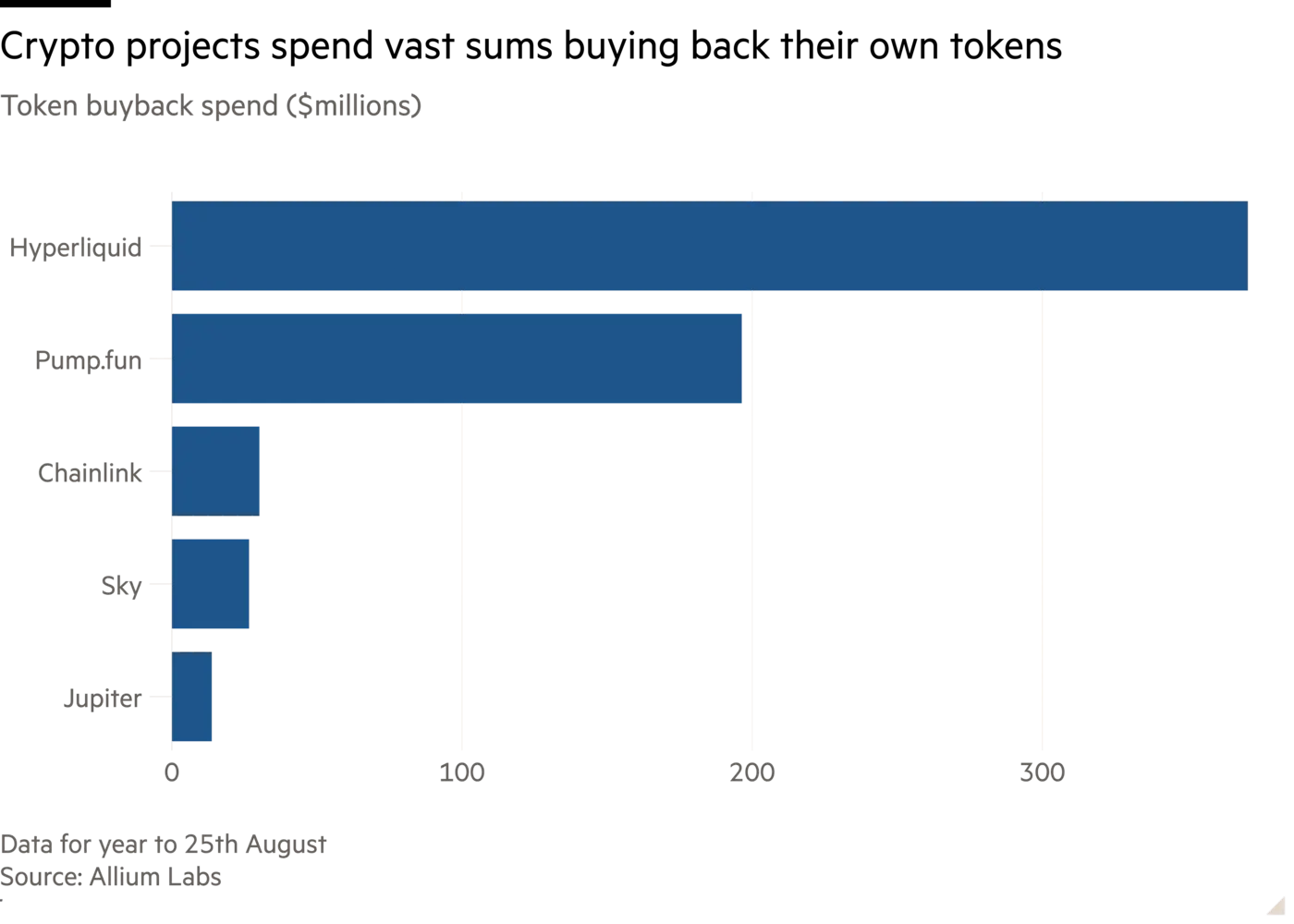
Decentralized exchange Hyperliquid and memecoin launchpad Pump.fun have emerged as the dominant forces behind an unprecedented wave of capital deployment in the digital asset sector, reportedly accounting for nearly 90% of a record $638 million in token buybacks carried out by cryptocurrency projects so far in 2026.
Data compiled by Allium Labs and cited by the Financial Times highlights a dramatic acceleration in corporate-style treasury strategies within the decentralized finance and application layer sectors. Crypto projects have collectively spent a staggering $638 million to repurchase their native tokens year-to-date. This figure marks a substantial increase compared to previous years, dramatically outpacing the $545 million recorded during the same period in 2025 and climbing from a mere $366,000 in 2024.
Of the $638 million total injected into buyback mechanisms this year, Hyperliquid single-handedly accounted for roughly $370 million, while Pump.fun drove nearly $200 million in repurchases. The strategy mirrors corporate share buybacks utilized by publicly listed companies on traditional stock exchanges, where firms repurchase their own equities to reduce circulating supply, support market prices, and increase long-term returns for existing shareholders.
While token buybacks remain relatively rare across the broader cryptocurrency industry, an increasing number of foundational protocols are adopting the model to strengthen their market positions and align project revenue with tokenholder value. This trend gained further momentum when the Ethena Foundation opened a vote on a major fee-switch proposal. Under the proposed framework, 95% of the net revenue generated from Ethena’s core business lines would be redirected toward repurchasing Ethena (ENA) tokens from the open market. The market reaction to the governance initiative was swift, with the ENA token rising 10.7% on the day the proposal was introduced.
HYPE, PUMP Outperform Crypto Market as Buybacks Boost Token Valuations
The aggressive deployment of revenue toward token repurchasing has yielded visible results for the market valuations of the protocols leading the trend. The native tokens of Hyperliquid, known as HYPE, and Pump.fun, known as PUMP, have significantly outperformed the broader cryptocurrency market downturn observed during the first eight months of 2026.
According to TradingView data, HYPE surged 145% year-to-date, while PUMP climbed 109%. These impressive gains contrast sharply with the performance of premier digital assets and the wider ecosystem. Bitcoin’s price fell 10% over the same timeframe, and the total cryptocurrency market capitalization experienced an 11.9% decline, underscoring how direct protocol revenue allocation can insulate native assets from broader macroeconomic and sector-wide bearish pressures.
The mechanics behind these buybacks vary by protocol design, but scale is a defining characteristic for both market leaders. Hyperliquid consistently channels approximately 99% of its operational revenue directly into token buybacks. Highlighting this immense financial velocity, Hyperliquid reported $169 million in second-quarter revenue on August 6 and directed $141 million of that sum straight toward HYPE buybacks.
Similarly, Pump.fun allocates approximately 50% of its net protocol revenue for token repurchases. The popular memecoin launchpad currently commands a formidable $420 million in annualized revenue, a figure calculated based on the average daily revenue generated over the preceding 90 days.
Industry analysts suggest that this shift toward structural value accrual could fundamentally alter how digital assets are valued by institutional and retail participants alike. Earlier in August, Bitwise Chief Investment Officer Matt Hougan noted that crypto valuations could potentially double over the next two years as decentralized protocols increasingly leverage robust revenue streams to fund token buybacks and permanent burns, thereby returning tangible value to investors and redefining tokenomics across the Web3 landscape.