
Chaos Labs has officially severed ties with the Aave ecosystem, walking away from its multi-year tenure as the decentralized finance protocol’s primary risk service provider. The departure, announced early Monday, brings an end to a lucrative three-year partnership that began in November 2022. The split follows a period of mounting operational friction, disagreements over how the lending protocol should handle systemic risk management, and failed negotiations regarding the future structure of Aave’s risk advisory framework.
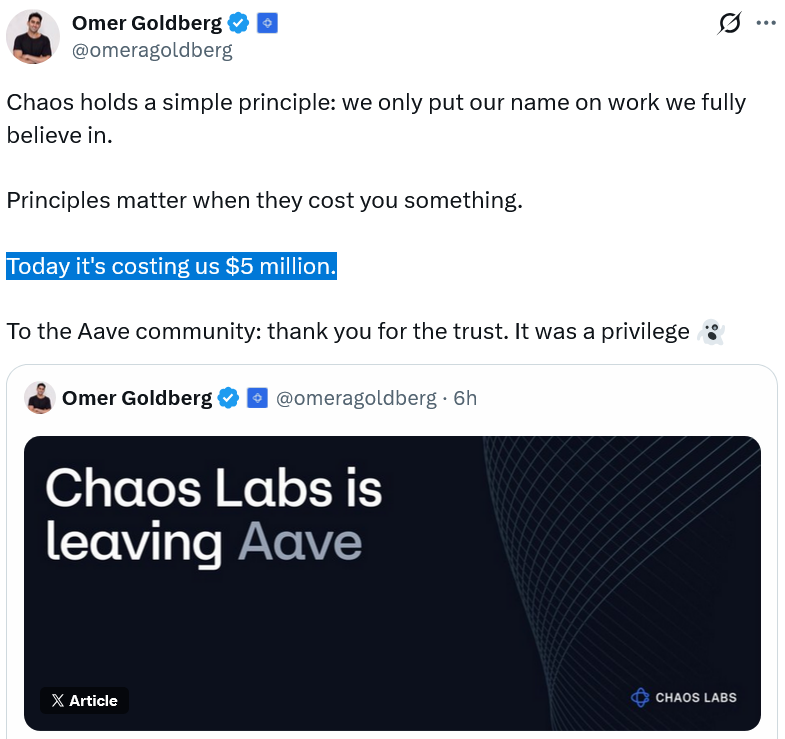
The separation was publicly confirmed by Chaos Labs founder Omer Goldberg in a post on X, where he outlined the reasons behind the abrupt departure from one of the most prominent blue-chip protocols in the decentralized finance sector. Goldberg emphasized that the choice was deliberate and considered, rather than a knee-jerk reaction to an isolated disagreement, noting that the team had previously attempted to work constructively alongside various decentralized autonomous organization contributors.
According to Goldberg, Aave Labs had acted professionally throughout recent discussions and had even supported increasing the firm’s annual compensation budget to $5 million in an effort to retain its services. However, Goldberg stated that the two entities had reached a philosophical impasse regarding risk administration. The current engagement no longer aligned with Chaos Labs’ internal principles on how risk should be evaluated and mitigated across the lending markets.
The split marks a significant turning point for Aave, where Chaos Labs previously served a foundational role in shaping back-end market infrastructure. Since late 2022, the risk firm has been responsible for pricing loans and managing risk parameters across Aave V2 and V3 markets. During this operational period, Aave experienced substantial growth, with its total value locked multiplying roughly fivefold to reach an impressive $26 billion.
The issue of risk management has taken center stage within the Aave community recently. These internal debates were amplified following a high-profile incident on March 12, when a user suffered a $50 million loss during a volatile trade while interacting directly with Aave’s user interface. In response to the market backlash and user safety concerns, Aave announced plans to introduce an "Aave Shield" feature designed to warn and deter platform users from executing high-risk, volatile trades.

Goldberg pointed out that operational pressures have mounted significantly over the past year, exacerbated by the departure of several key Aave contributors that placed an increased burden on external partners. Furthermore, the upcoming rollout of Aave V4 introduces expanded functionalities that carry new operational and legal liabilities, which would ultimately fall on the shoulders of the risk provider.
Addressing the complexities of protocol migration, Goldberg explained that while developers remain optimistic about a swift transition to V4, historical precedent dictates that major infrastructure upgrades often take months or even years to fully materialize. Until V4 completely absorbs the existing markets and liquidity of V3, both complex systems must be operated and managed simultaneously. Consequently, the operational workload does not decrease during the transition phase; it effectively doubles.
Goldberg also highlighted the growing legal and regulatory pressures facing infrastructure providers in the decentralized finance space. He noted that there is currently no established regulatory framework, legal safe harbor, or settled law that clearly defines the liability of risk managers or curators in the event of a catastrophic protocol failure. Under the current landscape, effective risk management goes unnoticed when systems function smoothly, but accountability is swift and severe when failures occur. Because of these mounting liabilities and philosophical differences, Chaos Labs ultimately decided to forgo its $5 million financial engagement.
Chaos Wanted Aave to Boot LlamaRisk and Chainlink: Kulechov
Aave Labs CEO Stani Kulechov presented a different perspective on the circumstances surrounding the departure, asserting that the split did not happen on entirely acrimonious terms, but stemmed from structural demands that Aave was unwilling to accommodate. According to Kulechov, Chaos Labs had recently submitted a proposal aimed at positioning itself as the sole risk management provider for the entire protocol, a move that would effectively force out competing partners—a compromise the Aave leadership deemed unacceptable.
Kulechov explained that accepting Chaos Labs’ terms would have required the protocol to terminate its relationship with LlamaRisk, thereby dismantling Aave’s established two-layer economic risk model. Furthermore, Kulechov stated that Chaos had pushed for Aave to integrate its proprietary price oracles to replace the decentralized oracle network provided by Chainlink.
Integrating Chaos-built oracles was a step Aave was not willing to take, given its long-standing operational history and user familiarity with Chainlink’s services at scale. Kulechov also noted that Chaos Labs was already exploring winding down its broader risk consultancy services before the discussions stalled, even though Aave had offered to double its financial package to $5 million in an attempt to secure their continued involvement.
Despite the high-profile exit, Kulechov reassured the community that Chaos Labs’ departure has caused no operational disruption to the core Aave protocol, its underlying smart contracts, token listings, or broader network integrations. Looking ahead, Aave confirmed it will collaborate closely with LlamaRisk to ensure a seamless transition and to preserve its dual-layer economic risk framework.
The departure of Chaos Labs occurs against the backdrop of broader governance disputes within the ecosystem. The Aave community has recently experienced intense debates regarding the distribution of funding and revenue control, specifically concerning how financial resources should be allocated between Aave Labs and the decentralized autonomous organization.
Even as the protocol navigates these internal shifts, structural adjustments, and provider realignments, Aave continues to hit major operational milestones. In late February, the lending protocol officially crossed the $1 trillion mark in cumulative lifetime lending volume, securing a historic first for the broader decentralized finance industry.