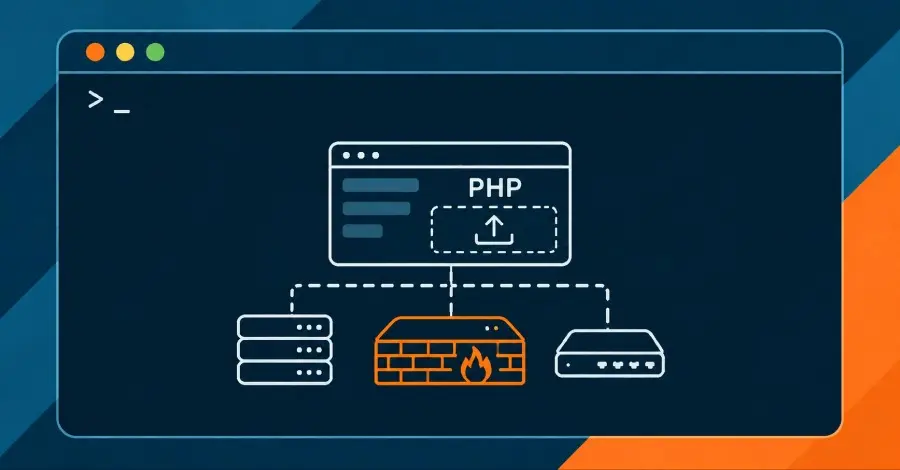
The modern threat landscape often treats web application security as a distinct discipline confined to developer workflows and traditional enterprise software. However, recent events surrounding the discovery and exploitation of critical vulnerabilities known as PHP2Shell have underscored a stark reality: almost any software, appliance, or security gateway connected to a network functions as a web application to some extent. When severe flaws emerge in foundational components like the PHP runtime, the attack surface expands far beyond standard web servers, exposing deeply embedded enterprise appliances to automated exploitation and targeted compromises.
One of the earliest and most prominent targets of PHP2Shell exploitation was the network firewall. On October 28, Palo Alto Networks confirmed that threat actors were actively targeting two critical PHP vulnerabilities—cataloged as CVE-2026-109618 and CVE-2026-109619—against PAN-OS management interfaces that happened to be exposed directly to the internet. Both flaws grant unauthenticated attackers the ability to execute arbitrary code on the underlying web server without requiring valid credentials.
The public disclosure of these vulnerabilities did not go according to standard coordinated timelines. Sensitive technical details leaked prematurely on October 20, forcing the PHP project to rush an emergency patch out to the community just one day later. While the vulnerabilities require no authentication to trigger, they are not inherently trivial to exploit reliably. Successful exploitation demands a high degree of technical skill and precise knowledge regarding the target system architecture.
This requirement becomes trivial when dealing with network appliances, which typically run identical, highly standardized, and often outdated software packages that sophisticated attackers can analyze and study in advance. This points to a much broader systemic issue across enterprise IT environments: an immense volume of web applications controls critical network infrastructure, yet these components frequently go unrecognized as web applications and are consequently left inadequately protected.
Why Appliances Are the Softer Target
On ordinary, consumer-facing or enterprise web servers, address space layout randomization (ASLR) serves as a formidable defensive barrier that complicates exploitation efforts. By dynamically shuffling the memory locations where code and data reside, ASLR prevents an exploit payload from relying on static, hardcoded memory addresses. Early analysis conducted by security firm VulnCheck indicated that the PHP2Shell bugs were readily exploitable on ARM64 platforms and on x86 architectures that lacked ASLR enabled.
However, public exploits capable of bypassing ASLR on x86-64 systems were initially scarce, with confirmed techniques generally restricted to specific PHP builds. VulnCheck ultimately demonstrated a working exploit chain that leveraged a memory leak to achieve reliable code execution even with ASLR fully enabled.
Network appliances fundamentally alter this defensive equation. This vulnerability does not stem from a complete absence of modern protections, but rather from the uniform nature of appliance ecosystems. Because every device running a specific software version shares identical binaries, attackers can calculate necessary memory offsets long before launching an attack.
In the case of the PAN-OS exploitation, attackers still had to overcome ASLR by leaking the base address of the libphp.so library via the HTTP Set-Cookie header, while dealing with SELinux policies that sought to confine the resulting shell. Furthermore, PAN-OS distributions frequently ship with end-of-life PHP versions, specifically versions 8.0.30 and 7.4.33.
Collaborative investigations between Palo Alto Networks and the Israeli security firm Dream revealed that sophisticated threat actors managed to acquire PAN-OS firmware images, decrypt them, extract the embedded PHP libraries, and construct precise memory profiles spanning nine distinct software versions. The attackers subsequently chained the PHP2Shell vulnerability with a Linux kernel flaw known as Fragensia, tracked as CVE-2026-46300, to successfully achieve root privileges across 25 production systems—comprising 24 firewalls and one management server—located in the United States, Japan, Taiwan, and South Korea.
While contemporary web application security initiatives tend to concentrate heavily on massive, cloud-native applications, critical incidents consistently demonstrate that smaller, ubiquitous components—often described colloquially as the mosquitoes of the internet—pose severe organizational risks. Appliances run predictable, frequently aging software, and their widespread deployment creates an attractive, high-value surface for coordinated campaigns.
HTTP Is More Complex Than Your Defenses Assume
Understanding why these vulnerabilities manifest requires examining the underlying protocol. HTTP is an extraordinarily complex protocol that supports a multitude of configuration options and transfer mechanisms. For instance, when a client uploads a file, it is not required to transmit the data in a single continuous stream. Instead, clients can stream request bodies using chunked transfer encoding without declaring a total content length. Furthermore, when web servers automatically decompress incoming request bodies, calculating the precise amount of memory required to buffer and store the data becomes exceptionally difficult for the server infrastructure.
Consequently, memory-safety vulnerabilities remain a persistent challenge in both web applications and the underlying web servers hosting them. In the context of PHP2Shell, a specifically crafted multipart file upload forces PHP to exceed its configured memory limits during the initial request parsing phase, occurring long before any custom application logic executes. The core flaws reside in the memory artifacts PHP leaves behind when an abrupt abort occurs: uninitialized request memory designated as CVE-2026-109618, and a dangling pointer to freed memory cataloged as CVE-2026-109619.
Significantly, the incoming requests do not need to be massive in physical size. Highly nested, empty file upload fields can trick PHP into allocating vastly more memory than the actual body content contains. As a result, an HTTP request well below the default 8 megabyte post_max_size threshold can still successfully exhaust the default 128 megabyte memory limit.
Defenders must possess a deep understanding of protocol mechanics to recognize what these exploit signatures look like in transit, which is essential for writing accurate detection rules and intrusion detection signatures. This inherent protocol complexity also limits the effectiveness of intermediary network middleboxes. In some instances, intermediary devices can interfere in unintended ways; security researchers at Intruder discovered that Nginx instances positioned in front of PAN-OS deployments automatically buffered chunked request bodies, which paradoxically broke certain public exploit chains.
Web application firewalls (WAFs) frequently fall short against these structural anomalies, and because file uploads represent core functionality for a vast array of web applications, blocking them outright is rarely a viable operational solution.
This dynamic neutralizes many traditional perimeter defenses. What remains is the fundamental necessity of cataloging and identifying where critical web applications reside within an enterprise infrastructure. Organizations must prioritize locating administrative management interfaces—beginning with firewalls and other foundational network equipment—and strictly limit access to trusted internal IP addresses. Palo Alto Networks’ own remediation guidance for PHP2Shell emphasized removing direct internet accessibility from management interfaces entirely. If organizations rely on web application firewalls, those defenses must be meticulously configured with a clear understanding of their inherent limitations.
Risk Assessment and the Challenge of Prioritization
Perhaps the clearest lesson emerging from the PHP2Shell incident is the immense difficulty security teams face when attempting to accurately assess and calculate the real-world risk posed by sophisticated vulnerabilities. Prioritization remains a persistent hurdle for defenders navigating a continuous flood of emerging advisories, and PHP2Shell proved particularly difficult to evaluate from multiple angles.
Discrepancies in severity scoring illustrated the challenge. The PHP project rated both underlying flaws at 9.2 under the CVSS 4.0 framework, while Fortinet’s product security incident response team assigned a score of 9.8 using CVSS v3. Palo Alto Networks initially scored the issue at 8.7 for its proprietary products and classified it with moderate urgency before elevating the severity rating to 9.2 as a critical issue with the highest urgency on October 27, subsequently confirming active exploitation one week after issuing its initial advisory.
Adding to the confusion, many public proof-of-concept scripts failed to function reliably, meaning that a sudden surge of exploit attempts observed in enterprise server logs provided little actionable insight into whether a specific target was genuinely at risk. Furthermore, PHP core developer Gina Peter Banyard warned the community that early workaround suggestions, such as disabling session upload progress tracking, were insufficient on their own to mitigate the threat.
These real-world challenges highlight the ongoing need to educate defenders on effective risk assessment methodologies, the mechanics of protective features like ASLR, and the underlying reasons why network appliances remain uniquely vulnerable targets. Defending modern network infrastructure requires an approach that transcends traditional boundaries, ensuring that security practitioners understand the complex intersection of web applications, underlying protocol parsers, and enterprise hardware.