
The digital asset landscape continues to grapple with the fallout from one of the most devastating exploits in recent memory, as blockchain data reveals that the hacker behind the massive $293 million Kelp DAO breach has successfully laundered the vast majority of the unfrozen capital.
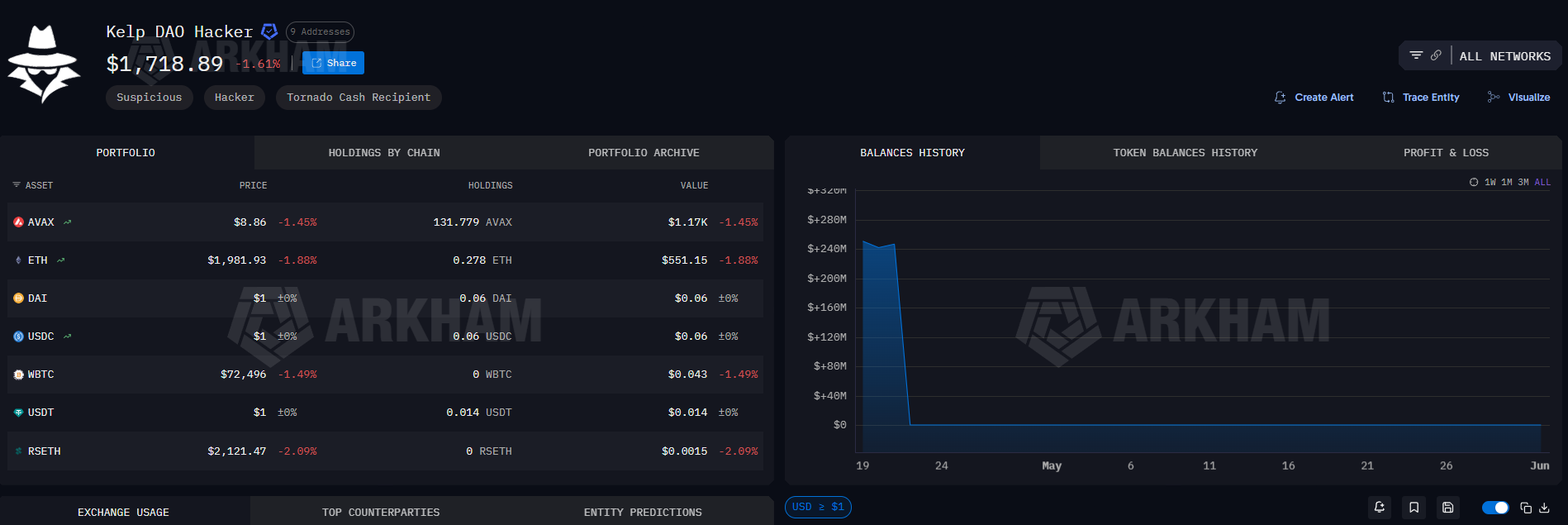
According to comprehensive onchain analytics and intelligence provided by blockchain data firm Arkham, the primary wallet tagged to the Kelp DAO exploit has systematically moved and obscured nearly all of the accessible stolen funds over a compressed six-week timeframe. Today, only a meager $1.7 million remains traceable within the core attacker-controlled address, highlighting the immense difficulties law enforcement agencies and blockchain forensics investigators face when attempting to recover ill-gotten cryptocurrency assets after a sophisticated laundering campaign.
The malicious actor initially struck on April 18, executing a devastating drain of 116,500 Kelp DAO restaked Ether tokens, commonly known as rsETH. This single security breach single-handedly inflated the total monthly volume of stolen funds across the broader cryptocurrency sector to a staggering $630 million for April, making it one of the most punishing months for digital asset security in recent years.
A Sophisticated Multi-Layered Laundering Strategy
The rapid liquidation and obfuscation of the stolen capital followed a meticulously planned architectural blueprint designed to evade onchain surveillance and thwart tracing attempts by security firms. According to detailed technical breakdowns shared by onchain analyst Specter, the laundering operation utilized a complex two-layer framework to break the transactional lineage of the stolen digital assets.
In the initial phase, the hacker bridged the compromised assets to the Bitcoin network by leveraging the Wasabi cryptocurrency mixer, a privacy-centric tool designed to obscure transaction histories by blending coins from multiple users. Once the digital footprint had been sufficiently scrambled on the Bitcoin blockchain, the funds were subsequently bridged back into the Ethereum ecosystem.
The final phase of the laundering cycle involved withdrawing and depositing the assets through Tornado Cash, a well-known decentralized mixing protocol designed to sever the link between source and destination addresses on the Ethereum network. By routing the massive capital reserve through these specialized privacy protocols in rapid succession, the perpetrator effectively reduced the probability of recovering the remaining unfrozen funds to near zero.
Legal Battles and Asset Freezing Efforts
While the bulk of the unfrozen capital has successfully slipped through the cracks of onchain traceability, a portion of the stolen funds met a different fate due to swift coordinated actions by decentralized finance stakeholders and legal authorities.
Just days after the initial incident, an additional $71 million connected to the Kelp DAO exploit was swiftly frozen by the Arbitrum Security Council on April 21. This decisive intervention provided a glimmer of hope for victims and protocol developers alike. Prior to this, a formal governance proposal and an official United States court order had already authorized the transfer of these specific frozen funds into an Aave-controlled multi-signature wallet, establishing a dedicated framework for the ongoing rsETH recovery and remediation initiative.
The legal dimension of the recovery effort remains active and complex. A crucial upcoming court hearing focusing on ownership claims tied directly to the frozen funds is scheduled to take place in a New York courtroom, as indicated by recent court documents. This legal proceeding represents a vital battleground for determining how the successfully intercepted capital will ultimately be handled and whether it can be repatriated to the affected platform users.
This latest development unfolds just a week after Kelp DAO officially announced that it had successfully restored its restaked Ether token supply, marking a major milestone in a grueling five-week recovery effort. The milestone was achieved after the final tranche, consisting of 20,373.7 rsETH tokens, was successfully transmitted back to the LayerZero smart contract. This specific smart contract holds responsibility for the critical mechanics of locking, minting, burning, and releasing rsETH during cross-chain transfer operations, allowing the protocol to gradually reestablish equilibrium following the massive shock to its circulating supply.
A Steep Decline in May Exploits Fails to Calm Industry Nerves
The catastrophic scale of the Kelp DAO breach cast a long shadow over the decentralized finance industry, even as broader macro-level metrics regarding crypto security appeared to improve significantly in the weeks that followed.
Cryptocurrency hacks and exploits experienced a dramatic downward correction during May, registering a nearly 90% decline in total stolen funds compared to the alarming figures recorded in April. According to comprehensive data compiled by blockchain security and analytics platform CertiK, total losses resulting from crypto exploits plummeted to $68.3 million in May. A breakdown of the month’s security incidents revealed that approximately $2.6 million was lost to increasingly sophisticated phishing attacks, while proactive security measures and negotiations allowed for a total of $9.4 million to be successfully recovered or voluntarily returned by opportunistic actors.
Despite this substantial statistical drop in overall attack volume and financial losses, the psychological and structural scars left by the $293 million Kelp DAO exploit continue to reverberate throughout the decentralized finance community. The sheer magnitude of the breach forced an industry-wide reassessment of fundamental architectural assumptions, prompting numerous decentralized finance protocols to critically reevaluate the security standards and reliability of their chosen oracle and cross-chain bridge providers.
In the wake of the incident, a wave of platform migrations swept across the sector as protocols scrambled to fortify their infrastructure against similar vectors of attack. Within a mere three weeks following the exploit, prominent Bitcoin decentralized finance platform Solv Protocol and liquidity protocol Tydro independently announced their migration to Chainlink’s Cross-Chain Interoperability Protocol, commonly known as CCIP, explicitly seeking out a more robust and battle-tested oracle and cross-chain communication provider.
Kelp DAO itself enacted drastic changes to its underlying architecture, moving to migrate its rsETH token directly to Chainlink CCIP. This strategic pivot involved completely abandoning its previous LayerZero-powered bridge infrastructure after internal and external post-mortems attributed the vulnerability to weaknesses inherent in that specific cross-chain configuration.
The debate over accountability for the disaster remains a point of contention between the protocol developers and infrastructure providers. Shortly after the incident on April 20, LayerZero publicly stated that the exploit was fundamentally caused by a single point of failure localized within Kelp DAO’s custom implementation. According to LayerZero’s public disclosures, the protocol’s configuration relied on a single LayerZero Decentralized Verifier Network as its exclusive verified path, operating in direct contradiction to prior technical warnings advising against utilizing such a centralized and vulnerable setup.
As the legal proceedings in New York move forward and the remaining frozen assets hang in the balance, the aftermath of the Kelp DAO exploit stands as a stark reminder of the persistent structural vulnerabilities facing cross-chain decentralized finance infrastructure, leaving developers and users alike navigating an increasingly complex landscape of security challenges and recovery legalities.