
Ethereum creator Vitalik Buterin has sparked widespread industry debate by suggesting that the network should promote Ether (ETH) primarily as a store of value (SoV), stepping away from the narrative that the token derives its core value from burning transaction fees.
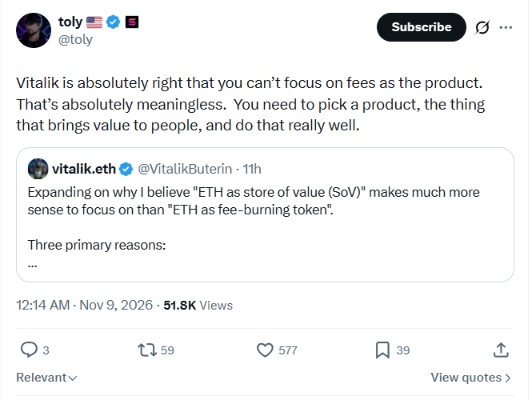
In an extensive social media thread, Buterin argued that the concept of “ETH as a fee-burning token never was as strong as it seemed.” He cautioned that overly optimizing the network for fee-burning mechanics would negatively impact Ethereum’s fundamental pillars of “decentralization and capture resistance.” Instead, Buterin believes Ethereum’s long-term worth should stem from the stability provided by its unwavering focus on censorship resistance, open-source development, privacy, and security—collectively referred to as CROPS. He contends these attributes will become increasingly paramount in an era dominated by artificial intelligence disruption.
The fee-burning narrative gained massive traction following the 2021 EIP-1559 upgrade, which briefly pushed Ethereum into deflationary territory during periods of high network activity and hefty fee revenue. Prominent industry voices, including the Bankless podcasters, enthusiastically dubbed the asset “ultrasound money.” However, shifts in network design and usage have led to a sustained decline in gas fees and overall revenue, making that specific narrative increasingly difficult to maintain. Data indicates that between January and October of this year, median transaction fees tumbled from 35 cents down to 3.5 cents, even as daily transaction counts expanded by more than 50%.
The pivot drew sharp criticism from prominent Bitcoin proponents who fiercely guard Bitcoin’s exclusive status as digital gold. Held Media founder Dan Held derided Buterin’s comments on social media, characterizing them as a desperate attempt by Ethereum to pivot to Bitcoin’s store-of-value narrative after previous marketing angles had faltered. Held questioned how a protocol with a constantly changing monetary policy could ever be considered sound money. Conversely, Ethereum supporters defended the design, pointing out that the network’s monetary policy has remained strictly unchanged since The Merge in 2022, with subsequent updates consistently reducing rather than expanding token issuance.

Ethereum advocates largely welcomed the protocol creator’s efforts to establish a definitive narrative direction. MetaLeX attorney Gabriel Shapiro described the comments as a “nature is healing” moment, asserting that on a fundamental level, ETH has the potential to outperform both Zcash and Bitcoin as a store of value. Meanwhile, Solana co-founder Anatoly Yakovenko weighed in, agreeing that developers cannot rely solely on transaction fees as the primary product, though he offered a characteristic subtle jab at Ethereum’s broader ecosystem.
Washington Braces for Policy Shifts Following Democratic Sweep
Despite the crypto industry deploying unprecedented financial resources during the recent midterm elections—including spending $176 million across 100 legislative races, such as a $64 million effort to unseat Senator Sherrod Brown—the political impact of crypto super PACs remains a subject of intense debate.
Even though the Democratic Party secured control of both the Senate and the House of Representatives, Fairshake representatives noted that the super PAC still achieved a 92% success rate, backing winning candidates in all but seven of the 93 races it targeted. Stand With Crypto data indicates that a slim majority of federal legislators are now viewed as pro-crypto, counting 50 supportive senators against 33 opponents, alongside 241 supportive members of the House versus 106 vocal critics.
Nevertheless, the return of prominent crypto critics to influential committee leadership positions signals a potentially hostile legislative environment. Senator Sherrod Brown is expected to join the Senate Agriculture Committee, while Senator Elizabeth Warren is widely tipped to assume the chairmanship of the Senate Banking Committee.
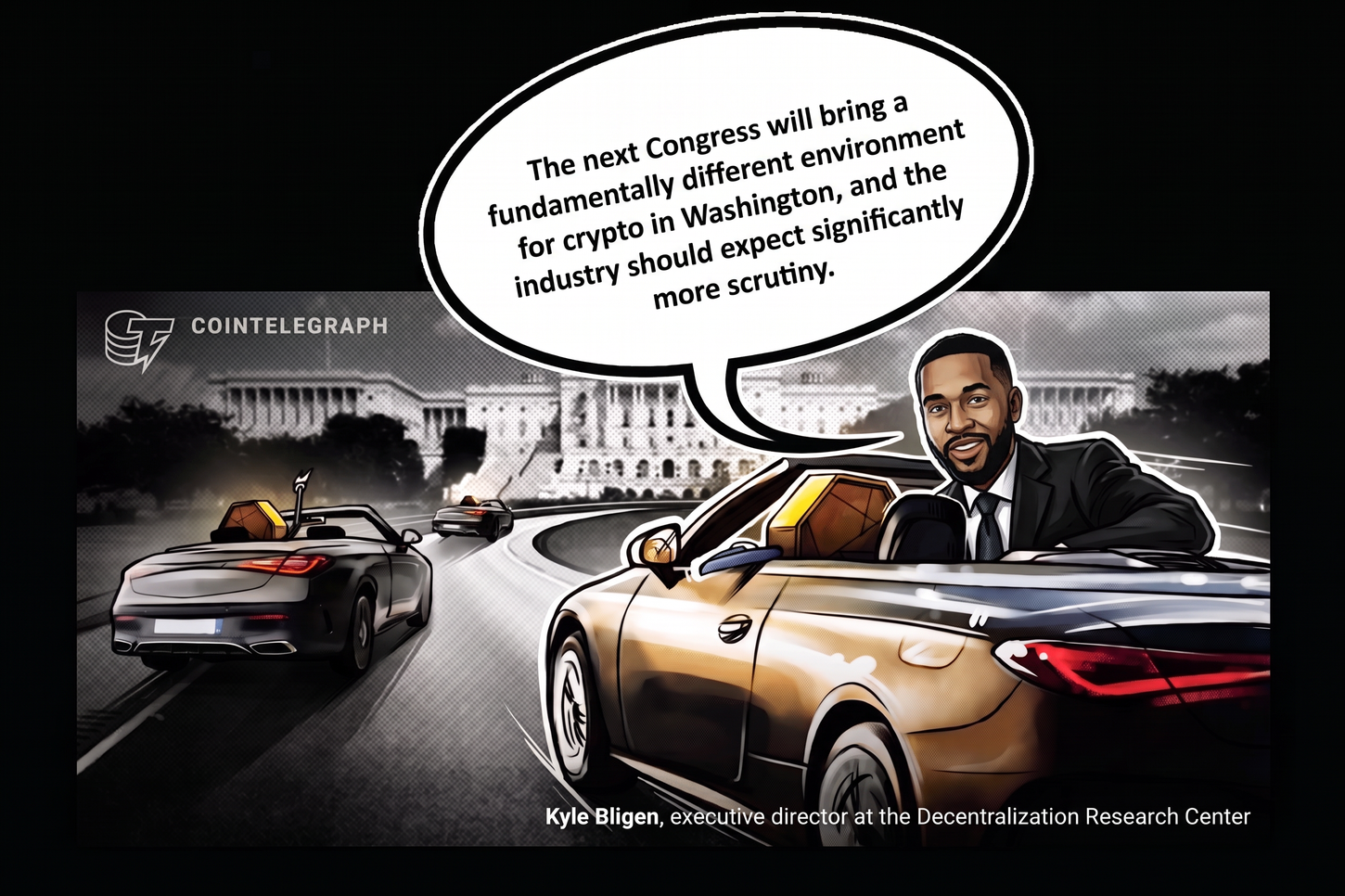
Industry analysts warn that the shifting balance of power in Washington will subject digital assets to rigorous oversight. Kyle Bligen, executive director at the Decentralization Research Center, noted that the upcoming Congress will introduce a fundamentally different regulatory climate, warning that the industry should anticipate significantly heightened scrutiny. Reports indicate that Democratic lawmakers are already exploring ways to expand market structure proposals originally championed by Representative Maxine Waters into a comprehensive legislative package. Meanwhile, prospects for passing the CLARITY Act remain dim unless sponsors incorporate stringent ethics provisions targeting alleged conflicts of interest within the executive branch.
Fake Job Interview Campaign Leads to Massive Binance Security Breach
In one of the most sophisticated cyberattacks in the history of the digital asset sector, Binance confirmed that a multi-month operation orchestrated by North Korean hackers resulted in a staggering $6.34 billion security breach.
According to Binance’s forensic findings, the intrusion began back in June when an employee inadvertently downloaded a compromised Homebrew installation while attempting to install an AI coding tool. Although the exchange’s security systems quickly flagged the anomaly, attackers had already harvested background data regarding personnel working on Binance’s core wallet infrastructure.
The plot escalated in September when threat actors posing as corporate recruiters targeted another software engineer. Under the guise of a standard technical assessment, the hackers tricked the employee into executing a malicious file disguised as a coding assignment. On Oct. 20, the attackers leveraged the compromised workstation—alongside an internal AI utility—to infiltrate the systems of two additional engineers, ultimately deploying sophisticated malware that granted them unauthorized access to the exchange’s internal wallet-signing service.
Binance co-CEO Richard Teng addressed the incident in a public statement, emphasizing that the multi-stage event was not a momentary lapse in security but rather the result of a coordinated, months-long corporate espionage campaign.
Ethereum Developer Targets 2028 for Quantum Resistance
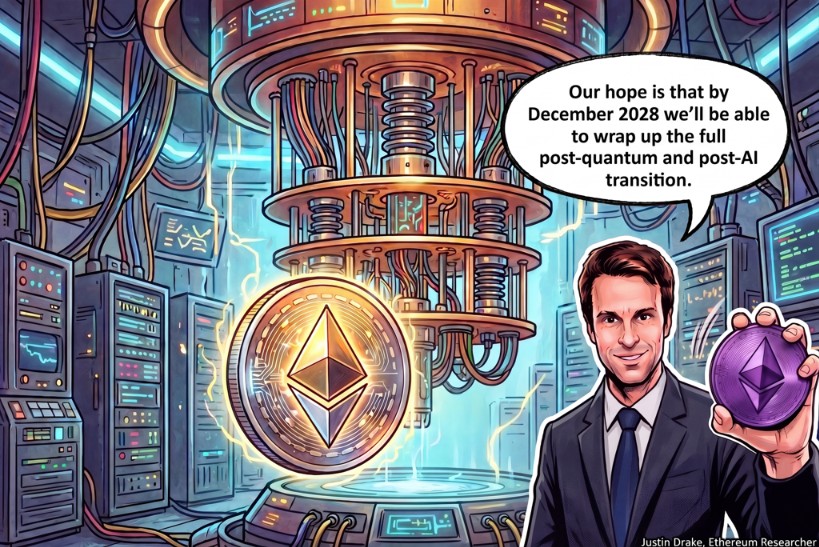
In a surprise announcement at Devcon 8 in Mumbai, Ethereum Foundation researcher Justin Drake revealed an accelerated timeline for the network’s long-term cryptographic security overhaul. Drake stated that core developers are now targeting December 2028 to finalize Ethereum’s comprehensive post-quantum and post-AI transition, moving the deadline up by a full year compared to the previously publicized roadmap.
The revised schedule leaves developers with a tight 24-month window to successfully deliver three major network upgrades. The Ethereum Foundation’s September protocol roadmap had previously established December 2029 as the target date for achieving full quantum resistance. However, development roadmaps face immediate hurdles, with core contributors having recently delayed the deployment of the Glamsterdam upgrade indefinitely as they work to resolve complex security vulnerabilities tied to eight critical smart contract invariants.
THORChain Resumes Operations Despite Direct FBI Warning
Cross-chain liquidity protocol THORChain has resumed trading activities across most supported networks, actively defying a direct directive from the Federal Bureau of Investigation not to process funds associated with the massive Binance exchange hack.

Following the announcement that asset swaps for Bitcoin, Ethereum, Bitcoin Cash, Dogecoin, Litecoin, Tron, and Zcash had been restored alongside previously operational chains like Avalanche, Base, and XRP, the protocol’s native RUNE token rallied 15% within a 24-hour window.
On-chain analytics firm Chainalysis reported that THORChain validators had already funneled over $46 million linked to the Binance exploit during the initial 72 hours following the breach, yielding approximately $200,000 in validator fees. The flow of illicit funds was only temporarily halted due to an unrelated Ethereum block reorganization. THORChain co-founder JPThor argued that the protocol’s ability to ignore federal warnings definitively proves its decentralized nature, stating that no centralized entity operating within Western jurisdictions would openly disregard such directives unless true censorship resistance was built into the system’s architecture.
Broad Market Retrenchment and Institutional Custody Focus
As the weekly trading session concluded, major digital assets experienced downward pressure. Bitcoin slid 4.5% to change hands around $74,302, Ethereum fell 6.3% to trade at $2,117, and XRP retreated 5% to settle at $1.11, bringing the aggregate crypto market capitalization down to $2.49 trillion. Among the top 100 altcoins, notable weekly gainers included Pieverse, Injective, and Tether Gold, while tokens such as Official Trump, Worldcoin, and Ethena suffered the steepest declines.
In the wake of the record-breaking Binance exploit, institutional analysts have underscored the growing necessity of robust regulatory protections. Grayscale’s head of research, Zach Pandl, noted in a market report that while the multi-billion-dollar hack represents a temporary blow to investor confidence, it will ultimately drive the industry toward higher security standards and accelerate the adoption of regulated institutional custody products. Pandl emphasized that exchange-traded investment vehicles that store assets with state-chartered banks and qualified custodians offer essential safeguards, including offline cold storage, multi-signature authentication frameworks, independent SOC attestations, and comprehensive insurance policies.
Concurrently, regulatory pressures continue to reshape the European landscape. Binance France notified users that its local operations are officially winding down, with all customer accounts scheduled for closure by Dec. 31. The exchange announced that any residual balances left unclaimed on the platform after late November will face recurring monthly maintenance fees. The withdrawal from the French market follows the exchange’s failure to secure comprehensive regulatory authorization under the European Union’s Markets in Crypto-Assets framework ahead of the strict statutory deadlines.
Additional structural risks surfaced elsewhere in the ecosystem as prediction markets and decentralized applications faced renewed scrutiny. Researchers at Vanderbilt University flagged suspicious betting activity on prediction platforms shortly before public release dates for regional political polls. Meanwhile, decentralized payment provider Gnosis Pay disclosed a security breach affecting its legacy consumer card system, resulting in the unauthorized exposure of customer payment card data, residential addresses, and connected cryptocurrency wallet credentials, though core treasury funds remained secure.